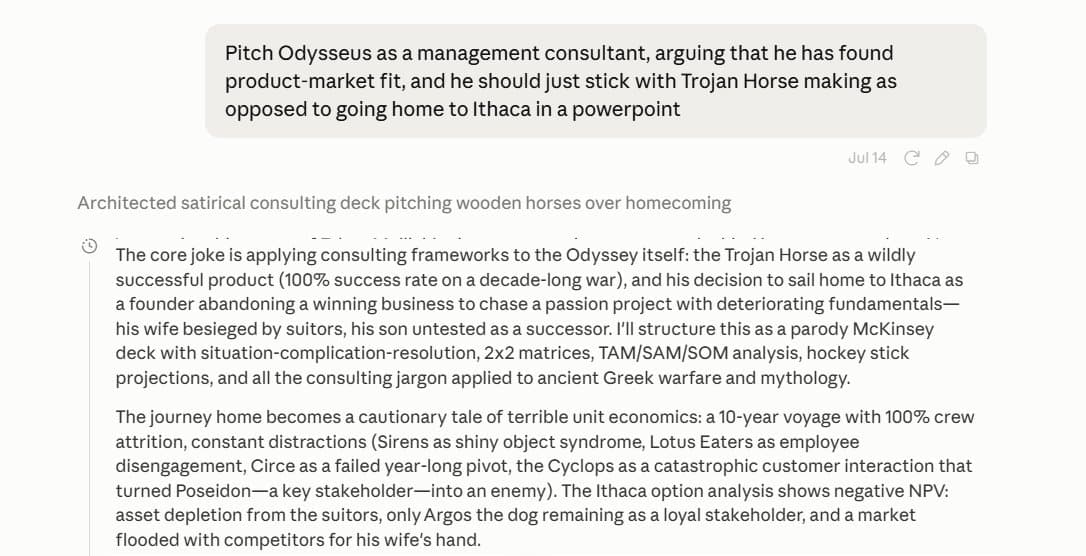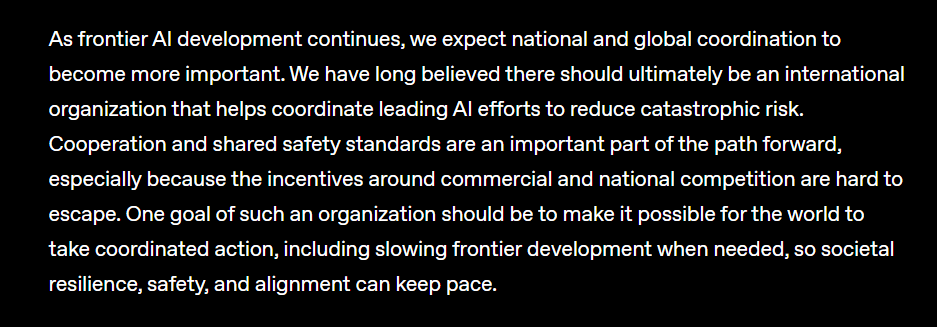
Anthropic and OpenAI both floated the idea of slowing AI development in recent strategy posts. According to @emollick, the companies said any slowdown would require globally coordinated action using as-yet-unidentified methods.
Key facts
- Anthropic and OpenAI both mentioned slowing AI development.
- Posts require globally coordinated action with unidentified methods.
- No concrete treaty or verification regime proposed.
- Timing coincides with major fundraising rounds for both labs.
- Framing sets an effectively impossible bar for implementation.
The posts, published within days of each other, mark a notable shift in public positioning from the two leading frontier labs. Both acknowledge the possibility of voluntarily decelerating model releases or training runs — but only if the entire world agrees to do so simultaneously.
Neither post specifies what form such coordination would take. The absence of concrete mechanisms — no proposed treaty, no verification regime, no threshold trigger — means the statements function primarily as political signals rather than operational commitments.
The timing is worth noting. Both labs are currently locked in a competitive race for enterprise contracts and foundation model dominance. OpenAI recently closed a $6.6B round at a $157B valuation; Anthropic is reportedly seeking $2B at a $30-40B valuation. Any unilateral slowdown would cede market share to rivals — including Google, Meta, and a growing cohort of open-weight model developers.
The 'coordinated across the entire world' framing effectively sets a bar that is nearly impossible to reach. International AI governance talks at the UN and OECD have produced non-binding principles but no enforcement mechanisms. China, the US, and the EU have sharply divergent views on regulation scope and pace.
This is not the first time frontier labs have raised the idea of slowdowns — but the explicit coupling with 'as-yet-unidentified methods' is new. Earlier statements from both companies focused on internal safety processes, red-teaming, and responsible scaling policies. The shift to requiring global coordination represents a de facto hedge: the companies can claim to support slowdowns in principle while knowing the practical conditions are unlikely to be met.
The posts should be read as a form of regulatory positioning. By publicly endorsing the concept of coordinated slowdowns, the labs shape the Overton window for future policy debates. They also inoculate themselves against accusations of reckless acceleration — while continuing to accelerate.
What to watch
Watch for any follow-up from either lab specifying concrete methods — or for a third party (e.g., a government or multi-lateral body) to propose a coordination framework. The absence of detail in these posts suggests the slowdown idea remains a rhetorical device rather than a near-term policy goal. Also track whether any frontier lab unilaterally pauses training runs in 2026.
[Updated 09 Jun via wired_ai]
The strategic posture of both labs is now shadowed by a parallel financial race: OpenAI has confidentially filed for an IPO, following Anthropic's similar filing just over a week earlier [per WIRED]. The dual IPO moves inject a new commercial urgency into the public positioning around AI slowdowns. With both companies now preparing for public market scrutiny, any hypothetical coordinated slowdown would face additional pressure from shareholder expectations for growth and revenue. The IPO filings suggest that the 'as-yet-unidentified methods' for global coordination may remain elusive as both labs focus on capital markets.
[Updated 10 Jun via wired_ai]
OpenAI CEO Sam Altman described the IPO process as "a complicated set of tradeoffs" and declined to set a timeline, according to The Decoder. The confidential S-1 filing with the SEC follows Anthropic's similar move by just over a week, intensifying the public market race between the two AI rivals.