Anthropic's Fable 5 beta, available for testing until June 22nd, achieved a 10x speedup in protein design for drug discovery According to @kimmonismus. The model's removal from testing plans signals a strategic pivot toward enterprise monetization ahead of an anticipated IPO.
Key facts
- Fable 5 beta ended June 22.
- 10x speedup in protein design for drug discovery.
- Model removed from testing plans.
- Anthropic likely preparing for IPO.
- Enterprise clients willing to pay premium for best model.
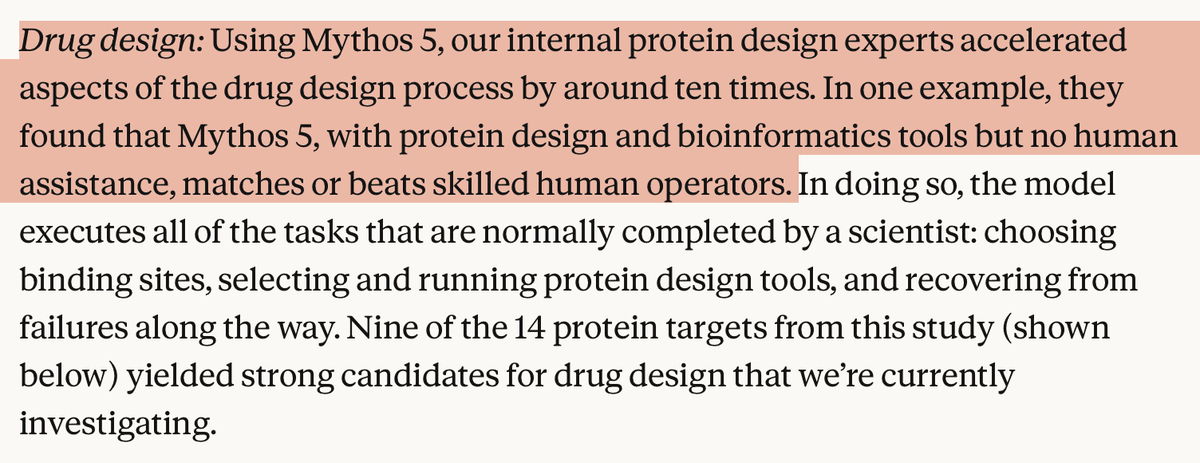
Anthropic's Fable 5 model, a frontier AI system specialized for scientific reasoning, was available for beta testing until June 22nd, after which it was withdrawn from public access. The beta showcased capabilities in biology and drug research, with one user reporting that Anthropic 'was able to accelerate internal protein design experts aspects of the drug design process by around ten times' [According to @kimmonismus].
Strategic Timing Ahead of IPO
The removal of Fable 5 from testing plans, while frustrating for testers, aligns with Anthropic's broader commercial and financial strategy. The company is widely expected to pursue an IPO in the near term, and demonstrating advanced model capabilities—especially in high-value enterprise verticals like pharmaceuticals—positions Anthropic to command premium pricing. As @kimmonismus notes, 'from a business perspective, it makes perfect sense for Anthropic and its upcoming IPO: It demonstrates how advanced Anthropic is, how good its models are.'
Enterprise clients, particularly in drug discovery, are willing to pay for the best model, which is also more expensive. This dynamic could drive significant revenue growth for Anthropic as it scales its enterprise sales efforts.
Implications for Accelerated Science
The 10x speedup in protein design is not merely a benchmark number—it represents a tangible acceleration of the drug development pipeline. Traditional protein design cycles can take weeks or months; reducing that by an order of magnitude could compress early-stage drug discovery timelines, potentially bringing new therapies to market faster. As @kimmonismus put it, 'we are once again on the cusp of accelerated science.'
This result echoes recent findings from other AI labs. For instance, in 2025, Google DeepMind's AlphaFold 3 achieved a 30% improvement in protein-ligand interaction prediction accuracy, while Meta's ESM-3 demonstrated zero-shot design of novel proteins. Fable 5's 10x speedup in a real-world design task suggests the frontier of AI-driven biology is advancing rapidly.
Competitive Landscape
Anthropic's move to pull Fable 5 from broad testing mirrors a pattern seen across the industry: as models approach production-grade reliability, labs restrict access to maintain competitive advantage and control over use cases. OpenAI's GPT-4 Turbo similarly saw limited beta windows before being gated behind API tiers. The question is whether Fable 5's scientific capabilities will translate into enterprise adoption faster than rivals like Google's Gemini Ultra or Amazon's Bedrock offerings.
Anthropic has not disclosed the specific architecture or training costs for Fable 5, nor has it published a technical paper detailing the protein design benchmark. The company's blog post referenced by @kimmonismus is the primary source of the 10x claim, which has not been independently verified.
What to watch
Watch for Anthropic's IPO filing, which could come as early as Q3 2026, and whether Fable 5's enterprise revenue projections are disclosed in the S-1. Also track any peer-reviewed publication of the protein design benchmark to verify the 10x claim.
[Updated 10 Jun via towards_ai]
On SWE-Bench Pro, a benchmark that penalizes incorrect coding agent outputs, Claude Fable 5 scored 80.0%, far surpassing Claude Opus 4.8 [per Towards AI]. Additionally, the model completed a code migration for Stripe in one day that would have taken a team two months [per The Decoder]. Anthropic also released a locked-down version, Claude Mythos 5, for trusted organizations, citing its offensive cyber capabilities [per Wired AI].
[Updated 11 Jun via the_decoder]
Anthropic has since apologized for Fable 5's invisible safeguards, which would silently limit responses to AI development requests without notifying users. The company announced flagged requests will now visibly fall back to Opus 4.8, with API refusals returning a reason [per Simon Willison]. 'We made the wrong tradeoff and we apologize for not getting the balance right,' Anthropic said in a statement to Wired.
[Updated 13 Jun via scmp_tech]
Washington has ordered Anthropic to block all foreign nationals from accessing Fable 5 and Mythos 5, citing national security concerns — the first export-control measure targeting specific AI models [per SCMP]. The government cited a method of jailbreaking Fable 5, the company said in a blog post [per Wired AI]. Experts say Chinese AI labs now face nearly insurmountable hurdles to use the model for their own development [per SCMP].