On April 3, 2026, The Bones Studio released a 43-second technical demonstration of its robot learning pipeline. The demo showcases a process the company calls "Captured → Labeled → Transferred," which aims to create detailed robotic behaviors by recording human demonstrations once and transferring them cleanly to machines.
What the Demo Shows
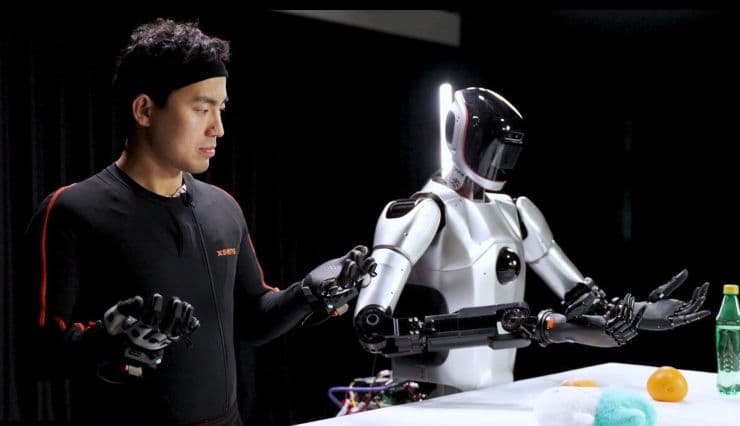
The video shows a person standing on a small ladder to slide a curtain along an overhead rail. A high-precision optical motion capture system tracks the person's every joint angle and even the deformation of the curtain fabric in real time. The system overlays visual labels for object detection and manipulation zones during the capture.
The captured motion data is then transferred directly to a humanoid robot. In a simulated home setting, the robot repeats the task while standing on a step stool. The robot execution shows stable balance and makes precise grip adjustments to slide the curtain, closely mirroring the human's original motion and strategy.
The Technical Pipeline
The core of the demonstration is the three-stage pipeline:
- Captured: High-fidelity recording of a human demonstration using optical motion capture. This goes beyond simple trajectory recording to capture detailed kinematics and even interactions with deformable objects (like fabric).
- Labeled: Real-time annotation of the scene with semantic information. The demo shows overlays for object detection (identifying the curtain, rail, ladder) and defining manipulation zones (where to grip). This step adds crucial context to the raw motion data.
- Transferred: The motion and label data are formatted and sent to a humanoid robot control system. The robot then executes the task, aiming to replicate both the action sequence and the underlying problem-solving strategy observed in the human.
The goal, as noted by observer Rohan Paul, is to establish this type of detailed, one-shot human demonstration as a new standard for teaching robots complex, dexterous tasks, particularly for home and everyday environments.
Why This Approach Matters for Robotics
Teaching robots to perform useful tasks in unstructured environments like homes is a monumental challenge. Traditional methods often involve extensive programming, reinforcement learning in simulation (which doesn't always transfer to reality), or learning from large but often low-quality video datasets.
The "Captured → Labeled → Transferred" paradigm offers a different path:
- High-Quality, Strategy-Rich Data: A single, well-executed human demonstration contains implicit knowledge about balance, force application, and task strategy that is difficult to code explicitly.
- Efficiency: The promise is "record once, transfer many times." A perfect demonstration for a task like making coffee or folding laundry could be captured once and then deployed to thousands of robots, bypassing the need for each robot to learn from scratch.
- Semantic Grounding: By labeling objects and zones during capture, the system ties actions to specific entities in the world. This is a step toward robots that understand what they are manipulating and why, not just how to move.
The demo focuses on a humanoid form factor, suggesting the pipeline is designed for robots that operate in human-centric spaces, using a body plan and kinematics similar to our own to make the transfer of motion data more direct.
Limitations and Open Questions
The demo is a promising proof-of-concept but leaves several practical questions unanswered:
- Sim-to-Real Gap: The robot execution is shown in a simulated environment. The critical test will be transferring these policies to a physical robot in a real, messy home.
- Generalization: Can a single demonstration generalize to slightly different curtain rails, stool heights, or fabric weights? Robustness to environmental variation is key.
- Pipeline Scalability: How long does it take to process and label a capture? Can the pipeline handle a library of hundreds of diverse tasks efficiently?
gentic.news Analysis
This demo from The Bones Studio taps directly into the industry's pressing need for scalable data pipelines for embodied AI. It's less about a novel AI algorithm and more about a rigorous engineering process for creating high-fidelity, actionable training data for robots. The emphasis on detailed human demonstration as a source of strategic knowledge aligns with a broader trend we've covered, such as in our analysis of DeepMind's RT-H paper, which also leveraged human video data but at an internet scale. However, Bones Studio's approach is notably more curated and high-bandwidth, favoring quality and precision over quantity.
The focus on humanoid robots and home tasks places this work in direct conversation with projects from Tesla (Optimus), Figure AI, and 1X Technologies. These companies are all racing to solve the problem of useful general-purpose manipulation. While others often highlight end-to-end neural networks or large behavior models, Bones Studio is showcasing the data generation backbone that could feed those models. If their capture and labeling system is robust, it could become a valuable tool for any team training physical robots, potentially as a service or a software suite.
This demonstration also highlights a strategic split in the field. On one side are approaches that learn from vast, often noisy datasets (like videos from YouTube or robotic teleoperation). On the other are precision-engineered pipelines like this one that start with perfect data. The ultimate solution for robot learning in homes may well be a hybrid: using meticulously captured demonstrations for foundational skills, combined with large-scale but noisier data for adaptation and generalization.
Frequently Asked Questions
What is The Bones Studio?
The Bones Studio is a company focused on robotics and AI, as evidenced by this technical demonstration. Based on the content of the demo, they appear to be developing tools and pipelines for capturing human motion and transferring it to robots, specifically for training in home and everyday tasks.
How does this robot learning method work?
The method is a three-stage pipeline: 1) Capture a human performing a task using high-precision optical motion capture, 2) Label the captured data in real-time with semantic information like object detection and manipulation points, and 3) Transfer the combined motion and label data to a humanoid robot's control system so it can execute the same task.
Is this robot learning from a single demonstration?
The demo and accompanying commentary suggest the goal is "one-shot" or "few-shot" learning. The idea is that a single, detailed human demonstration contains enough strategic information about the task (balance, grip, sequence) that it can be transferred to a robot, eliminating the need for thousands of trial-and-error attempts by the machine.
What are the main challenges for this technology?
The primary challenges are the simulation-to-reality transfer (making it work on a physical robot), generalization (adapting the learned skill to slightly different objects or environments), and scalability (efficiently building a large library of tasks using this potentially labor-intensive capture process).