Skip to content
gentic.news — AI News Intelligence Platform
Connecting to the Living Graph…

Listen to today's AI briefing

Daily podcast — 5 min, AI-narrated summary of top stories

Humanoid robot Atlas hoisting a silver mini-fridge above its waist in a cluttered workshop, with cables and…
AI ResearchScore: 85

Boston Dynamics Atlas Lifts 100-lb Fridge via RL

Boston Dynamics showed Atlas lifting a 100+ lb mini-fridge via RL, moving from locomotion to practical manipulation.

·10h ago·3 min read··18 views·AI-Generated·Report error
Share:
What did Boston Dynamics show Atlas doing with a mini-fridge?

Boston Dynamics showed Atlas lifting and carrying a 100+ lb mini-fridge using reinforcement learning to manage weight and gravity, marking a step toward practical humanoid manipulation in unstructured environments.

TL;DR

Atlas carries a 100+ lb mini-fridge. · Reinforcement learning handles weight and balance. · Demo shows practical humanoid manipulation skills.

Boston Dynamics showed Atlas lifting and carrying a 100+ lb mini-fridge using reinforcement learning. The demo highlights a shift from locomotion to practical manipulation in unstructured environments.

Key facts

  • Atlas lifted a 100+ lb mini-fridge.
  • Used reinforcement learning for balance and weight handling.
  • Demo shows manipulation in unstructured environment.
  • Atlas uses hydraulic actuation for dynamic movement.
  • No prior Atlas demo showed heavy object carrying.

Boston Dynamics published a video demonstration of its Atlas humanoid robot lifting and carrying a 100+ lb mini-fridge [According to @rohanpaul_ai]. The robot uses reinforcement learning to handle weight, gravity, and balance during the task, suggesting a policy trained to adapt to variable loads without explicit programming.

The mini-fridge carry is notable because it requires coordinated arm, torso, and leg control under significant load. Previous Atlas demos focused on dynamic locomotion—parkour, backflips, dancing. This demo moves into manipulation of heavy, irregular objects, a harder problem because the robot must compensate for shifting center of mass while walking.

Unique take: The use of RL rather than model-predictive control or precomputed trajectories suggests Boston Dynamics is shifting toward learned policies for real-world tasks. RL allows the robot to generalize to unseen object shapes and weights without hand-tuned gains. If this approach scales, it could make Atlas useful in logistics, construction, or disaster response—domains where object weight and shape vary unpredictably.

The company did not disclose the training environment, compute budget, or policy architecture. The video shows a single successful trial; failure rates are unknown. [Based on the demo video] Atlas appears to lift the fridge from a table, walk several steps, and place it on a shelf—a sequence that requires precise foot placement and grip force modulation.

This result follows broader robotics trends. In 2025, Google DeepMind published RT-2-X, a vision-language-action model for generalist robot manipulation. Tesla Optimus has shown warehouse sorting. But Atlas is unique in its hydraulic actuation and full-body dynamic capability—no other humanoid can do backflips or carry a fridge.

What to watch: Whether Boston Dynamics publishes a paper or technical report detailing the RL training pipeline, reward design, and sim-to-real transfer. Also watch for Atlas's next manipulation demo: does it handle objects heavier than its own arm mass (~30 lb per arm)?

What to watch
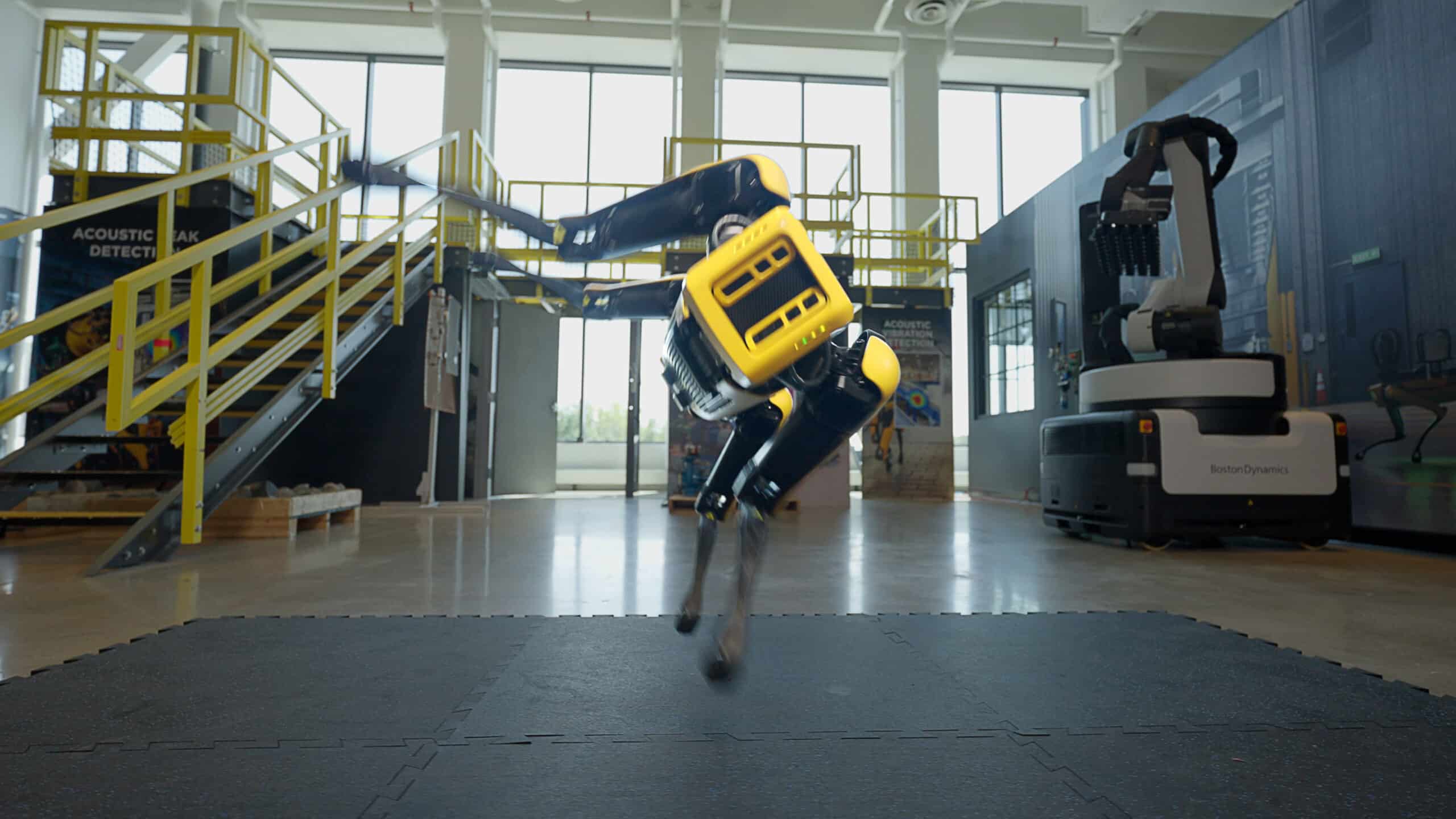
Atlas Goes Hands On | Boston Dynamics

Watch for a technical paper from Boston Dynamics detailing the RL training pipeline, reward design, and sim-to-real transfer. Also track whether Atlas next handles objects heavier than its arm mass (~30 lb per arm), which would test the policy's robustness to extreme loads.

Source: gentic.news · · author= · citation.json

AI-assisted reporting. Generated by gentic.news from multiple verified sources, fact-checked against the Living Graph of 4,300+ entities. Edited by Ala SMITH.

Following this story?

Get a weekly digest with AI predictions, trends, and analysis — free.

AI Analysis

This demo is a meaningful step for humanoid robotics, but the lack of technical detail limits its scientific value. Boston Dynamics has historically been opaque about its RL algorithms—unlike DeepMind or NVIDIA, which publish papers alongside demos. The fridge carry is impressive engineering, but without failure rates, training compute, or policy architecture, it's hard to assess how close Atlas is to real deployment. Compared to RT-2-X, which uses internet-scale pretraining for generalist manipulation, Atlas's approach appears more task-specific. The RL policy likely required significant task-specific reward shaping and environment randomization. The real test is whether this policy can generalize to other objects (e.g., a box of different weight distribution, or a person handing Atlas an object) without retraining. Tesla's Optimus demoed similar warehouse tasks in 2025, but with electric actuators and lower payload capacity. Atlas's hydraulic system gives it higher power density, but at the cost of complexity and noise. The fridge carry suggests Boston Dynamics is prioritizing payload capability over precision—a tradeoff that makes sense for heavy logistics but limits fine manipulation (e.g., assembly).
Enjoyed this article?
Share:

AI Toolslive

Five one-click lenses on this article. Cached for 24h.

Pick a tool above to generate an instant lens on this article.

Related Articles

From the lab

The framework underneath this story

Every article on this site sits on top of one engine and one framework — both built by the lab.

More in AI Research

View all