Key Takeaways
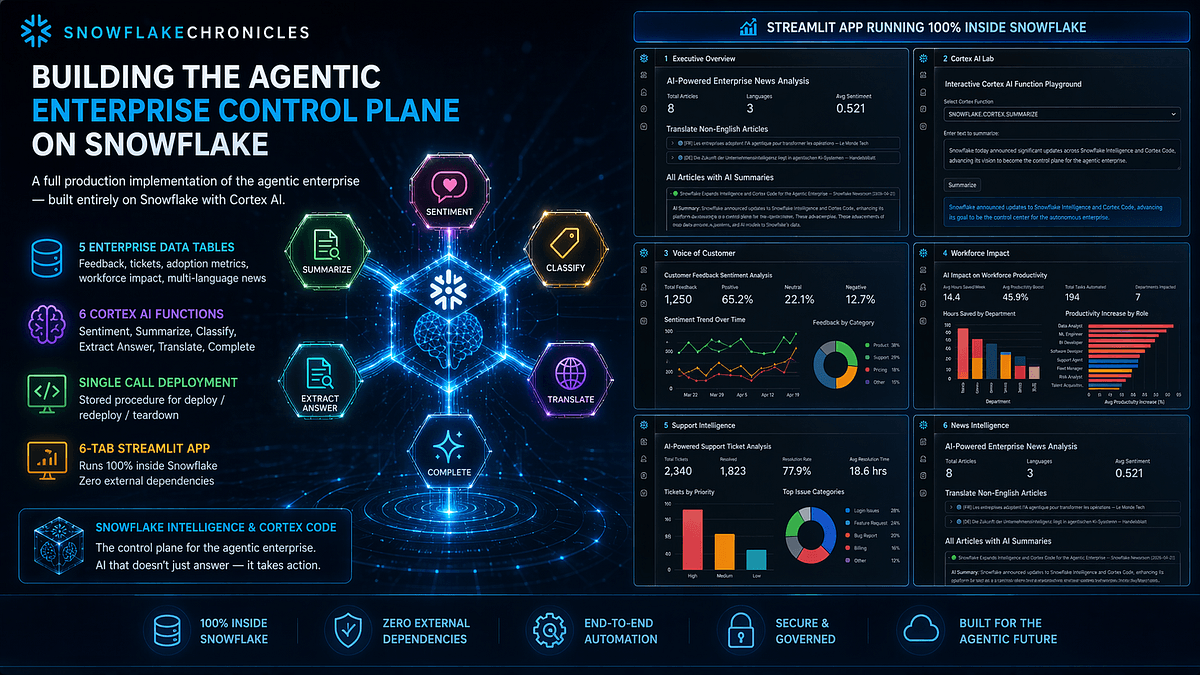
- Snowflake Intelligence and Cortex Code now enable a fully embedded agentic AI control plane.
- This article provides a tested, end-to-end blueprint for building a production-grade Streamlit dashboard that integrates five enterprise tables with six Cortex AI functions, all governed by existing data platform RBAC.
What Happened
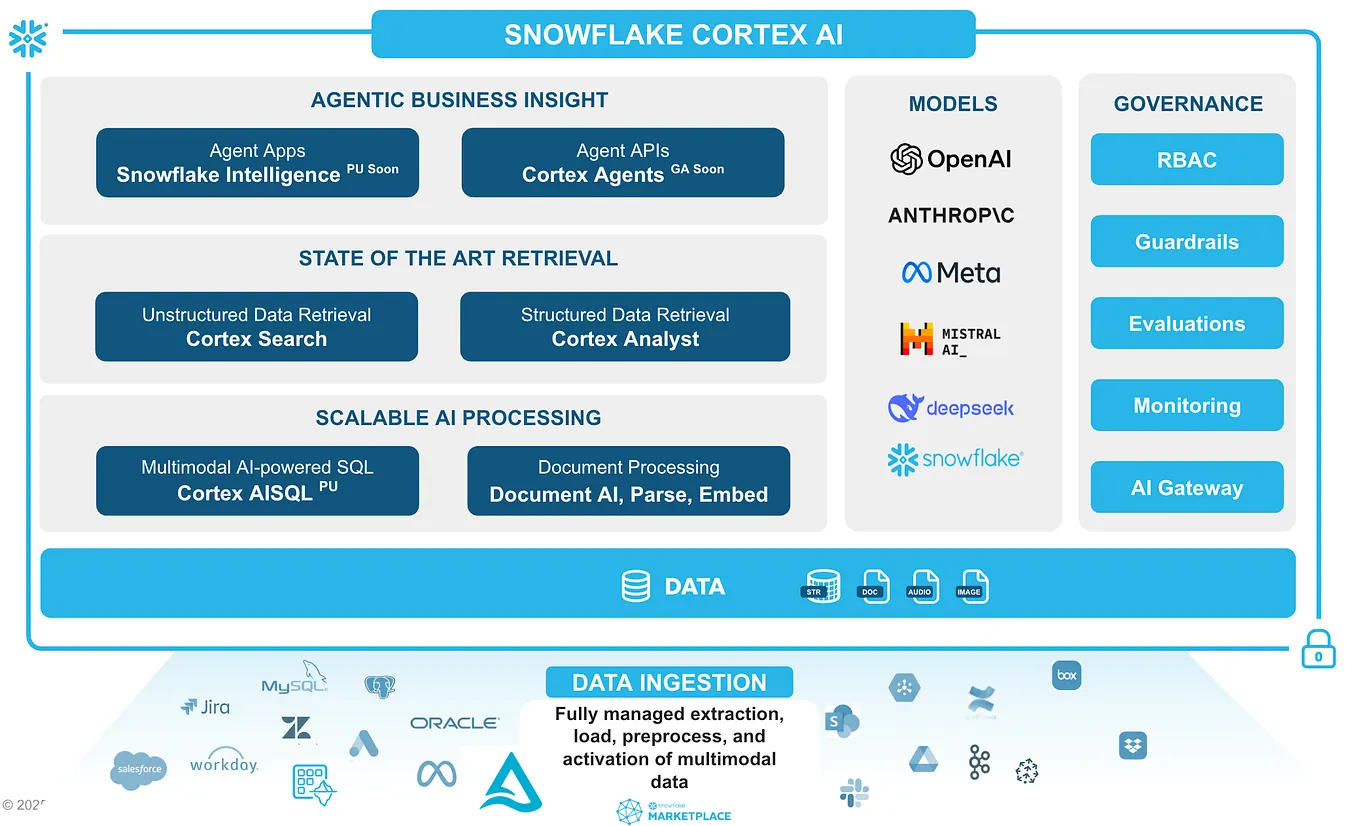
On April 21, 2026, Snowflake formalized a shift that practitioners had been anticipating: Snowflake Intelligence and Cortex Code are now the control plane for the agentic enterprise. AI is no longer just answering questions; it is taking action within the data platform itself.
A detailed technical guide published on Towards AI walks through building a production-grade Streamlit dashboard that embodies this new paradigm. The core innovation is that AI is embedded inside your data platform, governed by the same RBAC that controls your tables, and callable from the same SQL your engineers already write. This is a fundamental departure from the old model where AI lived as a separate service.
Technical Details
The guide demonstrates a fully self-contained deployment, tested end-to-end with no external workspace, no external files, and no manual steps. The complete package includes:
- Five enterprise data tables with 70+ synthetic records, covering customer feedback, support tickets, AI adoption metrics, workforce impact, and enterprise news.
- Six Cortex AI functions demonstrated with real SQL, including sentiment analysis, entity extraction, and summarization.
- A six-tab Streamlit app deployed using a novel technique: Python stored procedures that build the entire application line-by-line and write it directly to stage, using
chr()substitution to handle SQL parser conflicts at runtime.
The synthetic data is engineered, not random: 10 fictitious enterprises across industries, sentiment spanning +0.87 to -0.30, urgency-skewed tickets, and cross-table coverage designed for real AI insights.
Retail & Luxury Implications
While the source is a general technical guide, its implications for retail and luxury are direct and significant. The core capability — embedding AI agents directly within your existing data platform — addresses several pain points common in the sector:
- Customer Feedback Analysis at Scale: The demo's customer feedback table, with sentiment analysis via Cortex, mirrors the challenge luxury brands face processing millions of reviews, survey responses, and social media mentions across 30+ markets. The ability to do this in real-time, within Snowflake, without moving data to a separate AI service, is operationally transformative.
- Support Ticket Automation: The support tickets table with priority and category fields maps directly to luxury customer service operations. An agentic control plane could triage, summarize, and even draft responses to customer issues, all while respecting data governance.
- Workforce and AI Adoption Tracking: The workforce impact and AI adoption metrics tables are directly relevant for retail organizations deploying AI tools across stores, supply chains, and marketing teams. Tracking hours saved and productivity gains per department becomes a first-class SQL operation.
- Inventory and Supply Chain: While not in the demo, the same pattern applies to inventory tables, supplier performance data, and logistics — all core to retail operations.
Business Impact
For a large retail or luxury conglomerate, the business impact is measurable in several dimensions:
- Reduced Data Movement Costs: AI operates where the data lives, eliminating the cost, latency, and governance risk of exporting data to external AI services.
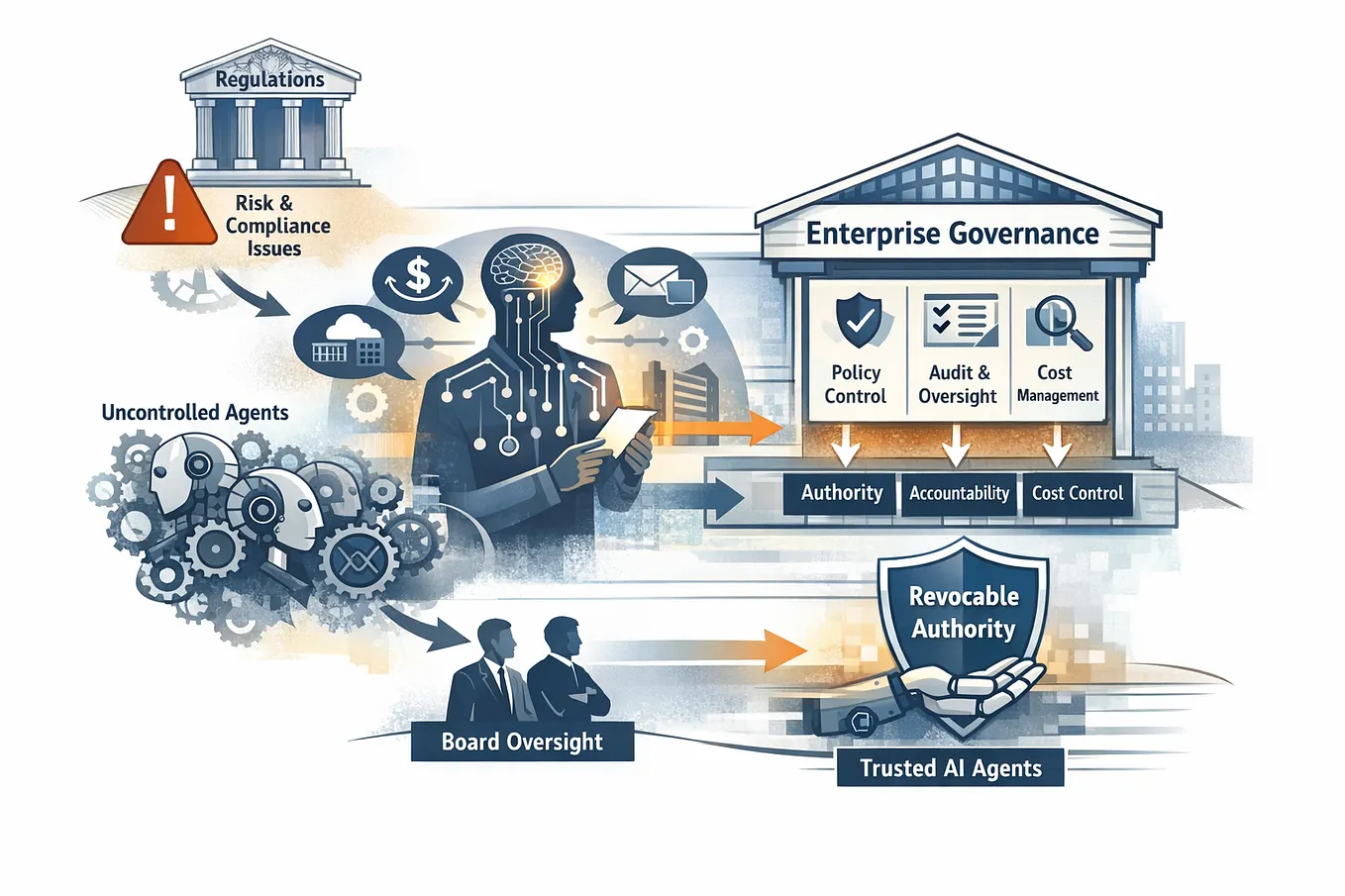
- Unified Governance: All AI actions are governed by the same RBAC policies already in place for financial and customer data. This is critical for luxury brands where data privacy and exclusivity are paramount.
- Faster Time-to-Insight: SQL-callable AI means data engineers and analysts can build AI-powered dashboards without a separate AI team or specialized infrastructure.
- Scalable Agentic Workflows: The ability to build and deploy Streamlit apps entirely within Snowflake, using stored procedures, means AI agents can be created, tested, and deployed without touching external CI/CD pipelines.
Implementation Approach
For a retail AI leader considering this approach:
- Start with a single use case: Customer feedback sentiment analysis is the lowest-hanging fruit, as it requires only a feedback table and one Cortex function.
- Leverage existing Snowflake investments: If your organization already uses Snowflake for data warehousing, the path to agentic AI is significantly shorter.
- Use the synthetic data pattern: Create a small, engineered dataset to test your specific use case before scaling to production data.
- Adopt the stored-procedure deployment pattern: This ensures reproducible, auditable deployments that align with enterprise change management.
Governance & Risk Assessment
The approach described has strong governance defaults:
- Data never leaves the platform: All AI processing happens within Snowflake's security boundary.
- RBAC applies uniformly: The same access controls that protect salary data protect AI-generated insights.
- Auditability is built-in: Every query is logged; every AI action is traceable to a user session.
However, practitioners should note:
- Model maturity: Cortex AI functions are powerful but may not match the performance of specialized, fine-tuned models for niche luxury domains (e.g., gemstone grading or haute couture pattern recognition).
- Latency under load: The demo notes latency issues during peak traffic for recommendation engines — a concern for luxury e-commerce during seasonal peaks.
gentic.news Analysis
This technical guide arrives at a moment when the industry is actively standardizing the infrastructure for agentic AI. On April 8, 2026, Intel and SambaNova Systems jointly proposed a hybrid inference architecture blueprint for agentic AI workloads, signaling that hardware vendors are racing to support this paradigm. Intel's broader push includes joining the 'Terafab' project with SpaceX, xAI, and Tesla to refactor silicon fabrication — a reminder that the hardware layer is being rethought for AI-native operations.
What's significant here is that Snowflake is executing on the software side of the same vision: making agentic AI a first-class citizen within the enterprise data platform, rather than a bolt-on service. This aligns with the broader trend we've covered, such as the UALink 2.0 spec finalized on April 20, 2026, which aims to challenge NVLink for AI clusters — the infrastructure race is on at every layer of the stack.
For retail leaders, the key takeaway is that the control plane for AI agents is becoming a data platform feature, not a separate product. This reduces architectural complexity and governance risk, making it more feasible to deploy AI agents at scale across customer service, supply chain, and marketing operations.
The synthetic data approach in this guide is particularly smart for retail: before deploying an agentic system on real customer data, luxury brands can use engineered datasets that mirror their specific product hierarchies, customer segments, and seasonal patterns to validate performance and compliance.