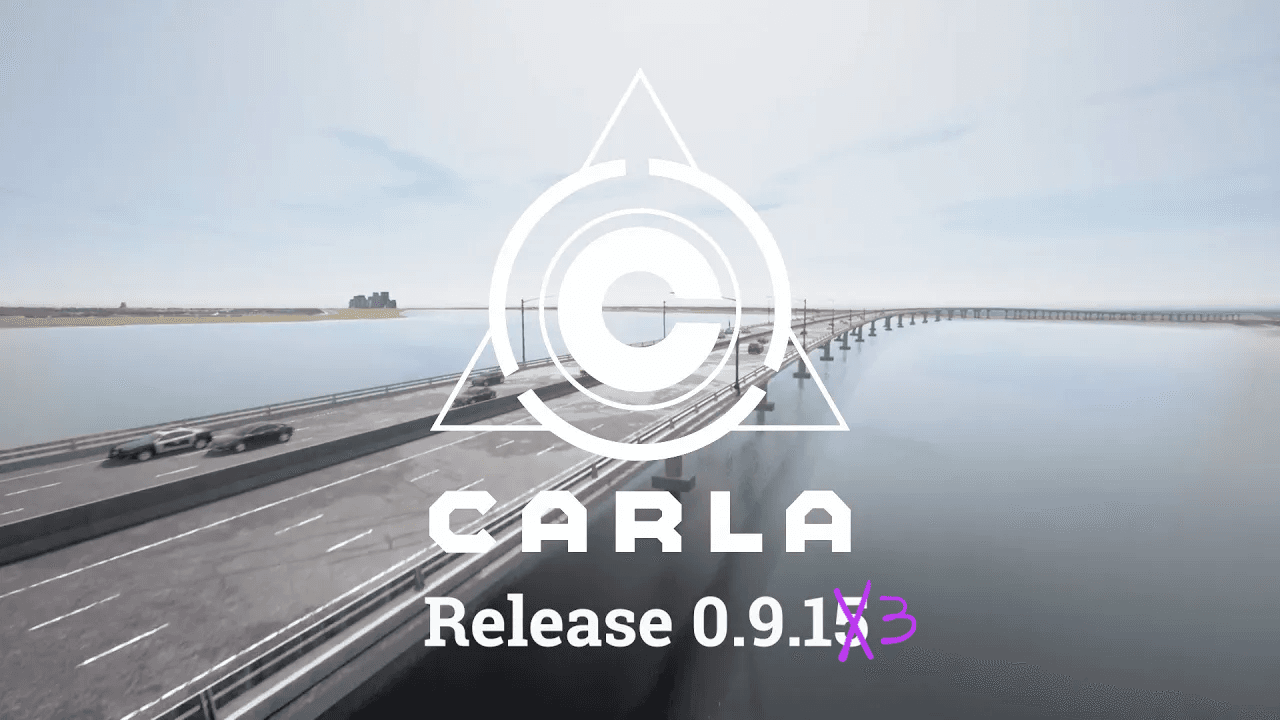
A new simulation platform called CARLA-Air has been released, merging two of the most prominent open-source simulators for autonomous systems—CARLA (for autonomous driving) and AirSim (for aerial drones)—into a single, unified Unreal Engine process. This integration aims to solve a critical bottleneck in embodied AI research: the high latency and complexity of running separate simulations for air and ground agents that need to interact.
The core innovation is architectural. Previously, researchers wanting to simulate scenarios involving both drones and autonomous vehicles would need to run CARLA and AirSim as separate processes, often on different machines, and then bridge them with custom networking code. This introduced significant latency, made sensor synchronization across platforms difficult, and complicated the reinforcement learning (RL) training loop. CARLA-Air eliminates this by integrating both simulators' functionalities directly into one Unreal Engine 4 (UE4) runtime.
What CARLA-Air Enables
The platform provides a unified environment for developing and testing "air-ground" embodied AI systems. The key capabilities, as announced, include:
- Zero Bridging Latency: Because all simulation logic runs in one UE4 process, communication between aerial and ground agent controllers, and between their respective sensors, happens with minimal overhead. This is crucial for training RL policies that require tight coordination.
- Synchronized Multi-Modal Sensing: The platform supports 18 different sensor modalities (e.g., RGB cameras, depth, semantic segmentation, lidar, IMU, GPS) that can be attached to any agent—drone or vehicle—and whose data streams are inherently synchronized within the simulation timestep.
- Photorealistic Urban Environments: It inherits CARLA's highly detailed, dynamic urban maps (based on real-world locations like Town01-Town10), allowing drones to fly through realistic cityscapes with traffic, pedestrians, and variable weather/lighting conditions.
- ROS2 & RL Integration: Native support for the Robot Operating System 2 (ROS2) middleware facilitates connecting simulated agents to real-world robotics software stacks. The seamless RL training support suggests a designed-in API for common frameworks like RLlib or Stable-Baselines3, allowing agents to be trained directly within the unified sim.
Technical Architecture and How It Works
While the source tweet is a high-level announcement, the technical approach likely involves refactoring the client-server architecture common to both CARLA and AirSim. In a standard setup, both simulators run a UE4 server that simulates the world physics and renders sensors, while external Python or C++ clients send control commands and receive sensor data.
CARLA-Air presumably modifies the UE4 plugin layer to host both the CARLA and AirSim agent classes, sensor suites, and vehicle/drone physics models concurrently. This creates a single authoritative simulation state. A unified Python API would then expose functions to spawn, control, and gather data from either car or drone agents, treating them as first-class entities in the same world. The "zero bridging latency" claim stems from removing the network hop between two separate simulator servers.
Why This Matters for Embodied AI Research
Training robust embodied AI—agents that perceive and act in a physical world—requires vast amounts of varied experience. Simulation is the only scalable way to acquire this data, especially for dangerous or expensive real-world testing involving drones and autonomous vehicles.
CARLA-Air directly targets complex multi-agent, multi-domain scenarios that are emerging as key research frontiers:
- Drone Fleet Coordination for Urban Delivery: Simulating delivery drones navigating between buildings, avoiding vehicles, and landing on moving trucks.
- Autonomous Vehicle Perception Augmentation: Using simulated drone-overhead views to provide a "bird's-eye-view" context to ground vehicles, a technique known as V2X (vehicle-to-everything) communication.
- Search and Rescue: Training joint air-ground systems where drones scout an area and guide ground vehicles to targets.
By providing a high-fidelity, performant sandbox for these scenarios, CARLA-Air lowers the barrier to entry for a significant segment of robotics and AI research.
gentic.news Analysis
This release is a logical and necessary convergence in the simulation-for-AI toolkit. For years, the ecosystem has been fragmented: CARLA, developed primarily by the Computer Vision Center at Universitat Autònoma de Barcelona, became the de facto standard for autonomous vehicle research. Microsoft's AirSim filled a similar niche for aerial vehicles and drones. Researchers working at the intersection, like those at CMU or UC Berkeley exploring multi-modal mobility, often had to shoulder the significant engineering burden of integrating the two.
CARLA-Air represents a maturation of the field, moving from single-domain tools to platforms capable of modeling complex, real-world interactions. This aligns with a broader trend we've covered, such as the push towards "foundation models for robotics," where large, diverse datasets of simulated experience are seen as a prerequisite for generalizable robot intelligence. A unified simulator like CARLA-Air is a critical data-generation engine for that approach.
The timing is also pertinent. As real-world autonomous drone logistics and advanced driver-assistance systems (ADAS) move closer to deployment, the need for rigorous, multi-agent simulation in photorealistic environments has skyrocketed. CARLA-Air provides an open-source alternative to expensive commercial simulators (e.g., NVIDIA DRIVE Sim, Siemens Simcenter) for academia and startups, potentially accelerating innovation in the sector. Its commitment to ROS2 support ensures it plugs directly into the existing robotics development pipeline, increasing its utility for practitioners aiming to transfer policies from simulation to real hardware.
Frequently Asked Questions
What is the difference between CARLA, AirSim, and CARLA-Air?
CARLA is an open-source simulator for autonomous driving research. AirSim is an open-source simulator for drone and aerial vehicle research. CARLA-Air is a new platform that merges the capabilities of both into a single Unreal Engine process, allowing you to simulate drones and autonomous vehicles interacting in the same photorealistic city environment with synchronized sensors and no inter-process communication latency.
Do I need separate licenses for Unreal Engine to use CARLA-Air?
Like its parent projects, CARLA-Air is almost certainly built on Unreal Engine 4. Its use will be subject to Epic Games' Unreal Engine End User License Agreement (EULA). For non-commercial, academic, or open-source research, this is typically free. For commercial use, you must comply with UE's royalty-based licensing terms once a revenue threshold is passed.
Can I use CARLA-Air to train reinforcement learning policies for a drone that follows a car?
Yes, this is a primary use case CARLA-Air is designed to enable. The zero-latency, unified environment and support for seamless RL training mean you can define a joint observation space (e.g., drone camera view + car lidar data) and action space (drone thrust & yaw, car steering & throttle) to train a single or multi-agent policy controlling both entities in coordination.
Where can I find the code and documentation for CARLA-Air?
The source tweet links to a repository (likely on GitHub). At the time of writing, the link points to https://t.co/wSIk1mE7qW. You should follow that link to access the official codebase, installation instructions, and API documentation.