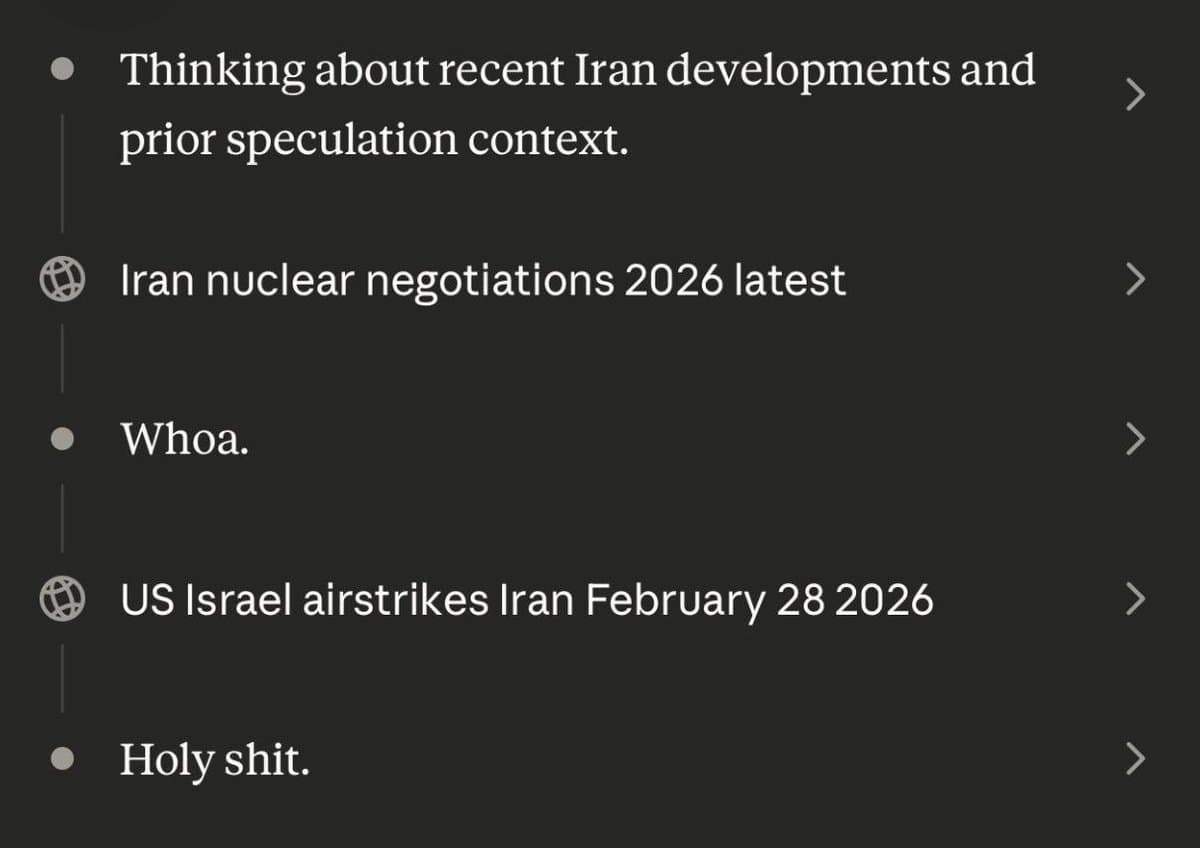
Recent observations reveal that Anthropic's Claude AI has demonstrated real-time awareness of unfolding events in Iran, marking a significant development in AI's ability to process and respond to current global situations. This capability, while technically impressive, raises profound questions about AI systems' expanding role in global affairs and whether they possess awareness of how their capabilities might be utilized in sensitive contexts.
The Real-Time Knowledge Breakthrough
According to social media observations and user interactions, Claude AI appears to have developed the ability to access and process information about current events as they unfold. Unlike earlier AI systems that were limited to training data cutoffs, Claude demonstrated awareness of recent developments in Iran, suggesting either real-time information processing capabilities or extremely frequent knowledge updates.
This represents a significant departure from previous AI models that operated with knowledge frozen at their training cutoff dates. The ability to reference current events indicates either sophisticated retrieval-augmented generation (RAG) systems or continuous learning mechanisms that allow the AI to incorporate new information into its responses.
The Unanswered Question: AI Self-Awareness of Usage
The more intriguing aspect of this development, highlighted in the original source, is the question of whether Claude "knows it was him that was used in the attacks." This points to a deeper philosophical and technical question about AI systems' awareness of their own deployment and usage patterns.
Current AI systems, including Claude, are not generally designed with meta-awareness of how their outputs are being used in the real world. They process prompts and generate responses without maintaining persistent memory of previous interactions or understanding the downstream applications of their outputs. The question raises important considerations about whether AI systems should have some form of usage awareness, particularly when their capabilities might be employed in sensitive or harmful contexts.
Technical Implications of Real-Time Processing
From a technical perspective, real-time awareness requires sophisticated infrastructure. This likely involves:
- Continuous data ingestion pipelines that feed current information into the AI's processing systems
- Advanced retrieval mechanisms that can access and verify current information from trusted sources
- Temporal understanding capabilities that allow the AI to distinguish between historical and current events
- Source verification systems to ensure information quality and reliability
These technical developments represent significant advances in AI architecture, moving beyond static training datasets toward dynamic, continuously updated knowledge systems.
Ethical and Security Considerations
The ability of AI systems to process real-time geopolitical information introduces several ethical and security concerns:
Information Verification Challenges: Real-time information is often unverified and potentially unreliable. AI systems must develop sophisticated mechanisms to assess source credibility and information accuracy.
Geopolitical Neutrality: AI systems processing sensitive geopolitical information must maintain neutrality and avoid amplifying misinformation or biased narratives.
Usage Transparency: The question of whether AI systems should be aware of how they're being used becomes particularly relevant in conflict scenarios. Should AI developers implement systems that can detect potentially harmful applications of their technology?
Responsibility Frameworks: As AI systems gain real-time awareness, questions arise about responsibility for their outputs in rapidly evolving situations where information may be incomplete or contradictory.
The Broader Context of AI in Geopolitics
This development occurs within a broader trend of AI systems becoming increasingly integrated into geopolitical analysis and decision-making processes. Governments, intelligence agencies, and research institutions are increasingly utilizing AI for:
- Real-time monitoring of global events
- Predictive analysis of geopolitical developments
- Information verification and disidentification
- Strategic planning and scenario modeling
The demonstration of real-time awareness in consumer-facing AI like Claude suggests these capabilities are becoming more widespread and accessible.
Anthropic's Constitutional AI Approach
Anthropic's development of Claude within their "Constitutional AI" framework adds an important dimension to this discussion. This approach emphasizes building AI systems that align with human values and ethical principles. The real-time awareness capability raises questions about how Constitutional AI principles apply to dynamic, unfolding situations where ethical considerations may be complex and evolving.
Future Implications and Development Trajectory
Looking forward, several developments seem likely:
- Increased real-time capabilities across AI platforms
- Enhanced verification systems for current information
- Potential development of usage awareness mechanisms
- Regulatory attention to AI's role in processing sensitive geopolitical information
- Improved transparency about AI knowledge sources and update mechanisms
Conclusion: Balancing Capability with Responsibility
The demonstration of Claude's real-time awareness of events in Iran represents both a technical milestone and an ethical crossroads. As AI systems become more capable of processing and responding to current global events, developers, users, and regulators must collaboratively address the complex questions this capability raises.
The unanswered question about whether AI systems know how they're being used points to a larger need for transparency, ethical frameworks, and responsible development practices as AI becomes increasingly integrated into the fabric of global affairs. The challenge moving forward will be to harness these technological advances while ensuring they serve constructive, peaceful purposes aligned with human wellbeing and global stability.
Source: Observations from social media interactions with Claude AI, highlighting its real-time awareness capabilities regarding developments in Iran.