A new AI tool called Clico is making waves by addressing one of the most persistent productivity bottlenecks in the AI-assisted workflow: the constant tab-switching between ChatGPT and other applications. According to developer Hasaan Toor, Clico represents a fundamental shift in how users interact with AI assistance during their daily digital tasks.
The Tab-Switching Problem
For millions of users who regularly employ ChatGPT or similar AI assistants, the workflow has become frustratingly familiar: working in a document, email, or web form, then needing to open a separate tab, copy text, paste it into ChatGPT, wait for a response, copy that response, switch back to the original tab, and finally paste the AI-generated content. This disruptive process not only breaks concentration but also creates opportunities for losing one's place in the original document or forgetting context.
"The tab-switching loop has become the silent productivity killer of the AI age," explains Toor in his announcement. "We've all experienced that moment of frustration when we realize we've lost our train of thought because we had to jump between applications to get AI assistance."
How Clico Works
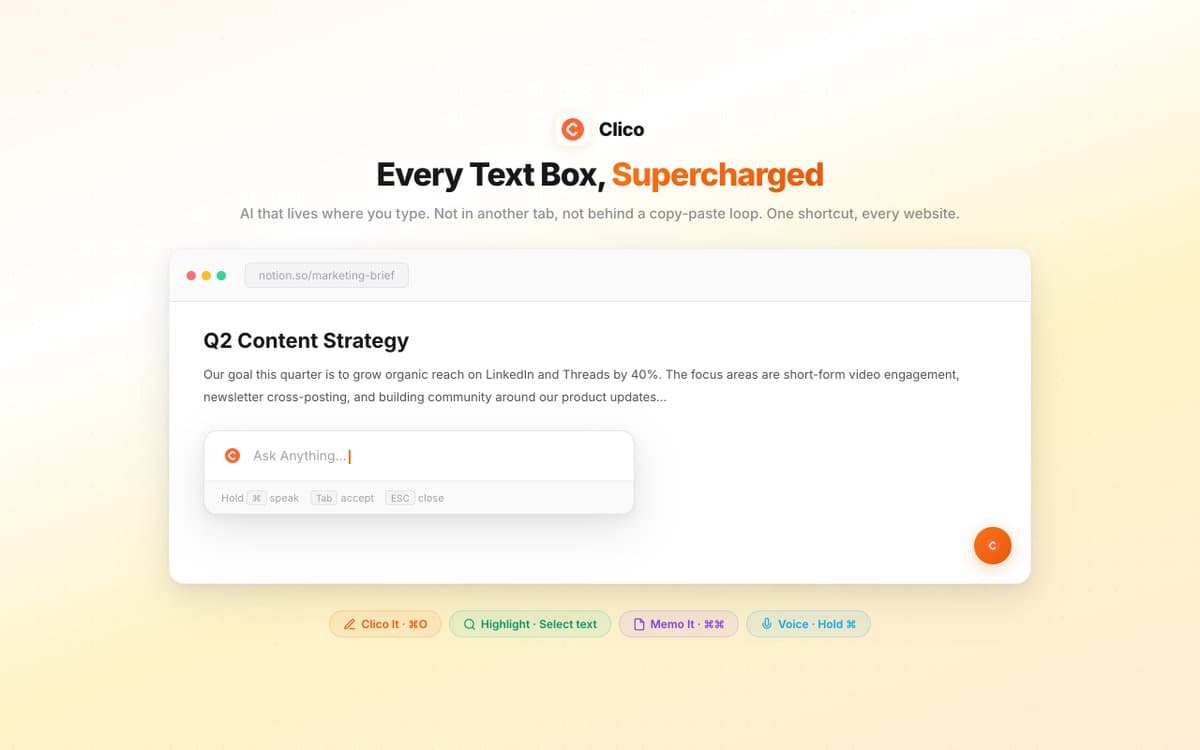
Clico takes a radically different approach by embedding AI functionality directly into the browser's existing text boxes. Rather than requiring users to navigate to a separate AI interface, Clico makes AI assistance available wherever text input occurs naturally.
The tool appears to function as a browser extension that adds AI capabilities to standard text fields across websites and applications. Users can presumably highlight text, right-click, or use keyboard shortcuts to access AI functions without ever leaving their current context.
While specific implementation details remain limited in the initial announcement, the core promise is clear: Clico aims to make AI assistance as seamless as right-clicking for a synonym suggestion or grammar correction—but with the full power of modern language models.
Potential Applications and Impact
The implications of this approach extend across numerous professional and personal use cases:
Content Creation: Writers could get real-time suggestions, expansions, or edits without breaking their writing flow.
Communication: Email composition, social media posting, and messaging could all benefit from integrated AI assistance.
Research and Analysis: Students and professionals could get explanations or summaries of text they're reading without leaving the source material.
Coding: Developers might receive code suggestions or debugging help directly within their development environments.
This integration-first philosophy represents a significant evolution in AI tool design. Rather than creating yet another destination website or application, Clico brings the AI to where work already happens.
Technical Considerations and Challenges
Successfully implementing such a system presents several technical challenges. The tool must work across diverse websites with different security protocols, text input methods, and user interface designs. Privacy concerns will also be paramount, as the extension would necessarily have access to text content across various websites.
Additionally, the quality of AI responses will depend on the underlying model powering Clico. The announcement doesn't specify whether Clico uses its own proprietary model, leverages existing APIs like OpenAI's, or employs a hybrid approach.
The Broader Trend Toward Integration
Clico arrives amid a growing movement toward more integrated AI experiences. Microsoft's Copilot integration across Office applications, Google's AI features in Workspace, and various coding assistants that work within IDEs all point toward the same conclusion: the most valuable AI tools will be those that minimize friction and maximize contextual relevance.
What makes Clico potentially distinctive is its ambition to work universally across the web rather than within specific applications. If successful, it could establish a new standard for how AI assistance should be delivered in browser-based environments.
Looking Forward
As with any new tool, Clico's success will depend on execution quality, user adoption, and the value it consistently delivers. The concept addresses a genuine pain point experienced by millions of AI users daily, suggesting strong potential market demand.
The tool's development signals an important maturation in AI application design—from standalone marvels to integrated utilities that enhance rather than interrupt existing workflows. As AI becomes increasingly woven into our digital experiences, solutions like Clico may represent the next logical step in making these powerful tools truly useful rather than merely impressive.
Source: Hasaan Toor's announcement on X (formerly Twitter) describing Clico's functionality and value proposition.