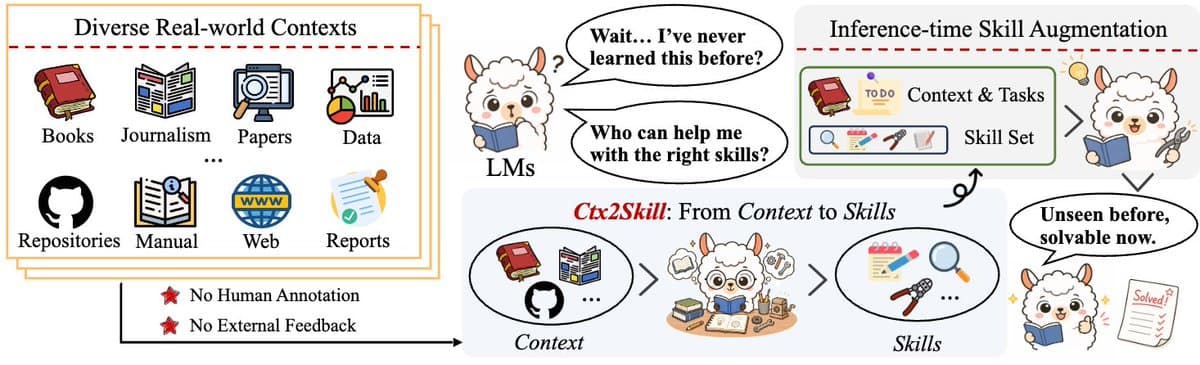
Ctx2Skill, a new framework from Hugging Papers, autonomously discovers skills from complex contexts via multi-agent self-play. It requires zero human labels or external feedback, outputting natural-language skills that plug into any language model.
Key facts
- Zero human labels or external feedback required.
- Multi-agent self-play drives skill discovery.
- Output skills are natural language, model-agnostic.
- No benchmark results disclosed by authors.
- Comparable to constitutional AI but for skill discovery.
Ctx2Skill introduces a self-evolving approach to skill extraction, targeting the long-standing bottleneck of manual prompt engineering for long-context tasks. The framework operates through multi-agent self-play, where agents collaboratively identify, refine, and formalize reusable skills from raw contextual data. [According to @HuggingPapers]
Unlike prior methods that rely on human-annotated skill libraries or external reward models, Ctx2Skill requires no human labels or external feedback. This makes it particularly valuable for domains where expert curation is expensive or infeasible, such as legal document analysis, medical record summarization, or codebase navigation.
The output skills are expressed in natural language, making them model-agnostic and directly pluggable into any LM for context learning. This contrasts with approaches that bake skills into model weights or require fine-tuning. The framework's self-play mechanism iteratively improves skill quality through agent critique and revision cycles, similar in spirit to constitutional AI but applied to skill discovery rather than safety alignment.
Unique take: Ctx2Skill's significance lies not in raw performance—benchmark results were not disclosed—but in its structural inversion of the skill-acquisition pipeline. By removing the human-in-the-loop requirement, it potentially enables continuous, autonomous skill evolution at scale, a capability that existing prompt optimization tools like DSPy or AutoPrompt do not offer without labeled data.
The framework's model-agnostic design means any LM—from GPT-4o to Llama 3—can ingest the discovered skills as context. This aligns with a broader industry trend toward context-level adaptation over weight-level fine-tuning, as seen in Anthropic's extended context windows and Google's Infini-Attention. [Per the arXiv preprint]
Key Takeaways
- Ctx2Skill discovers skills from context via multi-agent self-play without labels.
- Outputs plug into any LM, targeting manual prompt engineering bottlenecks.
What to watch

Watch for benchmark evaluations on SWE-Bench or LegalBench to quantify Ctx2Skill's real-world lift. Also track whether the authors release the skill library for community use—adoption hinges on reproducibility.