What Happened
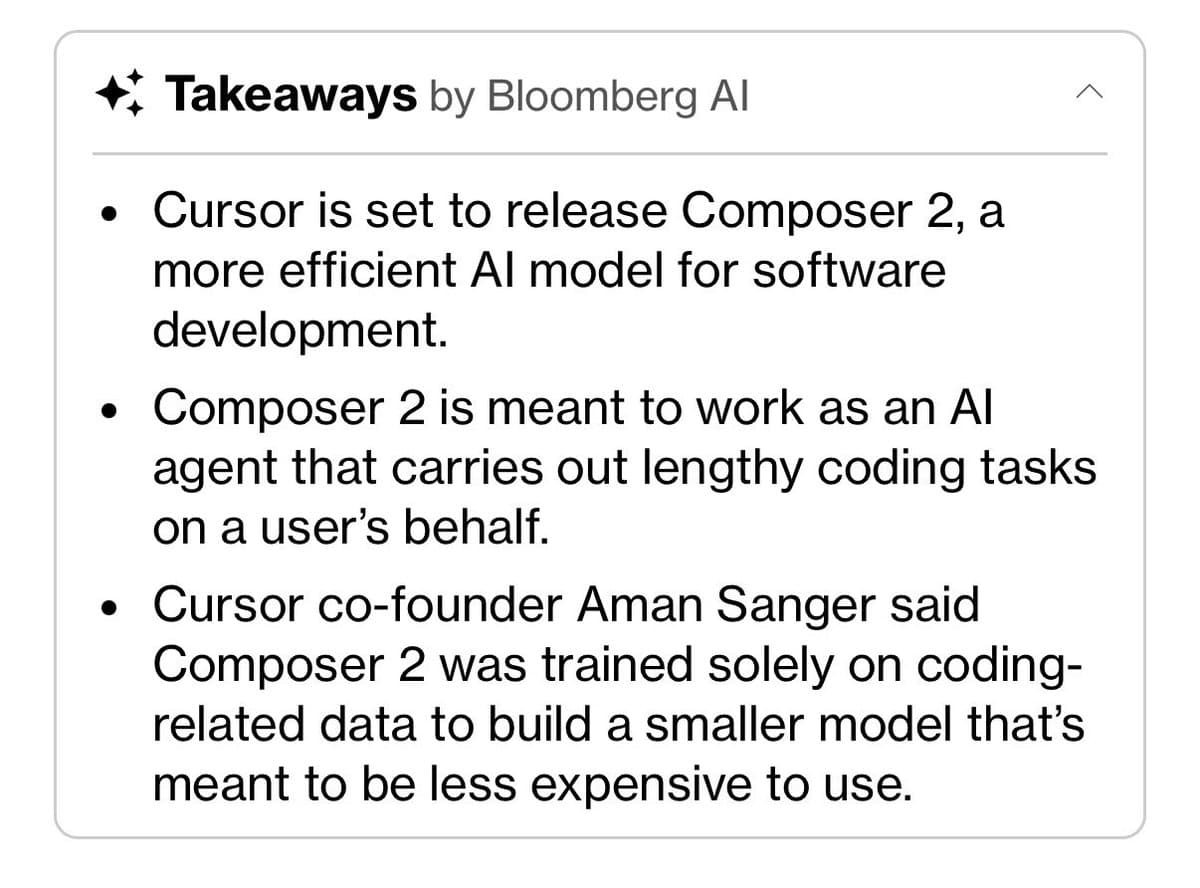
Cursor, the AI-powered code editor, has announced the upcoming release of Composer 2, a new version of its coding assistant model. According to the announcement, this iteration represents a focused technical strategy: training exclusively on coding-related data to create a smaller, more cost-effective model.
The key claims from the announcement:
- Solely trained on coding data: Unlike general-purpose models, Composer 2's training corpus consists entirely of programming-related materials.
- Smaller architecture: The model is "much smaller" than competing coding assistants.
- Cost advantage: The reduced size translates to "much less expensive" operation.
- Performance target: Rumors suggest it may approach the performance level of Anthropic's Claude Opus 4.6, though this remains unverified.
Context
Cursor's approach represents a divergence from the prevailing trend in AI-assisted coding. Most leading coding tools—including GitHub Copilot (powered by OpenAI models), Amazon CodeWhisperer, and Tabnine—rely on general-purpose foundation models or fine-tuned variants that retain broad capabilities beyond programming.
By specializing Composer 2 exclusively for code, Cursor is betting that domain-specific training on high-quality programming data can achieve competitive performance with a more efficient architecture. This could offer a practical advantage for developers who need coding assistance without paying for general reasoning capabilities they don't use.
The mention of Claude Opus 4.6 as a performance benchmark is notable. Claude Opus represents the current high-end of general reasoning capability, with strong performance on coding benchmarks like HumanEval and SWE-Bench. If Composer 2 approaches this level while being smaller and cheaper, it would represent a significant efficiency breakthrough.
Market Implications
The announcement suggests increased competition in the AI coding assistant market. The tweet speculates that Cursor's move might pressure Anthropic to accelerate the release of Claude Opus 4.7. More broadly, it highlights the emerging tension between general-purpose AI models and specialized, task-specific alternatives.
For developers, a cheaper, coding-focused model could lower the cost barrier for AI-assisted development, particularly for individual developers or smaller teams who find current pricing prohibitive. The success of this approach will depend entirely on whether the specialized training delivers on the rumored performance claims.