What Happened
Cursor has launched Composer 2, a new version of its coding AI model, making it available within the Cursor IDE. The announcement came via a tweet from @kimmonismus, highlighting both pricing and performance claims.
The key pricing details:
- Input tokens: $0.50 per million tokens
- Output tokens: $2.50 per million tokens
Performance Claims
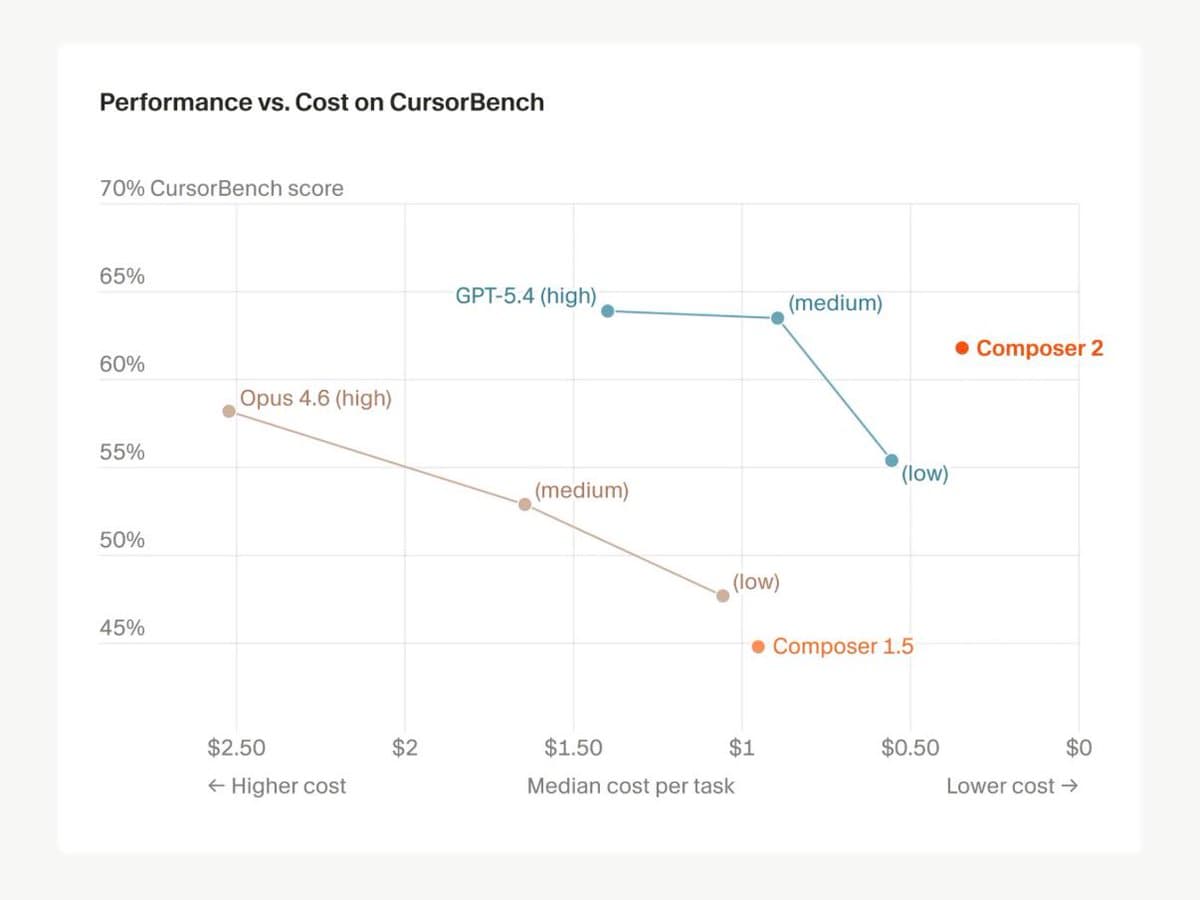
According to the announcement, Composer 2 shows "major jumps over prior versions" on three coding benchmarks:
CursorBench 61.3 Terminal-Bench 2.0 61.7 SWE-bench Multilingual 73.7The tweet describes this as "a notably very very strong price-performance launch for coding AI" and suggests this "pressure on OpenAI and Anthropic increased a lot."
Context
Cursor is an AI-powered code editor that has gained popularity among developers for its deep integration of AI assistance directly into the development workflow. The original Composer model was positioned as a coding-specific alternative to general-purpose models like GPT-4 and Claude.
The pricing structure places Composer 2 significantly below current market leaders:
- OpenAI's GPT-4 Turbo: $10.00 per million input tokens, $30.00 per million output tokens
- Anthropic's Claude 3 Opus: $15.00 per million input tokens, $75.00 per million output tokens
However, it's important to note that the announcement does not provide:
- Baseline scores for previous Composer versions
- Direct comparisons to competing models on these benchmarks
- Details about model architecture, training data, or context window
- Information about availability outside the Cursor IDE
What's Next
The launch represents Cursor's attempt to compete on both price and specialized coding performance. Developers using Cursor will now have access to what the company claims is a significantly improved model at aggressive pricing.
Without independent verification of the benchmark claims or details about model capabilities, the actual impact on the competitive landscape remains to be demonstrated through real-world developer adoption and performance in production coding workflows.