What Happened
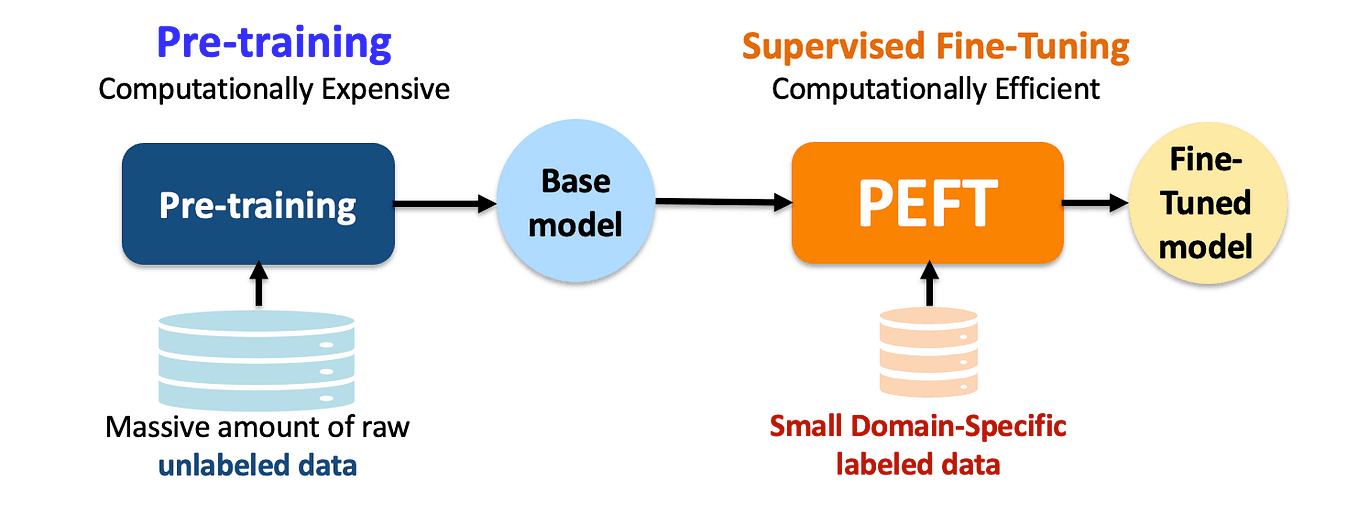
A technical article, published on Medium, provides a practical guide for efficiently fine-tuning large Vision-Language Models (VLMs). The core focus is on applying two established parameter-efficient fine-tuning (PEFT) techniques—Low-Rank Adaptation (LoRA) and Quantization—specifically to multimodal models that process both images and text. The goal is to make the customization of powerful, general-purpose VLMs (like GPT-4V or open-source variants such as LLaVA) feasible without requiring massive computational resources typically associated with full model training.
The article is positioned as an instructional resource for practitioners looking to adapt these models for specific tasks or domains.
Technical Details
The guide explains the combination of two key methods to reduce the cost of fine-tuning.
1. Low-Rank Adaptation (LoRA)
LoRA is a PEFT technique that avoids updating the entire set of a model's parameters (which can number in the billions). Instead, it injects trainable rank decomposition matrices into specific layers of a pre-trained model (often the attention layers in transformer architectures). During fine-tuning, only these small, injected matrices are updated, while the original, frozen model weights remain unchanged. This drastically reduces the number of trainable parameters—often by over 99%—leading to:
- Greatly reduced GPU memory usage, as only a tiny fraction of gradients need to be stored.
- Faster training times and lower computational costs.
- Easier model portability, as the fine-tuned component (the "LoRA adapter") is a small file that can be swapped on top of the base model.
2. Quantization
Quantization is a model compression technique that reduces the numerical precision of the model's weights. For instance, converting weights from 32-bit floating-point (FP32) or 16-bit (FP16/BF16) to 8-bit integers (INT8) or 4-bit (NF4). This process shrinks the model's memory footprint, allowing it to run on hardware with less VRAM. The article likely discusses applying quantization before applying LoRA fine-tuning—a common approach known as QLoRA (Quantized Low-Rank Adaptation). QLoRA enables fine-tuning of extremely large models on a single consumer-grade GPU by first quantizing the base model to 4-bit precision and then training LoRA adapters on top of it.
By combining these methods, the guide outlines a workflow to take a pre-trained VLM, load it in a quantized state to save memory, and then efficiently train a lightweight LoRA adapter tailored to a new dataset or objective.
Retail & Luxury Implications
The techniques described, while general-purpose, have clear and potent applications for brands seeking to leverage multimodal AI. The primary value is in making bespoke VLM development operationally and financially viable for in-house teams.
1. Domain-Specific Visual Intelligence:
A luxury brand could fine-tune an open-source VLM on its private archive of product imagery, campaign photos, and detailed style guides. The adapted model could learn brand-specific aesthetics, terminology (e.g., "savoir-faire," "jacquard weave," "patina"), and product attributes. This creates a powerful internal tool for:
- Automated Creative Asset Tagging & Curation: Ingesting thousands of campaign or lookbook images and generating rich, consistent metadata (mood, model, color palette, product features).
- Visual Search & Recommendation Enhancement: Powering a "search by image" feature that understands nuanced style similarities beyond basic categories.
- Assisting Creative & Design Teams: Acting as a brainstorming partner that can generate copy or mood boards aligned with the brand's visual language when prompted with an inspiration image.
2. Scalable Customer Interaction Analysis:
Fine-tuned VLMs could analyze customer interactions that blend image and text. For example, processing screenshots of social media posts where a customer shows a product and asks a question. The model could classify sentiment, identify the product, and summarize the query for a CRM system.
3. Efficient Prototyping and Innovation:
The low-cost nature of LoRA/QLoRA fine-tuning allows AI teams to rapidly prototype multiple specialized models—one for visual merchandising analysis, another for counterfeit detection cues, another for sustainability reporting from supply chain imagery—without separate, costly training runs for each. This fosters an experimental, agile approach to AI application development.
The critical implication is democratization. These techniques lower the barrier to entry for creating proprietary, domain-expert AI models, which is a key strategic advantage in the luxury sector where differentiation and deep brand knowledge are paramount.