Unsloth × NVIDIA Cut LLM Fine-Tuning ~25% — Three Glue-Code Wins on Blackwell
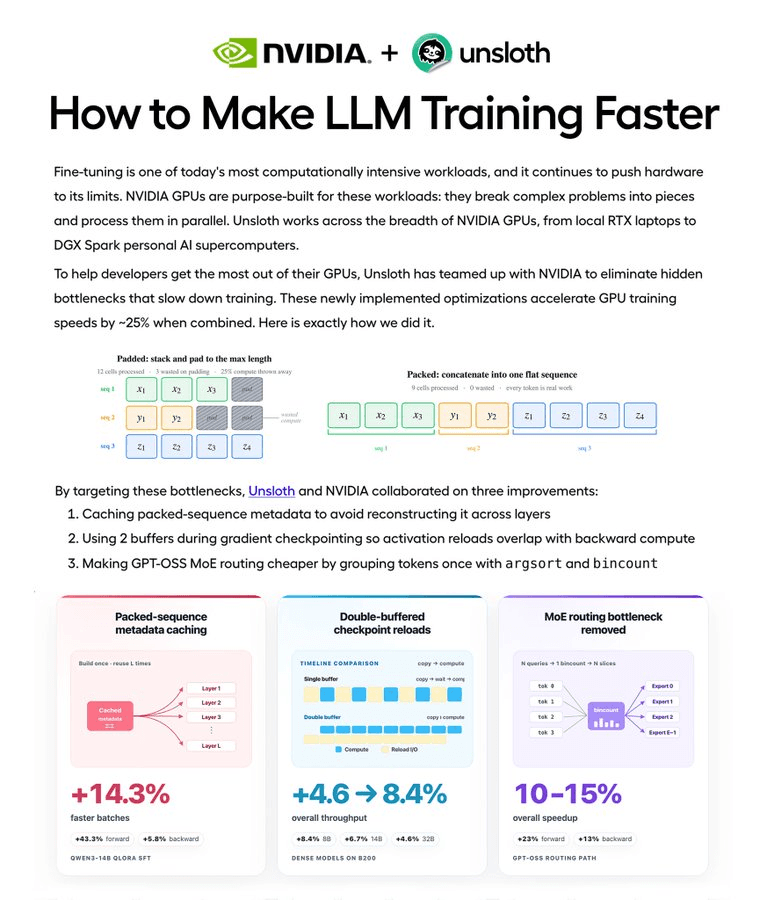
Daniel & Michael Han at Unsloth, in collaboration with NVIDIA, published a joint guide quantifying three glue-code optimizations that combine for ~25% faster LLM training on B200 Blackwell hardware. The wins target overhead around the main kernels — caching packed-sequence metadata, double-buffered gradient checkpoint reloads, and a cheaper GPT-OSS MoE router using argsort + bincount. All three are merged via public PRs.
How does the NVIDIA + Unsloth guide make fine-tuning 25% faster?
NVIDIA and Unsloth published a guide with 3 optimizations that make fine-tuning 25% faster: packed-sequence metadata caching, double-buffered checkpoint reloads, and faster MoE routing for GPT-OSS. The guide targets glue-code bottlenecks around kernels.
TL;DR
Three composing wins, ~25% combined: (1) packed-sequence metadata caching — +43.3% forward, +14.3% per batch on Qwen3-14B QLoRA SFT; (2) double-buffered checkpoint reload on B200 — +8.4% on 8B, +6.7% on 14B, +4.6% on 32B; (3) MoE routing rewritten with argsort+bincount — ~10–15% team-validated, +23% forward / +13% backward on the targeted path. PRs merged in unsloth/4243 and unsloth-zoo/534, /535.
Daniel & Michael Han at Unsloth, working with NVIDIA, published a guide on May 6, 2026 that puts hard numbers on three optimizations targeting the glue code between the main GPU kernels in LLM training. Combined, the three accelerate training by ~25% on NVIDIA B200Blackwell. Each is a small, measurable win, and the diagnostic principle behind all three is simple: once the main kernels are fast, the overhead that used to be invisible becomes a meaningful fraction of step time.
Three independently merged optimizations, each with a public GitHub PR.
Targets are post-kernel-tuning overhead (metadata, copy/sync, router cost).
Authors are Daniel and Michael Han (Unsloth); NVIDIA acknowledged for review and engineering support.
The three optimizations, with numbers
1. Packed-sequence metadata caching (PR #4243). When you concatenate variable-length samples into one packed batch, the model still needs boundary metadata — lengths, cu_seqlens, max_seqlen, the SDPA packed mask, and xFormers block masks. The previous code reconstructed all of this per layer. The new code computes it once per packed batch per device and reuses it across the layer stack. The forward pass sees the biggest win because it consumes the metadata most often.
Measured on Qwen3-14B QLoRA SFT: +43.3% forward, +5.8% backward, +14.3% per batch.
“Once the main kernels are fast, the next 25% lives in the glue code — metadata that gets recomputed per-layer, activation reloads that block the backward pass, and routers that re-sort tokens every step.”
2. Double-buffered gradient checkpoint reload (PR unsloth-zoo #534). Gradient checkpointing trades memory for compute by re-running the forward pass during backward. The reload of recomputed activations was previously synchronous — it blocked the backward kernel. The fix uses two buffers so the next reload overlaps with the current backward, hiding the copy under useful compute.
3. Faster GPT-OSS MoE routing (PR unsloth-zoo #535). The MoE router groups tokens by expert assignment. The old path re-sorted tokens with multiple passes; the new path groups once per step using argsort followed by bincount to compute per-expert counts. Applies to any MoE using the native_torch backend.
Measured: ~10–15% in team validation; on the targeted path, +23% forward / +13% backward.
The diagnostic pattern: do less repeated bookkeeping
The post's framing is more useful than any single number. The three wins are not unrelated tricks — they are three instances of the same pattern. Metadata that was the same across layers was being rebuilt per layer. Copies that could overlap with compute were instead serialised. Router work that needed to happen once was happening on every step. As the main kernels (FlashAttention, fused matmul, packed attention) get faster, the proportion of total step time that lives in this kind of overhead grows. The next 25% increasingly lives there, not in the kernels.
How this composes with the broader Unsloth 2026 stack
This sits on top of larger MoE work Unsloth has shipped this year. Hugging Face Transformers v5 brought roughly 6× faster MoE versus v4, and Unsloth's custom Triton grouped-GEMM + LoRA kernels add another ~2× — for an aggregate 12–30× speedup vs. Transformers v4, with >35% VRAM reduction and >6× longer effective context. On B200 with Qwen3-30B-A3B LoRA, the latest stack measures ~1.7× speedup and ~35% better memory efficiency, with savings widening at longer sequences (Unsloth 2026 update).
What to watch
Whether the techniques generalise beyond Unsloth's stack into vanilla Transformers + DeepSpeed or Megatron-LM.
Whether NVIDIA folds the patterns (packed-mask caching, double-buffered checkpoint reload) into NeMo / Megatron-LM by default.
Whether the MoE router rewrite extends beyond GPT-OSS to other open MoE families (Mixtral, DeepSeek-V3, Qwen3 MoE).
AI-assisted reporting. Generated by gentic.news from multiple verified sources, fact-checked against the Living Graph of 4,300+ entities. Edited by Ala SMITH.
Following this story?
Get a weekly digest with AI predictions, trends, and analysis — free.
AI Analysis
The guide's emphasis on glue-code optimization reflects a maturing ML systems landscape. As kernel libraries like cuDNN and Flash Attention approach peak efficiency, the remaining gains come from data movement, scheduling, and metadata handling—areas traditionally overlooked. The 3 optimizations (caching, double-buffering, MoE routing) are not novel individually, but their systematic treatment as a package is valuable. The 25% speedup claim is plausible but needs independent verification; similar patterns in prior work (e.g., NVIDIA's FastMoE, PyTorch's checkpointing) suggest 10-30% gains are achievable. The guide's value lies in its pedagogical clarity, providing bottleneck-fix-benchmark-sanity check for each optimization. This contrasts with vendor white papers that often skip the "why" behind the gains. The main risk is that the guide may be specific to Unsloth's fine-tuning stack, limiting generalizability. However, the principles likely transfer to other frameworks. The source tweet lacks the actual guide content, so the depth and reproducibility of the claims remain unverified.