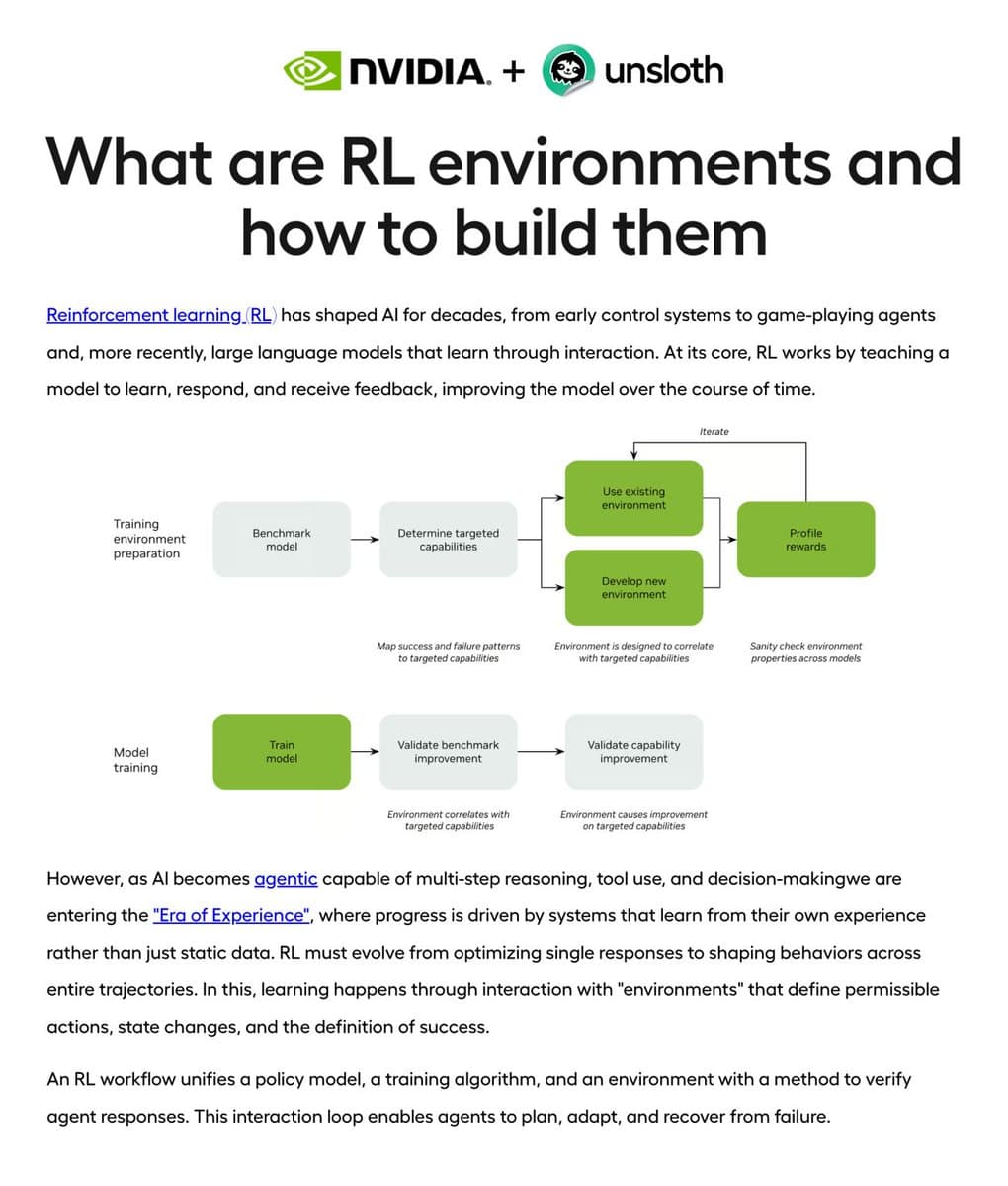
In a significant development for the AI research and development community, NVIDIA in collaboration with Unsloth has released what is being described as one of the most comprehensive and practical guides on building Reinforcement Learning (RL) environments from scratch. The guide, highlighted by AI practitioner Akshay Pachaar, aims to fill the substantial gaps that most introductory tutorials and documentation leave unaddressed, providing a much-needed roadmap for engineers and researchers looking to implement RL solutions effectively.
Why This Guide Matters
Reinforcement Learning represents a powerful paradigm within machine learning where an agent learns to make decisions by interacting with an environment to maximize cumulative reward. However, the practical implementation of RL systems has long been hampered by a steep learning curve, particularly around environment design—the simulated or real-world setting in which the agent operates. Many existing resources focus on algorithmic theory or apply RL to pre-existing, standardized environments (like OpenAI's Gym). This new guide shifts the focus to the foundational step: constructing those environments correctly from the ground up, which is often the make-or-break factor for a project's success.
Core Components of the Guide
Based on the source material, the guide is structured to address several critical, interconnected topics:
1. The Importance and Construction of RL Environments
The guide begins by establishing why RL environments matter. A well-designed environment is not just a container for an agent; it defines the state and action spaces, the reward structure, and the dynamics of interaction. Poor environment design can lead to unstable training, reward hacking (where the agent exploits loopholes to gain reward without achieving the intended goal), or complete failure to learn. The guide provides practical methodologies for building these environments robustly, likely covering aspects like state representation, action discretization, and ensuring the environment is neither too simple nor impossibly complex.
2. RL vs. Supervised Fine-Tuning (SFT): Choosing the Right Tool
A particularly valuable section addresses when RL is a better choice than Supervised Fine-Tuning. SFT, where a model is trained on labeled input-output pairs, is excellent for many tasks like classification or text generation based on examples. RL, however, excels in scenarios requiring sequential decision-making, exploration, and optimization of a long-term objective. The guide likely provides clear heuristics and case studies to help practitioners decide which paradigm fits their problem—preventing the misapplication of RL where simpler methods would suffice.
3. Best Practices: GRPO and Beyond
The guide covers GRPO (Global Reward for Policy Optimization) and other RL best practices. GRPO is a concept related to reward shaping and credit assignment—determining which actions led to a received reward. Best practices in this area are crucial for sample efficiency and stable convergence. This section probably delves into advanced techniques for reward design, policy optimization algorithms, and hyperparameter tuning specific to custom environments.
4. Verifiable Rewards and RLVR
Finally, the guide explores the concept of verifiable rewards and RLVR (Reinforcement Learning with Verifiable Rewards). This is a cutting-edge concern in RL safety and alignment. A "verifiable" reward is one that can be reliably measured and is aligned with the true objective, reducing the risk of reward hacking. RLVR involves frameworks for designing reward functions that are both learnable and verifiable, ensuring the agent's goals are transparent and match the designer's intent—a critical step toward trustworthy and reliable AI systems.
Implications for AI Development
This collaborative guide from an industry giant (NVIDIA) and a specialized AI efficiency company (Unsloth) signals a maturation in the AI toolchain. It moves beyond providing just hardware (GPUs) or algorithmic libraries (like PyTorch) to offering deep, practical knowledge for implementing complex paradigms. For startups, researchers, and enterprises, this lowers the barrier to entry for applying RL to novel problems in robotics, game AI, resource management, and algorithmic trading.
Furthermore, by emphasizing verifiable rewards and best practices, the guide contributes to the broader movement toward responsible and robust AI development. As RL systems are deployed in more real-world, high-stakes scenarios, ensuring their reliability and alignment becomes paramount. This resource provides a foundational step in that direction by educating developers on how to build the training grounds—the environments—with care and foresight.
The release is expected to accelerate innovation in RL applications and serve as an essential reference, bridging the gap between theoretical research and practical deployment. It exemplifies the kind of industry-academia-practitioner collaboration needed to advance the field in a tangible, accessible way.
Source: @akshay_pachaar on X, discussing the NVIDIA and Unsloth guide.