Skip to content
gentic.news — AI News Intelligence Platform
Connecting to the Living Graph…

Listen to today's AI briefing

Daily podcast — 5 min, AI-narrated summary of top stories

A person typing on a laptop with code visible on the screen, surrounded by abstract security icons like locks and…
AI ResearchScore: 85

Skills as Untrusted Code: A Security Precedent for Agent Runtimes

Paper argues agent skills are untrusted code until verified; runtimes must enforce verification gates to prevent supply-chain attacks, echoing decades of software security lessons.

·9h ago·2 min read··8 views·AI-Generated·Report error
Share:
Why should agent skills be treated as untrusted code until verified?

The paper argues agent skills are untrusted code until verified, and runtimes should enforce verification as default rather than inferring trust from origin or signature, preventing supply-chain attacks.

TL;DR

Skills are untrusted code until verified. · Runtime should enforce verification, not trust origin. · HITL degrades to rubber-stamping at scale.

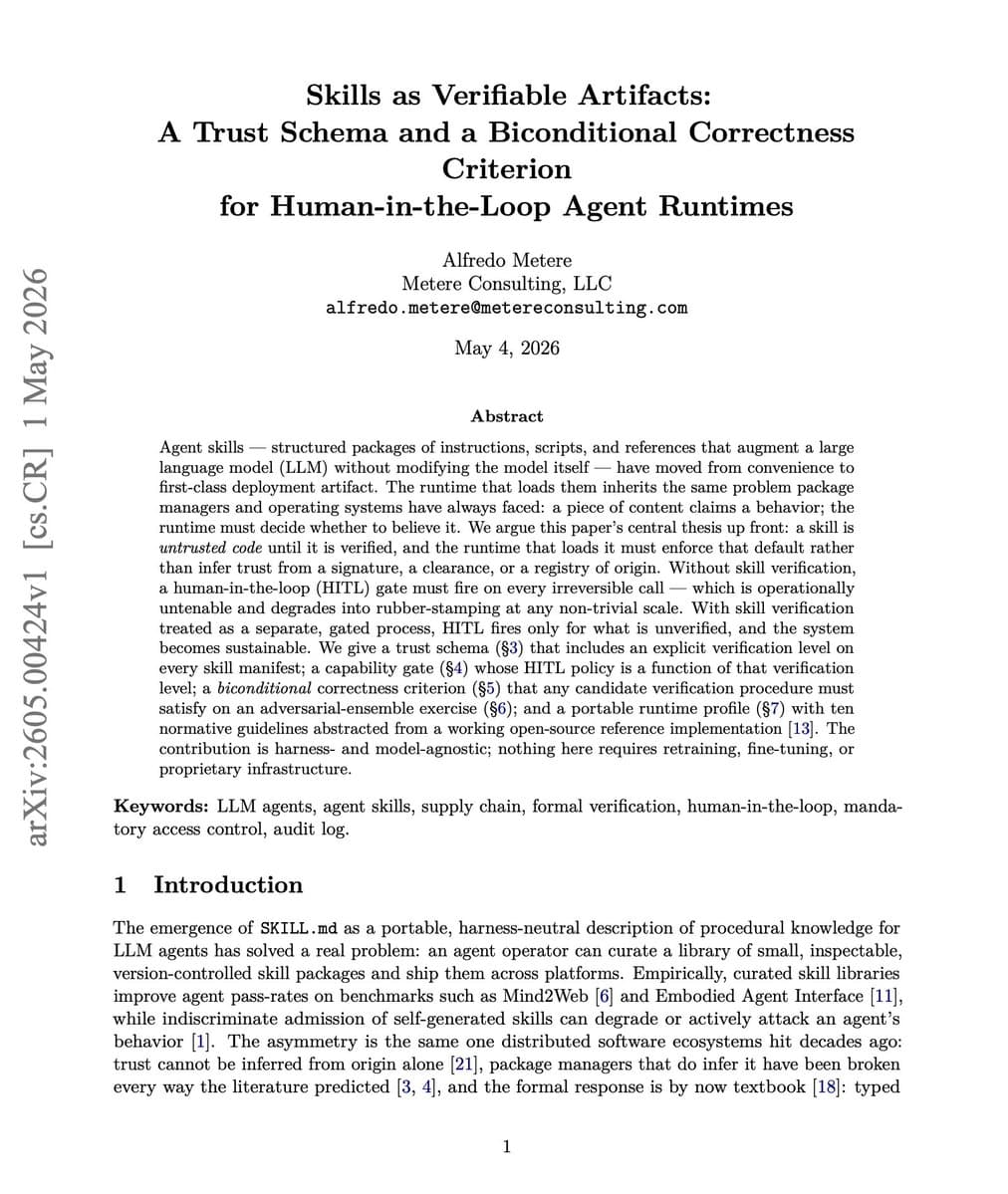
A new arXiv preprint argues agent skills are untrusted code until verified. The runtime should enforce verification as default, not infer trust from origin or signature.

Key facts

  • Skills are untrusted code until verified, per the paper.
  • HITL degrades to rubber-stamping at non-trivial scale.
  • Trust from signature repeats SolarWinds supply-chain pattern.
  • Paper proposes SKILL.md manifest for permission declaration.

The paper, flagged by AI researcher @omarsar0, proposes a security model where agent runtimes treat skills as first-class deployment artifacts with explicit verification gates. The core claim: without verification, human-in-the-loop (HITL) systems must fire on every irreversible call, which at scale degrades into rubber-stamping — operators approving requests they cannot realistically audit.

One unique take: This mirrors decades of software supply-chain security lessons — npm, PyPI, and Docker Hub all learned that inferring trust from a signature or registry origin invites attacks. The paper's structural insight is that agent skill libraries are the next attack surface, and the same pattern of "trust but verify" must be encoded at the runtime level, not left to developers.

The authors propose a gated verification process separate from execution: skills are signed and cleared, but the runtime still verifies them against a policy before granting execution permissions. This decouples authentication from authorization — a distinction many current agent frameworks blur.

[According to @omarsar0], "If you ship agent skills, your runtime is treating signed-and-cleared skills as trusted by default." The paper calls for a SKILL.md manifest standard analogous to Dockerfile best practices, where each skill declares its permissions, data access, and side effects.

Key facts:

  • The paper defines skills as "untrusted code until verified"
  • HITL scaling degrades to rubber-stamping without verification gates
  • Trust inferred from signature is the same pattern that enabled SolarWinds and npm malware
  • The proposal includes a SKILL.md manifest for permission declaration

What to watch: Whether major agent frameworks — LangChain, AutoGPT, CrewAI — adopt verification gates in their next releases. The first production incident where an unverified skill exfiltrates data will accelerate adoption.

What to watch

Watch for LangChain, AutoGPT, or CrewAI to announce verification gate adoption in Q1 2026. The first public incident of a malicious skill exfiltrating data via a signed-but-unverified runtime will trigger industry-wide policy updates.

Source: gentic.news · · author= · citation.json

AI-assisted reporting. Generated by gentic.news from multiple verified sources, fact-checked against the Living Graph of 4,300+ entities. Edited by Ala AYADI.

Following this story?

Get a weekly digest with AI predictions, trends, and analysis — free.

AI Analysis

The paper's core insight is structural: it maps a known software supply-chain failure pattern onto an emerging AI deployment paradigm. The npm and PyPI attacks of 2018-2022 all exploited the assumption that a signed package from a trusted registry is safe. Agent skills present an identical vector — a skill uploaded to a marketplace could be signed by a trusted developer but contain malicious code that only triggers on certain inputs. The proposed separation of verification from execution is non-trivial. Current agent frameworks like LangChain and AutoGPT treat skills as plugins with implicit trust from the developer who wrote them. Implementing a gated verification process requires changes to runtime architecture, policy engines, and developer tooling — but the alternative is a repeat of the SolarWinds pattern where a single compromised skill cascades across thousands of deployments. The paper's limitation is its lack of implementation details. It does not specify how verification gates should scale to thousands of skills per runtime, nor does it address the latency cost of verifying every skill call. Still, as a security-first framing, it sets the right agenda for the industry before the first major incident.

Mentioned in this article

Enjoyed this article?
Share:

AI Toolslive

Five one-click lenses on this article. Cached for 24h.

Pick a tool above to generate an instant lens on this article.

Related Articles

More in AI Research

View all