What Happened
A new technical guide published on Medium tackles a common but under-discussed challenge in AI development: fine-tuning a large language model (LLM) with severely limited computational resources. The article, "Fine-Tuning an LLM on a 4GB GPU: Design Decisions, Trade-offs, and Real Constraints," moves beyond tutorials that assume access to high-end A100/H100 GPUs or unlimited cloud credits. It provides a roadmap for engineers and developers working with consumer-grade hardware, such as an NVIDIA GTX 1650 or a low-memory cloud instance.
The core premise is that effective fine-tuning is possible under these constraints, but it requires a series of deliberate, informed trade-offs. The guide walks through the critical decision points, from the initial selection of a base model to the final training loop configuration.
Technical Details: The Constraint-Driven Stack
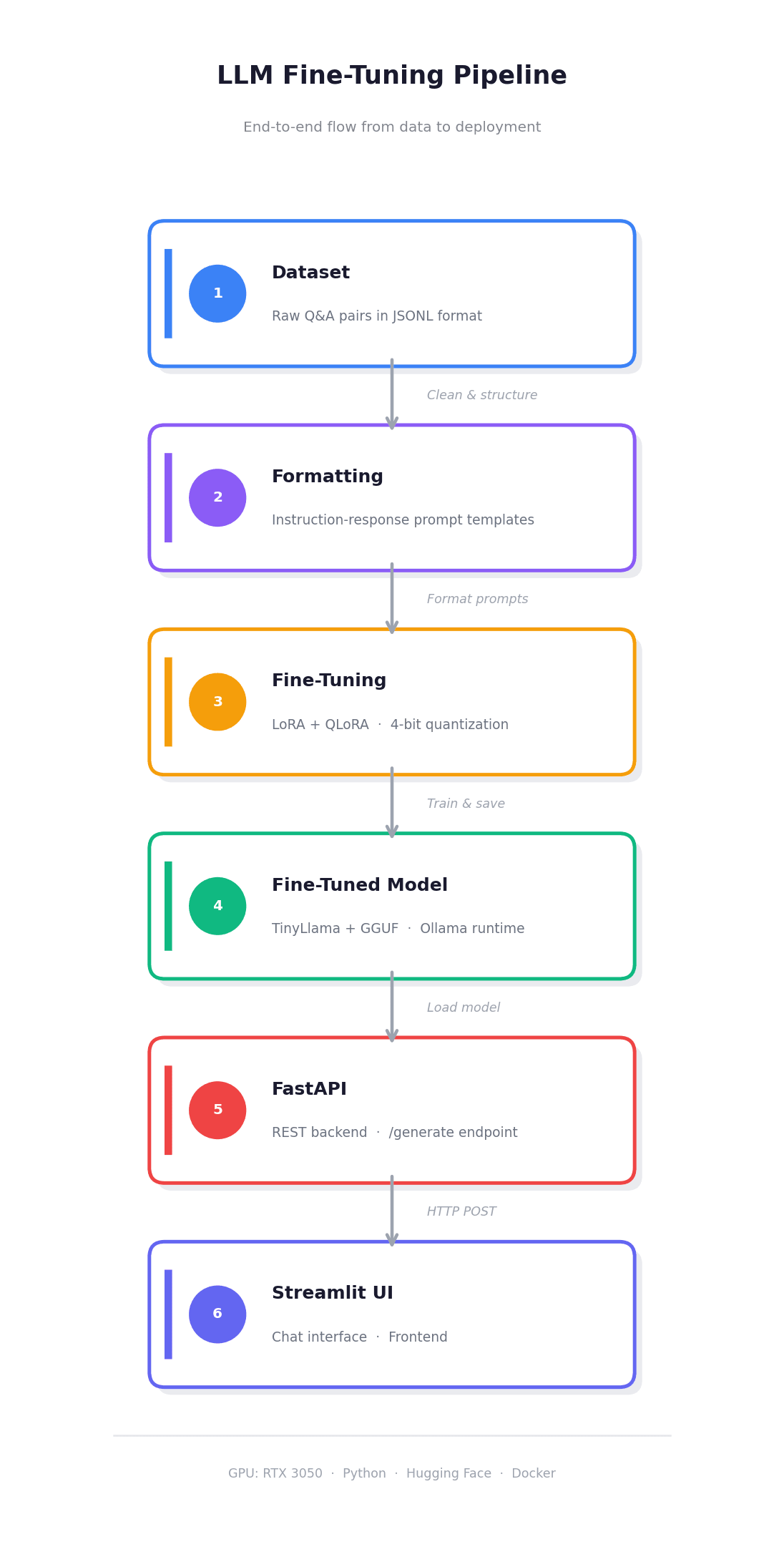
The author outlines a multi-layered strategy to fit a meaningful fine-tuning task into 4GB of GPU VRAM. The approach is a combination of model selection, compression, and parameter-efficient training techniques.
- Model Selection: The first and most critical step is choosing a suitably small base model. The guide likely advocates for models in the 1-3 billion parameter range (e.g., Phi-2, Gemma 2B, StableLM 3B) rather than attempting to shrink a 7B or 13B model. Starting small is non-negotiable.
- Quantization: To further reduce the memory footprint, the model weights must be quantized. This involves converting the standard 32-bit or 16-bit floating-point numbers (FP32/FP16) to lower-precision formats like 8-bit integers (INT8) or even 4-bit (NF4). Tools like
bitsandbytesare essential here. The guide would detail the trade-off: quantization saves massive amounts of memory but can introduce a slight degradation in model performance and stability. - Parameter-Efficient Fine-Tuning (PEFT): Instead of updating all billions of parameters (full fine-tuning), the method relies on techniques like LoRA (Low-Rank Adaptation) or QLoRA (Quantized LoRA). These methods train only a small set of additional, low-rank matrices that are injected into the model layers, leaving the vast majority of the original, quantized weights frozen. This drastically reduces the number of trainable parameters and the required memory for storing optimizer states.
- Gradient Accumulation and Micro-Batching: With limited VRAM, the batch size—the number of training examples processed at once—must be tiny, often 1. To simulate a larger batch size for stable training, the guide would explain the use of gradient accumulation. This involves running several forward/backward passes (micro-batches) and accumulating the gradients before updating the model weights.
- Optimizer Choice: Memory-efficient optimizers like 8-bit Adam are preferred over standard Adam, as they quantize the optimizer states, providing another significant memory saving.
The article's value is in synthesizing these techniques into a coherent, step-by-step pipeline and honestly discussing the compromises: slower training times, potential precision loss from aggressive quantization, and the practical limits on model size and task complexity.
Retail & Luxury Implications
For retail and luxury brands, this technical deep dive is not about a new customer-facing feature, but about democratizing the development of proprietary AI capabilities. The high cost of cloud GPU clusters (often $10-$100+ per hour) is a major barrier to experimentation and iteration for in-house AI teams, especially when exploring niche, domain-specific applications.
This guide provides a viable path to low-cost prototyping and development. Potential use cases that could be explored on a constrained budget include:
- Bespoke Copywriting Assistants: Fine-tuning a small model on a brand's historical campaign copy, product descriptions, and tone-of-style guides to generate on-brand marketing snippets.
- Internal Knowledge Q&A: Creating a specialized assistant that answers complex queries about internal processes, supplier codes, or fabric care instructions by learning from internal wikis and manuals.
- Customer Feedback Tagger: Training a model to classify customer service emails or product reviews into specific, brand-relevant sentiment and issue categories beyond generic positive/negative labels.
- Personalization Experiments: Prototyping next-product-to-buy or content recommendation models tailored to a brand's unique customer journey data.
This approach allows technical teams to validate the value of a fine-tuned model for a specific business problem with minimal financial risk before scaling to larger models and infrastructure for a production deployment. It turns fine-tuning from a capital-intensive project into a more accessible R&D activity.
gentic.news Analysis
This article is part of a clear and valuable trend on Medium of publishing intensely practical, production-focused AI engineering content. This follows Medium's recent publication of guides on identifying 'agent washing,' comparing prompt engineering, RAG, and fine-tuning, and warning about RAG deployment bottlenecks. The platform is establishing itself as a key source for technical implementation knowledge that bridges academic research and real-world deployment, a gap we frequently highlight at gentic.news.
The guide's focus on constraints directly connects to themes in our recent coverage, such as "Stop Shipping Demo-Perfect Multimodal Systems" and "The AI Agent Production Gap." It addresses a fundamental production challenge: cost and resource accessibility. While much AI discourse focuses on the capabilities of frontier models, the practical reality for most enterprise teams involves making strategic compromises to deliver value within budget.
Furthermore, the technique of QLoRA (Quantized LoRA) mentioned is a cornerstone of the current cost-effective fine-tuning ecosystem. Its relationship with Retrieval-Augmented Generation (RAG) is complementary, not competitive. As covered in our decision framework "When to Prompt, RAG, or Fine-Tune," fine-tuning (especially with these efficient methods) is ideal for teaching a model a new style, format, or specialized domain knowledge, whereas RAG is best for incorporating dynamic, external facts. A retail brand might use the 4GB GPU method to fine-tune a model on its brand voice, then deploy it in conjunction with a RAG system that pulls real-time inventory and product data.
Trend Context: The knowledge graph shows large language models and LLMs have been mentioned in over 12 and 15 articles this week respectively, indicating relentless focus and rapid evolution in the field. This guide is a necessary counterpoint to that scale, focusing on accessibility and practical application—a signal that the technology is maturing beyond just the largest players.