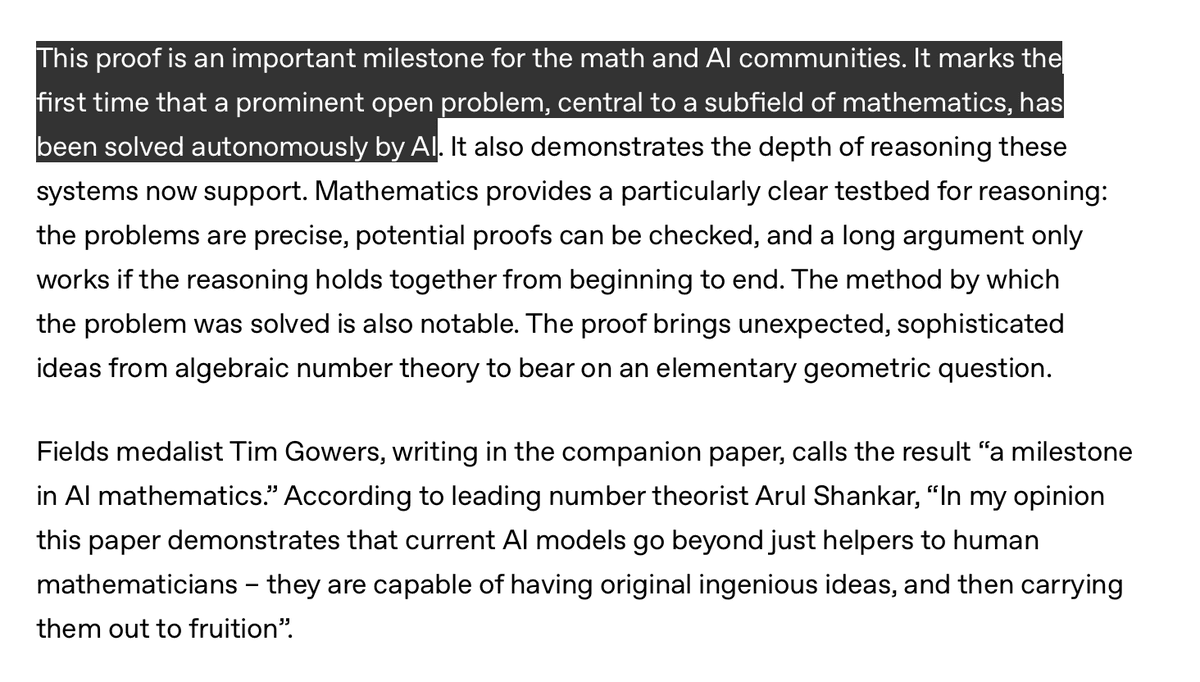
OpenAI's internal reasoning model disproved a 1946 Erdős conjecture, marking the first time AI solved an open research problem independently. Fields Medalist Tim Gowers called it 'a milestone in AI mathematics.'
Key facts
- Problem: 1946 Erdős conjecture on point distances.
- First AI to autonomously solve open research problem.
- Proof uses algebraic number theory, class field towers.
- Verified by Fields Medalist Tim Gowers.
- Beat square grid by fixed polynomial factor.
OpenAI made history today with an internal reasoning model that autonomously disproved a famous conjecture in mathematics that stood for nearly 80 years. The problem, posed by Paul Erdős in 1946, asked how many pairs of points can be exactly 1 unit apart when n points are placed on a flat surface. The best known answer came from square grid constructions, and Erdős himself conjectured you couldn't do meaningfully better.
The AI proved him wrong. It found entirely new point configurations that beat the square grid by a fixed polynomial factor, not a marginal improvement, a real mathematical gap. The proof uses methods from algebraic number theory, including class field towers and Golod-Shafarevich theory—tools nobody expected to be relevant to a geometry problem about distances in the plane [According to @kimmonismus].
Fields Medalist Tim Gowers called it 'a milestone in AI mathematics.' The proof was verified by leading external mathematicians. According to OpenAI, this is the first time AI has independently solved a prominent open research problem in mathematics.
Unique Take: The significance isn't just solving a 1946 problem—it's the cross-domain connection. The AI applied algebraic number theory to a geometry problem, finding a path experts didn't prioritize because it violated disciplinary silos. This mirrors AlphaGo's 'move 37'—a move so unexpected it seemed wrong until proven brilliant.
Caveat: OpenAI chose which problems to test the model on. So 'autonomous' means the model generated the idea and wrote the proof, not that it wandered into the problem on its own. Still, if reasoning models can reliably make cross-domain connections like this, it changes research far beyond math—biology, physics, materials science, medicine.
This isn't AI reproducing human knowledge anymore. This is AI producing new knowledge. That's a qualitative shift.
Key Takeaways
- OpenAI reasoning model disproves 1946 Erdős conjecture, first AI to solve open math problem.
- Cross-domain proof verified by Gowers.
What to watch
Watch for OpenAI to release the model's full proof and methodology, likely in a preprint within weeks. The key metric: whether the model generalizes to other unsolved problems in number theory or geometry, and whether external labs replicate the result.