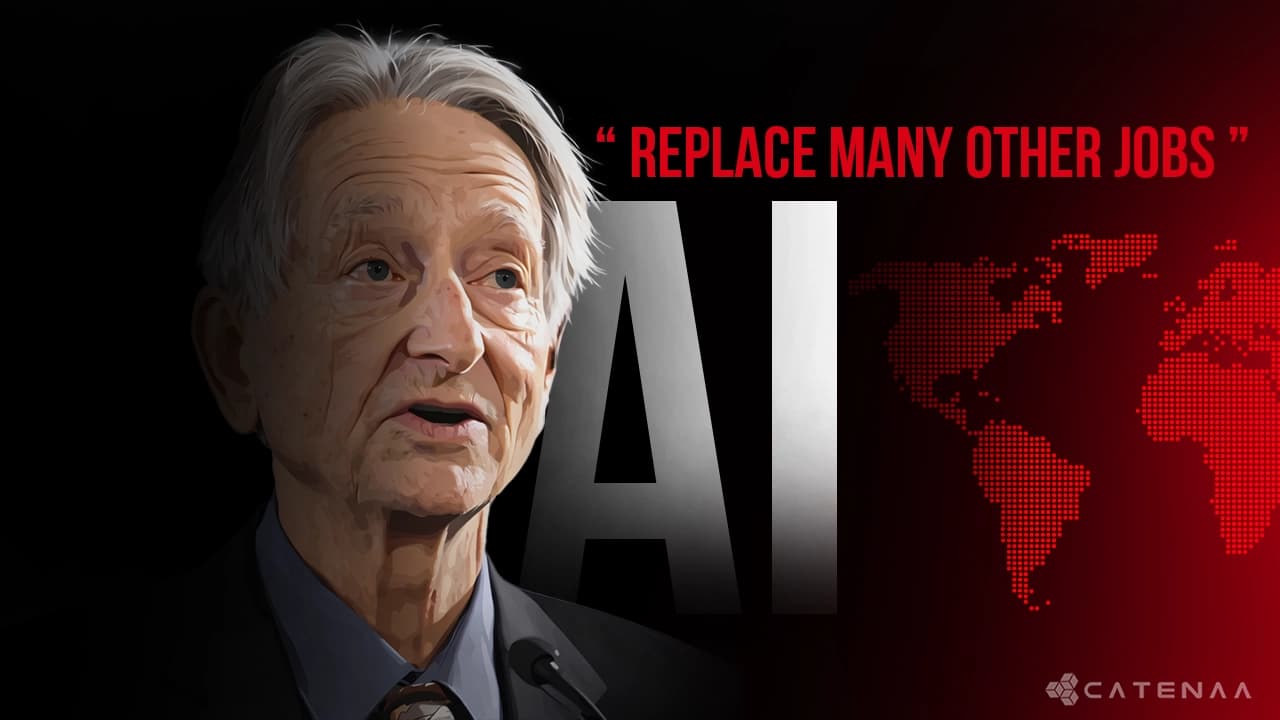
In a concise but significant statement, AI pioneer Geoffrey Hinton has articulated a core economic concern surrounding artificial intelligence: its potential to disrupt the historical pattern of technological job displacement.
What Hinton Said

Hinton's argument, shared via social media, is a direct challenge to a common historical analogy used to assuage fears about AI-driven automation. He states:
"History’s tech revolutions replaced one job with another. e.g. Tractors replaced farm jobs with factories & office jobs. But AI will break that cycle, because AI can replace both physical+intellectual labor."
The core claim is that AI represents a qualitatively different kind of automation. Past mechanization (like tractors) automated physical, often manual, labor. This displaced workers from one sector (agriculture) but created demand for different skills in new sectors (manufacturing, clerical work). The displaced could, in theory, retrain and move.
Hinton posits that AI, particularly advanced machine learning and robotics, automates both ends of the spectrum—the physical labor handled by tractors and the intellectual, cognitive, and clerical labor that characterized the replacement jobs. If a technology can perform both the manual task and the analytical, creative, or administrative task that follows, the historical "safety valve" of new job creation in a different domain may not function.
Context of the Warning
This warning is not Hinton's first. Since his high-profile departure from Google in 2023, citing concerns over the existential risks of AI, he has become one of the field's most prominent cautionary voices. His current statement refines a long-standing economic debate about AI's labor market impact, moving it from quantitative predictions of job numbers to a qualitative argument about the nature of the displacement.
It directly counters optimistic narratives that suggest AI will be a "net job creator" in the long run, similar to the Industrial Revolution or the rise of personal computing. Hinton's point is that the analogy fails because the substrate of the automation is different: it's general-purpose cognitive capability, not a specific physical tool.
The Immediate Implications

For technologists and business leaders, Hinton's framing sharpens the focus on two concurrent challenges:
- The Scope of Automation: Development is no longer targeting isolated tasks (driving, document review) but integrated workflows that combine perception, reasoning, and physical action.
- The Pace of Displacement: If displacement occurs across multiple job categories simultaneously—from warehouse pickers to paralegals to junior analysts—the social and economic systems for retraining and transition could be overwhelmed.
The statement lacks specific policy prescriptions but implicitly raises the stakes for discussions around universal basic income, accelerated education models, and the definition of work in an age of artificial general intelligence (AGI).
gentic.news Analysis
Hinton's concise argument crystallizes a concern that has been building at the intersection of AI capability and labor economics for several years. It aligns with research from institutions like OpenAI and McKinsey, which have modeled widespread automation potential across high-wage, cognitive roles previously considered safe. However, Hinton elevates it from a probabilistic forecast to a structural claim about technological history.
This perspective gains weight when viewed alongside the rapid commercialization of AI agents. As we covered in our analysis of Cognition AI's Devin, the target is not just assisting programmers but potentially replacing entry-level software engineering tasks. Similarly, the push for embodied AI and robotics, from companies like Figure AI (which recently partnered with BMW) and 1X Technologies, aims directly at physical service and logistics jobs. Hinton's warning is effectively that these two vectors—cognitive and physical automation—are converging, powered by the same underlying transformer and diffusion model architectures.
The historical pattern he references—the shift from agricultural to industrial to service economies—depended on human labor retaining a comparative advantage in some domain (initially dexterity, later analysis). If AGI or highly capable narrow AI erodes that advantage across most domains, the economic transition mechanism breaks down. This isn't a prediction of mass unemployment per se, but a warning that the market mechanisms which solved past transitions may be insufficient. It places greater onus on policymakers and technology architects to proactively design systems—both economic and technical—with this unprecedented displacement scope in mind.
Frequently Asked Questions
What did Geoffrey Hinton actually say about AI and jobs?
Geoffrey Hinton stated that unlike past technological revolutions (like tractors), which replaced one type of job (farm work) with another (factory/office work), AI will break this cycle because it can replace both physical labor and intellectual labor simultaneously, leaving no clear "new" domain for displaced workers to move into.
Is Geoffrey Hinton predicting mass unemployment from AI?
Hinton's statement is a structural argument about the nature of AI-driven displacement, not a specific prediction of unemployment rates. He is arguing that the historical economic model where technology destroys jobs in one sector but creates them in another may not hold true for AI, as it automates the very cognitive skills needed for the new jobs. This implies a much more challenging transition unless new economic and social policies are developed.
How does this differ from other warnings about AI and automation?
Many analyses focus on the number of jobs potentially affected. Hinton's warning is more fundamental: it's about the mechanism of economic adaptation failing. Previous automation created demand for new human skills (e.g., operating machines, managing information). If AI can learn and perform those new skills itself, the cycle of job replacement stalls. This aligns him with thinkers concerned about "long-term unemployment" due to a mismatch between human capabilities and what the market values.
What has Geoffrey Hinton done since leaving Google?
Since leaving Google in 2023, where he cited concerns about the risks of AI, Geoffrey Hinton has become a full-time public intellectual and advocate for responsible AI development. He has given numerous interviews, testified before governments, and engaged in public debates to warn about existential risks, misuse potential, and—as in this case—profound socioeconomic disruption from advanced AI systems.