Listen to today's AI briefing

Daily podcast — 5 min, AI-narrated summary of top stories

The 3,167-Line Function: What Claude Code's Leaked Source Teaches Us About
AI ResearchScore: 80

The 3,167-Line Function: What Claude Code's Leaked Source Teaches Us About

A leak of Claude Code's own source code shows the pitfalls of AI-generated code without strict architectural prompting. Learn how to avoid creating unmaintainable mega-functions.

GAla Smith & AI Research Desk·8h ago·4 min read·4 views·AI-Generated
Share:
Source: techtrenches.devvia hn_claude_code, devto_claudecodeCorroborated

The Leak: A Case Study in AI-Generated Architecture

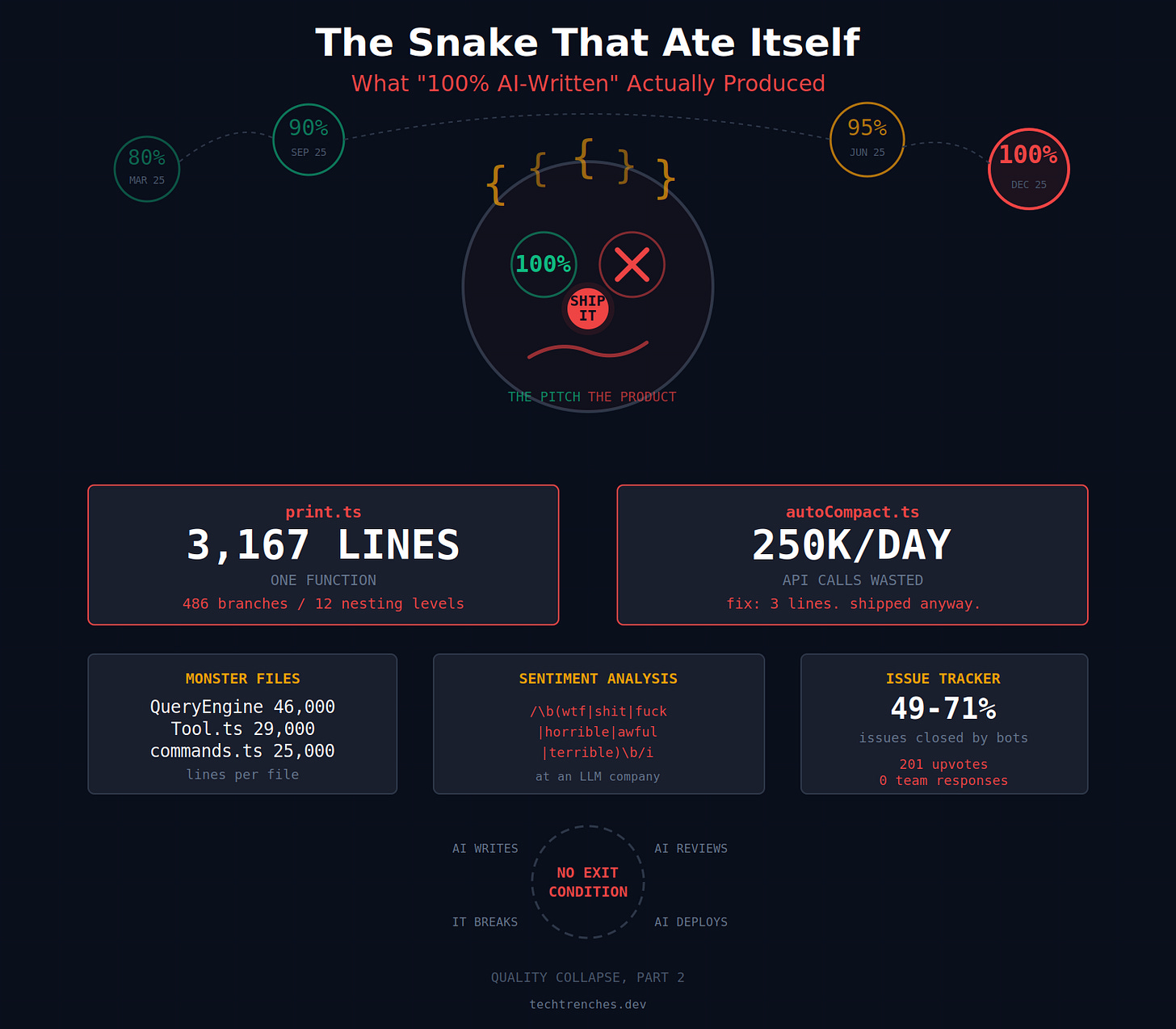
In March 2026, a packaging error exposed over 512,000 lines of Claude Code's own TypeScript source. The most striking artifact was a single function in print.ts spanning 3,167 lines. This monolithic block contained the agent run loop, SIGINT handling, rate limiting, AWS authentication, MCP lifecycle management, plugin loading, and more—concerns that should be separated across 8-10 modules.

This wasn't a bug; it was the direct output of an AI engineering process. As lead engineer Boris Cherny had tweeted months prior, "100% of my contributions to Claude Code were written by Claude Code." The leak provided a raw, unfiltered look at what that 100% AI-generated codebase can produce without strict human architectural guidance.

Why This Happens with AI Coding Assistants

Claude Code, like other AI coders, excels at local reasoning but struggles with system-level architecture unless explicitly guided. When given a broad task like "implement the print functionality," it will generate a complete, working solution. Without prompts enforcing modularity, it defaults to the path of least token resistance: one continuous stream of code.

This follows Anthropic's previous public statements about AI-written code percentages, which escalated from "70-90%" in September 2025 to "effectively 100%" by February 2026. The ambiguity in these metrics—whether measuring lines, commits, or effort—masked the architectural quality questions now revealed by the leak.

How To Avoid This in Your Own Workflow

1. Enforce Modularity in Your Prompts

Never ask for a complete feature. Instead, prompt for a system design first, then implement piece by piece.

Bad Prompt:

Write a function to handle printing with authentication, rate limiting, and error recovery.

Good Prompt:

Design a modular system for document printing with these components:
1. Authentication service
2. Rate limiter
3. Print job queue
4. Error handler with retry logic
5. Main print orchestrator

First, show me the TypeScript interfaces and module relationships. Then we'll implement each component separately.

2. Use CLAUDE.md to Set Architectural Standards

Add these lines to your project's CLAUDE.md:

## Architecture Rules
- No function may exceed 150 lines
- Maximum nesting depth: 4 levels
- Each module must have a single responsibility
- Use dependency injection for testability
- Document module boundaries before implementation

## When Implementing Features
1. First propose module decomposition
2. Get approval on the design
3. Implement smallest module first
4. Review before proceeding

3. Implement Code Review Gates

Even with 100% AI-generated code, you need human review at architectural boundaries:

# Review module structure before implementation
claude code "Review this module design for separation of concerns:
$(cat design.md)"

# Implement in small chunks
claude code "Implement only the RateLimiter class from the approved design"

4. Leverage MCP Servers for Analysis

Install MCP servers that enforce code quality:

# Code complexity analyzer
claude mcp install code-complexity

# Dependency graph visualizer  
claude mcp install dependency-mapper

These tools can flag mega-functions before they reach your codebase.

The Takeaway: AI Needs Architectural Handrails

The Claude Code leak demonstrates that AI-generated code without architectural constraints tends toward monolithic structures. This contradicts the clean, modular code we typically see in Claude Code's output for well-structured projects. The difference is in the prompting and constraints.

Your role as a developer using Claude Code isn't to write less code—it's to provide better architectural direction. The AI will follow the boundaries you set. No prompt should be without modularity requirements, size limits, or separation of concerns.

gentic.news Analysis

This leak provides unprecedented insight into AI engineering culture at scale. Following Anthropic's escalating claims about AI-written code percentages throughout 2025-2026, we now see the architectural consequences of pushing those percentages to their limit. This aligns with our previous coverage of "How to Structure CLAUDE.md for Enterprise Codebases"—the need for architectural guardrails becomes critical as AI contribution percentages increase.

The trend toward higher AI code generation percentages (📈) across the industry makes this case study particularly valuable. It shows that metrics like "lines written by AI" can be misleading without quality measures. As competitors like GitHub Copilot and Cursor advance their own AI capabilities, this leak serves as a cautionary tale about the importance of human architectural oversight even in highly automated workflows.

The relationship between engineering leadership (Boris Cherny) and product messaging (Dario Amodei, Mike Krieger) reveals how internal metrics can become external marketing claims without corresponding quality frameworks. For Claude Code users, the lesson is clear: your prompts and CLAUDE.md configurations are the quality framework that prevents your codebase from becoming the next case study.

Following this story?

Get a weekly digest with AI predictions, trends, and analysis — free.

AI Analysis

Claude Code users should immediately audit their prompting patterns. Are you asking for complete features without architectural decomposition? Change your approach: 1. **Add modularity requirements to every feature request**: Start with "Design a modular system for X" rather than "Implement X." 2. **Enforce function length limits in CLAUDE.md**: Add `MAX_FUNCTION_LINES: 150` to your project standards. 3. **Use the /compact flag with architectural reviews**: Before implementing, run `claude code /compact "Review this module design for separation of concerns"` to get focused feedback without unnecessary elaboration. 4. **Implement phased prompting**: Break every feature into design approval → interface definition → component implementation → integration testing phases. These changes will prevent the mega-function pattern from appearing in your codebase while maintaining high AI contribution percentages.

Mentioned in this article

Enjoyed this article?
Share:

Related Articles

More in AI Research

View all