A Show HN project, SDDW, introduces a spec-driven development workflow for Claude Code that decomposes complex tasks into specs and subtasks, clearing context between every step. The approach aims to reduce agent confusion and token consumption on mid-to-large projects where standard plan-then-code modes fail.
Key facts
- SDDW repo: github.com/sermakarevich/sddw
- Decomposes tasks across two dimensions.
- Clears context after every step and subtask.
- Targets mid-to-large projects where plan mode fails.
- Integrates with fleet-of-agents setups.
A developer on Hacker News shared a workflow called SDDW (Spec-Driven Development Workflow) for Claude Code, Anthropic's terminal-based coding agent [According to Show HN]. The core insight: as task complexity crosses a threshold, agents behave "funky" — losing adherence, burning tokens, and hallucinating. SDDW tackles this with a two-dimensional decomposition.
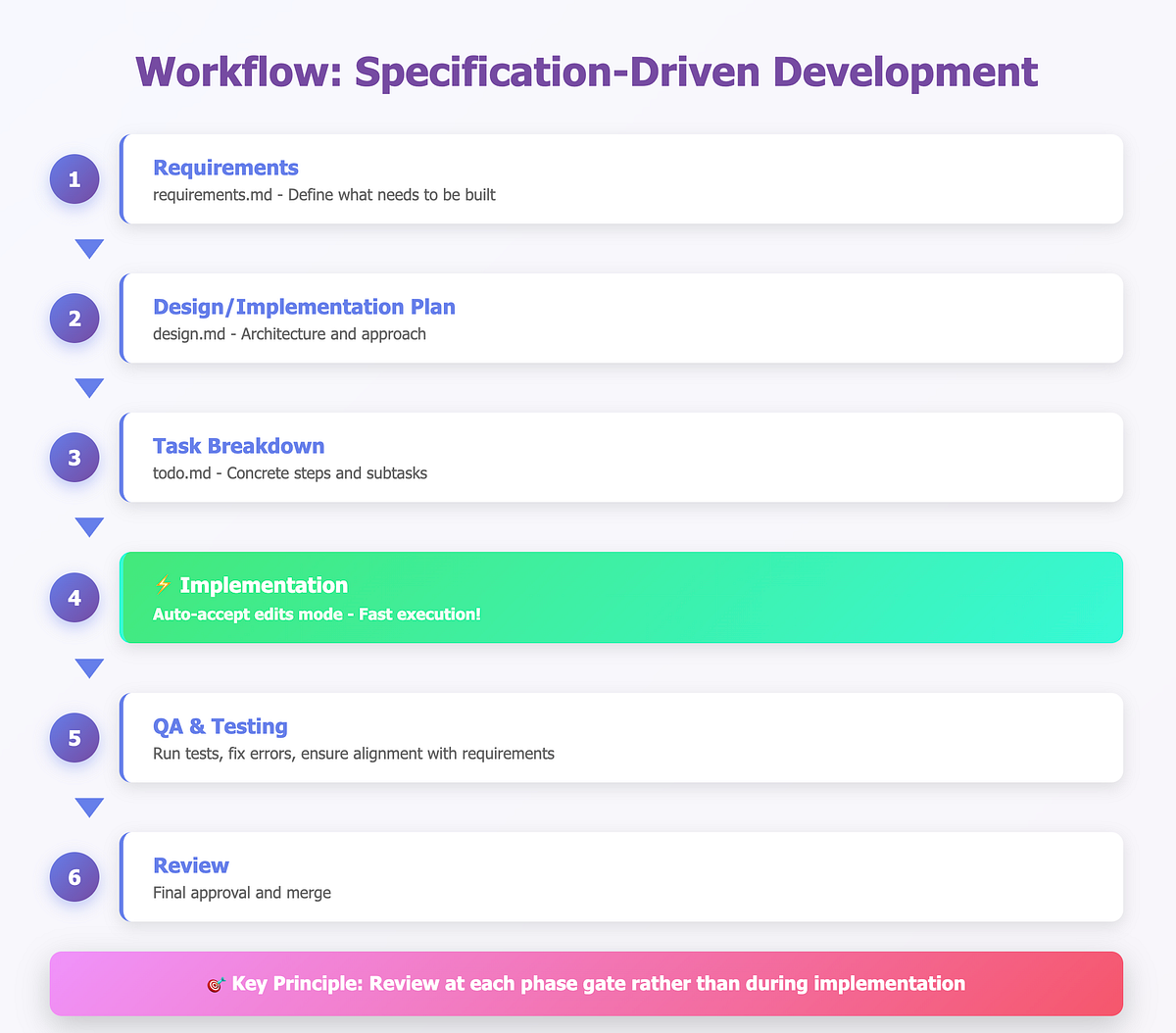
First, the workflow generates specs in multiple steps — requirements, code analysis, design — and writes them to disk for information persistence. Then it splits the implementation into subtasks, executing them one by one. After each spec generation and each subtask implementation, the context is cleared. The author claims this keeps context focused and token costs low, while "delivering specs layer by layer helps to catch early when agent got you wrong."
The author acknowledges measurement is subjective: "when plan mode + code does not work and sdd works (because of double decomposition) — you get what you need." They note token consumption is lower because context is wiped after every step, though the scope to deliver specs is larger.
The repository is available at github.com/sermakarevich/sddw. The author also mentions the workflow integrates with a fleet-of-agents setup [per Hacker News]. Top commenters suggested a preference for working at the "desired-state level" rather than manually operating each intermediate task.
Why this matters
SDDW's approach mirrors a known pattern in AI agent reliability: agent performance degrades with context size and task complexity. By decomposing both the specification and execution dimensions, and aggressively clearing context, SDDW attempts to push the boundary of what agents can reliably handle — without waiting for model improvements from Anthropic or competitors like GitHub Copilot.
Community sentiment
Hacker News discussion was measured, with 19 points and 11 comments. One commenter noted: "I fail to see any backing for claims 'boosting performance' and 'keeping costs low'" — a fair critique the author addressed by linking to slides and noting the subjective nature of measurement.
Comparison to prior art
This isn't the first attempt to structure agent workflows. GitHub Copilot Workspace and Anthropic's own Claude Agent framework offer built-in planning modes. But SDDW's explicit context-clearing and two-dimensional decomposition is unique — most alternatives keep a single context window and rely on the model's internal planning.
What to watch
Watch for whether Anthropic adopts similar context-clearing or task-decomposition patterns in official Claude Code updates, and whether the SDDW repo gains traction beyond a single developer's workflow.