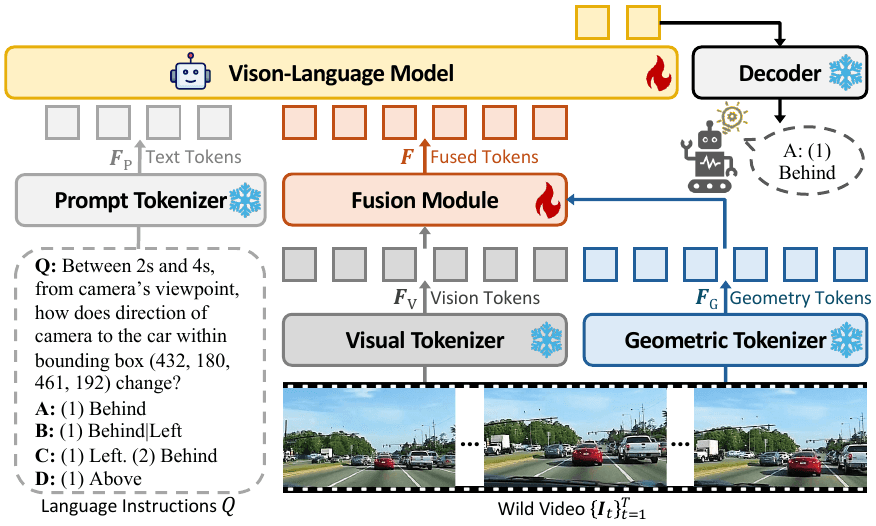
A new research method called GeoSR (Geometry-aware Spatial Reasoning) introduces a novel approach to improving how vision-language models understand spatial relationships. By creating explicit "geometry tokens" and using a gated fusion mechanism to prioritize them, the model overcomes a common shortcut where models rely on 2D visual patterns instead of true 3D spatial understanding. The work achieves state-of-the-art (SOTA) performance on the challenging VSI-Bench and DSR-Bench spatial reasoning benchmarks.
What the Researchers Built
The core problem GeoSR addresses is that current vision-language models (VLMs) often perform spatial reasoning by exploiting superficial 2D correlations in training data, rather than building a robust internal representation of 3D geometry. For example, a model might learn that "the cup is on the table" often corresponds to a specific pixel arrangement, not a true understanding of support relationships in 3D space.
GeoSR's architecture intervenes at the token level. It masks a portion of the standard 2D vision tokens from the input image, deliberately disabling the model's ability to rely on these low-level visual shortcuts. Concurrently, it introduces a new set of geometry tokens, which are designed to encode explicit 3D structural information—such as depth, normals, and spatial layouts—often derived from pre-processing or multi-view inputs.
How It Works: Gated Fusion and Masked Shortcuts
The technical innovation is in how these two streams of information are combined. GeoSR employs a gated fusion mechanism. This is not a simple concatenation; it's a dynamic, learnable system that decides, for any given reasoning task, how much to weigh the geometry tokens versus the remaining (unmasked) visual tokens. The "gate" amplifies the geometry information precisely where it matters most for spatial reasoning, allowing the model to focus on 3D structure when answering questions about "left of," "behind," or "supported by."
By masking the 2D tokens, the researchers force the model to become more reliant on the geometry pathway during training. This encourages the learning of a geometry-centric representation that is more generalizable and less tied to dataset-specific visual biases.
Key Results
The efficacy of GeoSR is validated on two major benchmarks for spatial reasoning:
- VSI-Bench (Visual Spatial Inference Benchmark): Measures a model's ability to perform complex spatial reasoning from images and text.
- DSR-Bench (Dynamic Spatial Reasoning Benchmark): Focuses on reasoning about spatial relationships that may change or involve dynamics.
The paper reports that GeoSR achieves state-of-the-art results on both benchmarks. While the source tweet does not provide specific numerical scores, achieving SOTA on these established benchmarks indicates a significant and measurable advance over previous methods like those based on pure CLIP, BLIP, or even more recent large multimodal models (LMMs) that lack explicit geometric processing.
VSI-Bench State-of-the-Art Surpasses prior VLMs by enforcing geometry-aware reasoning DSR-Bench State-of-the-Art Outperforms models reliant on 2D visual shortcutsWhy It Matters: Beyond Surface-Level Vision
Most state-of-the-art VLMs are trained on massive datasets of image-text pairs, optimizing for broad alignment. This work highlights a fundamental weakness in that paradigm: a lack of grounded, 3D geometric understanding. GeoSR demonstrates that explicit architectural inductive biases—like dedicated geometry tokens and gated fusion—are still crucial for tackling domains that require true spatial cognition.
For practitioners, this points to a future where the most capable multimodal systems may be hybrids, combining the broad knowledge and fluency of web-scale pretrained models with specialized, structurally-aware modules for tasks like robotics manipulation, AR/VR interaction, and embodied AI, where understanding the 3D world is non-negotiable.
gentic.news Analysis
This research taps directly into one of the most active frontiers in multimodal AI: moving from 2D pattern recognition to 3D scene understanding. The trend of augmenting large foundation models with specialized, structurally-grounded modules is gaining momentum. This aligns with work we covered last year on 3D-LLMs like LERF and LLaVA-3D, which aimed to connect language to 3D scenes. However, GeoSR takes a distinct, more fundamental approach by modifying the core tokenization and fusion process within the VLM itself, rather than building a system on top of a frozen model.
The method's success also implicitly critiques the prevailing "scale is all you need" direction. It shows that for specific cognitive capabilities like spatial reasoning, clever architectural design and targeted inductive biases can yield greater gains than simply adding more parameters or data. This is a reminder of the importance of hybrid research strategies in an era dominated by scaling laws.
Looking at the competitive landscape, companies like Google (with its Gemini series and RT-X robotics models) and OpenAI (with GPT-4V's spatial reasoning capabilities) are heavily invested in solving this problem. GeoSR's academic approach of masking shortcuts and fusing geometry provides a clear, interpretable blueprint that these industry labs will likely dissect and potentially incorporate into their next-generation systems. The race is on to build models that don't just see pixels but understand space.
Frequently Asked Questions
What are geometry tokens in AI models?
Geometry tokens are a specialized type of input representation designed to encode explicit 3D information about a scene, such as depth maps, surface normals, or point cloud data. Unlike standard vision tokens that represent patches of RGB pixels, geometry tokens provide a direct, structured description of spatial layout and shape, which is crucial for tasks requiring an understanding of the three-dimensional world.
What is VSI-Bench used for?
VSI-Bench (Visual Spatial Inference Benchmark) is a standardized test suite used to evaluate the spatial reasoning capabilities of vision-language models. It presents models with images and textual questions that require understanding spatial relationships (e.g., "Is the red block to the left of the blue cylinder?"). A model's score on VSI-Bench indicates how well it can perform this type of grounded, geometric reasoning beyond simple object recognition.
How does gated fusion work in neural networks?
Gated fusion is a mechanism that dynamically controls how information from different sources or modalities is combined within a neural network. It uses a learned gating function (often a small neural network or attention layer) to produce a set of weights or coefficients. These weights determine the contribution of each input stream to the final combined representation, allowing the model to emphasize the most relevant information for a given task contextually.
Why is spatial reasoning important for AI?
Spatial reasoning is a core component of general intelligence and is essential for AI systems that interact with the physical world. It is critical for applications in robotics (manipulating objects, navigation), autonomous vehicles (understanding the relative positions of cars and obstacles), augmented reality (placing digital objects in real space), and embodied AI (agents that operate in simulated or real environments). Without robust spatial reasoning, AI systems are limited to 2D pattern matching and cannot achieve true scene understanding.