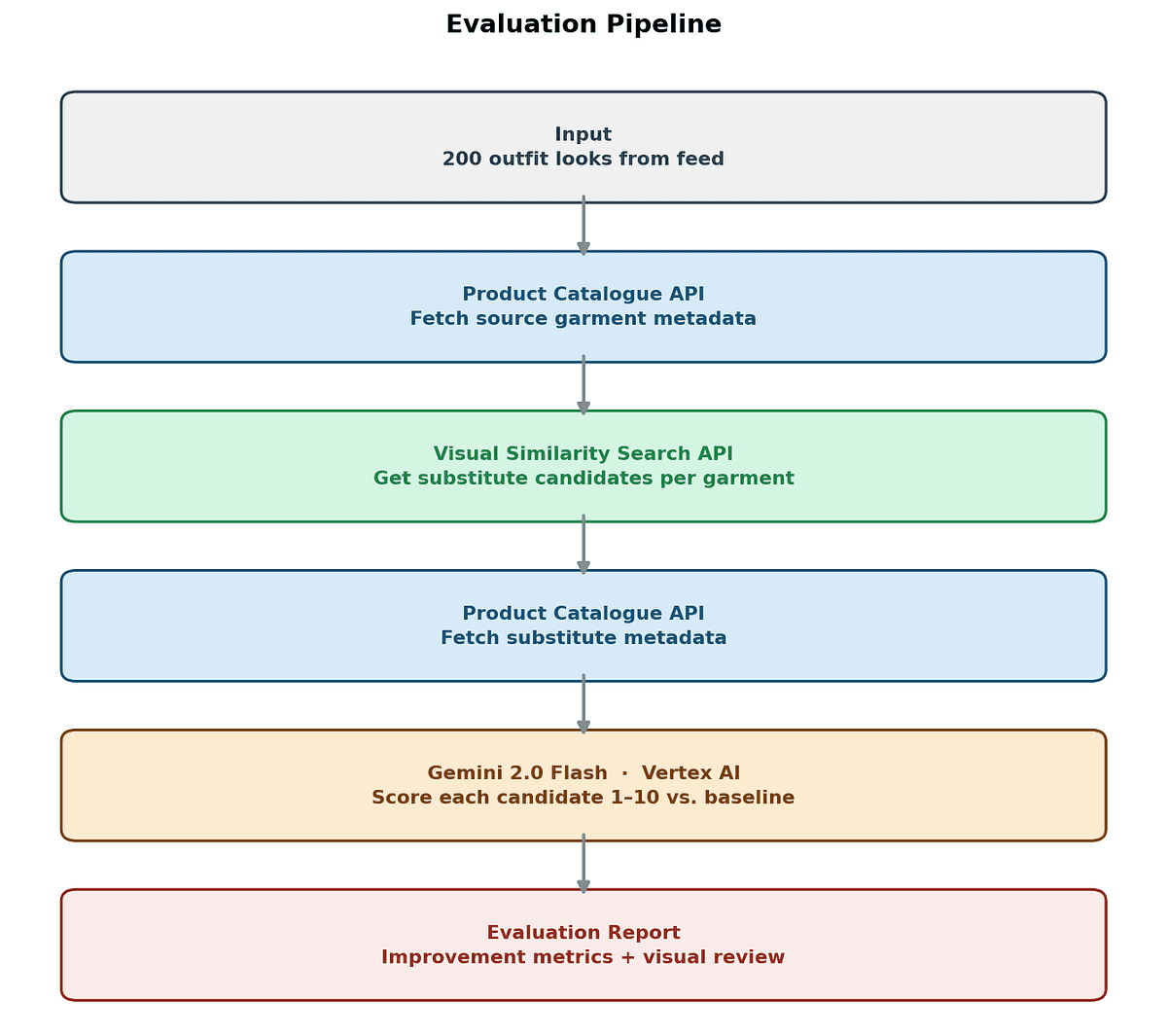
Glance AI built a VTON substitutes pipeline for out-of-stock products, paired with an evaluation pipeline to measure effectiveness. The system generates plausible substitute images when a product is unavailable, targeting e-commerce conversion recovery.
Key facts
- Glance AI built VTON substitutes for out-of-stock products
- Evaluation pipeline measures visual similarity and style coherence
- No benchmark scores or revenue figures disclosed
- Addresses a known but under-addressed e-commerce friction
The approach addresses a common e-commerce friction: a shopper finds a product they like, but it's out of stock. Instead of losing the sale, Glance AI's virtual try-on (VTON) system generates a substitute image — a visually similar item the shopper can try on virtually. The evaluation pipeline was designed to validate that the substitute looks realistic and matches the original product's style, not just any random garment.
The project, detailed in a Medium post by Mohamed Ansar, focuses on the measurement challenge: how do you define 'good' in a substitute? The team built metrics around visual similarity, style coherence, and plausibility. [According to Measuring What “Good” Looks Like in Virtual Try-On Online Shopping] the pipeline uses a combination of image embedding similarity and human evaluation to score outputs.
No benchmark scores or revenue impact figures were disclosed in the Medium post. The post reads as a technical case study rather than a product announcement, suggesting the work is still in internal validation or early deployment.
For context, Glance AI operates in the competitive VTON space alongside players like Zyler and Vue.ai, where out-of-stock substitution is a known but under-addressed problem. Most VTON systems assume a product is available; Glance AI's contribution is handling the negative case.
The unique take
This is not about better VTON fidelity — it's about what happens when the ideal product is gone. The evaluation pipeline is arguably more novel than the generation pipeline itself, because measuring substitute quality requires a ground truth that doesn't exist. Glance AI's approach treats substitution as a retrieval-plus-validation problem, not a pure generation task.
What to watch
Watch for whether Glance AI publishes benchmark results or integrates this pipeline into a live e-commerce platform. If the evaluation methodology is reproducible, it could become a de facto standard for VTON substitutes — a small but sticky niche in the recommender systems landscape.
Key Takeaways
- Glance AI built a VTON substitutes pipeline for out-of-stock products with an evaluation pipeline.
- No benchmark scores disclosed.
What to watch

Watch for whether Glance AI publishes benchmark results or integrates this pipeline into a live e-commerce platform. If the evaluation methodology is reproducible, it could become a de facto standard for VTON substitutes — a small but sticky niche in the recommender systems landscape.