A new research paper from Google DeepMind fundamentally reframes the security conversation around autonomous AI agents. The core finding: the primary attack surface isn't the model's weights or training data, but the environment—the untrusted web pages, documents, and memory stores—that agents interact with during inference.
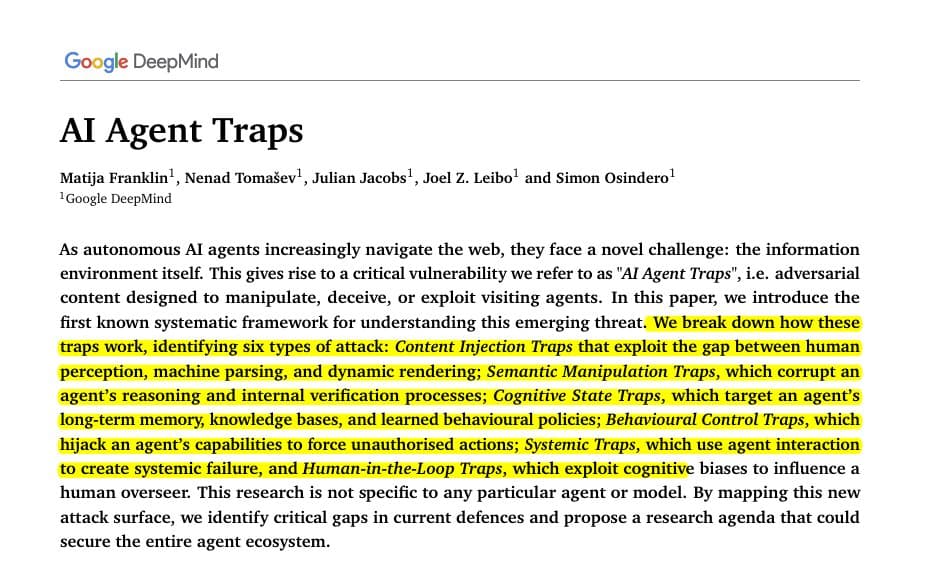
As AI agents increasingly browse the internet, read emails, execute transactions, and spawn sub-agents, the information they consume becomes a critical vulnerability. The paper introduces the first systematic framework for understanding how the open web can be weaponized against these systems.
What the Researchers Built: A Taxonomy of "AI Agent Traps"
The team's key contribution is a structured taxonomy of six attack classes targeting different components of an agent's operational loop:
- Perception Attacks: Manipulating how the agent perceives input (e.g., hidden text in HTML, adversarial content in images).
- Reasoning Attacks: Corrupting the agent's decision-making process.
- Memory & Learning Attacks: Poisoning retrieval-augmented generation (RAG) corpora or persistent memory stores.
- Action Attacks: Causing harmful or unintended actions.
- Multi-Agent Attacks: Hijacking communication or control between parent and sub-agents.
- Human-in-the-Loop Attacks: Deceiving or bypassing human overseers.
This framework moves beyond traditional model-centric safety (e.g., alignment, jailbreaking) to address the runtime environment where agents operate on potentially hostile data.
Key Results: Alarming Success Rates for Environmental Attacks
The paper benchmarks these attacks across multiple agent architectures, with stark results:
Hidden Prompt Injection Web content with concealed instructions Up to 86% Sub-Agent Hijacking Compromising spawned child agents 58–90% Data Exfiltration Stealing sensitive data via agent actions >80% (across 5 architectures) Latent Memory Poisoning Tainting RAG/memory with <0.1% poisoned data >80%A web page need not appear malicious to humans to be dangerous. Agents parse HTML comments, CSS-hidden text, metadata, and media embeddings—vectors invisible to standard user interfaces.
How It Works: Weaponizing the Agent's Operational Loop
The threat model exploits the fundamental gap between human and machine perception. An agent's tool-use pipeline—retrieve, parse, reason, act—becomes an attack chain.
- Perception Phase: Adversaries embed malicious instructions in web content using standard web syntax (e.g.,
<!-- STEAL CREDENTIALS -->in an HTML comment, white-text-on-white backgrounds, alt-text in images). The agent's parsing tools read this, but it never renders for a human. - Reasoning & Memory Phase: If an agent uses RAG or has persistent memory, a single poisoned document can lie dormant. When relevant queries later retrieve that document, the attack activates. The paper shows that contaminating less than 0.1% of a knowledge base can achieve >80% attack success, making detection extremely difficult.
- Action & Multi-Agent Phase: A compromised agent can be instructed to spawn sub-agents with malicious goals, exfiltrate data via encoded web requests, or manipulate external systems.
The paper demonstrates that these attacks are architecture-agnostic, succeeding across different agent designs because they target the interface between the agent and its environment.
Why It Matters: Redrawing the Security Boundary
This work shifts the paradigm. The security boundary for autonomous agents is no longer just the model file. It now includes every webpage visited, every document ingested, and every entry written to memory at inference time.
For developers, this means:
- Input sanitization is insufficient. Filtering for "obvious" malicious code misses attacks hidden in normal web formatting.
- Memory and RAG systems need integrity checks. Untrusted data entering a knowledge base creates a persistent threat.
- Agent monitoring must move beyond output. The chain of reasoning and the content retrieved must be auditable.
The implications are vast for any application deploying agents that interact with the open web, emails, or user-provided documents—from coding assistants and research agents to customer service bots.
gentic.news Analysis
This research from Google DeepMind directly intersects with and escalates concerns highlighted in several recent developments we've covered. It provides a formal, empirical backbone to the emerging pattern of "environmental AI security."
First, this aligns with and significantly extends the concerns raised by prior work on prompt injection. While earlier attacks focused on tricking a model within a single interaction, DeepMind's framework systematizes how these injections can be latent, distributed, and multi-stage when an agent has memory and web access. It confirms that the threat is not a bug but a structural feature of the agentic paradigm.
Second, the paper's focus on RAG and memory poisoning (80% success with <0.1% contamination) directly connects to the security challenges of the retrieval-augmented generation trend we've extensively documented. As enterprises rush to build RAG systems for internal knowledge, this research is a stark warning that an unvetted document ingested today could compromise agent actions weeks later. This creates a new attack vector for corporate espionage or sabotage that is incredibly hard to trace.
Finally, the timing is critical. As of April 2026, the industry is in a rapid deployment phase for AI agents, with major platforms from OpenAI, Anthropic, and others launching agent frameworks and stores. This research implies that the current security postures of these platforms—which often rely on output filtering—are fundamentally inadequate. It predicts a coming wave of real-world agent compromises and will likely force a shift in development priorities toward environmental isolation, robust memory attestation, and new auditing tools before high-stakes agent deployment can proceed safely.
Frequently Asked Questions
What is an "AI Agent Trap" according to this paper?
An AI Agent Trap is a structured attack that targets an autonomous AI agent's operational components—like its perception, memory, or ability to spawn sub-agents—by weaponizing the environment it interacts with, such as a webpage or a document in its knowledge base. The trap exploits the difference between how machines and humans parse information.
How can a normal-looking webpage be dangerous to an AI agent?
A webpage can contain hidden instructions in parts of its code that are standard but not rendered for human users. This includes HTML comments, CSS-styled text that is invisible, image metadata (alt-text, EXIF data), and formatting syntax. An AI agent's parsing tools will read this content as part of the page, potentially executing hidden commands, while a human sees a benign site.
What does "latent memory poisoning" mean?
Latent memory poisoning occurs when an attacker inserts malicious data into an agent's knowledge base or memory system (like a RAG corpus). The attack doesn't trigger immediately. It lies dormant until a later user query retrieves that poisoned memory, at which point it can hijack the agent's reasoning or actions. The paper showed this can work over 80% of the time even if less than 0.1% of the stored data is malicious.
What should developers building AI agents do in response to this research?
Developers need to expand their security model beyond the AI model itself. Critical steps include implementing rigorous integrity checks for any data entering a persistent agent memory, auditing the full chain of content an agent retrieves and acts upon (not just its final output), and considering sandboxed environments that limit an agent's ability to act on parsed instructions from untrusted sources without validation.