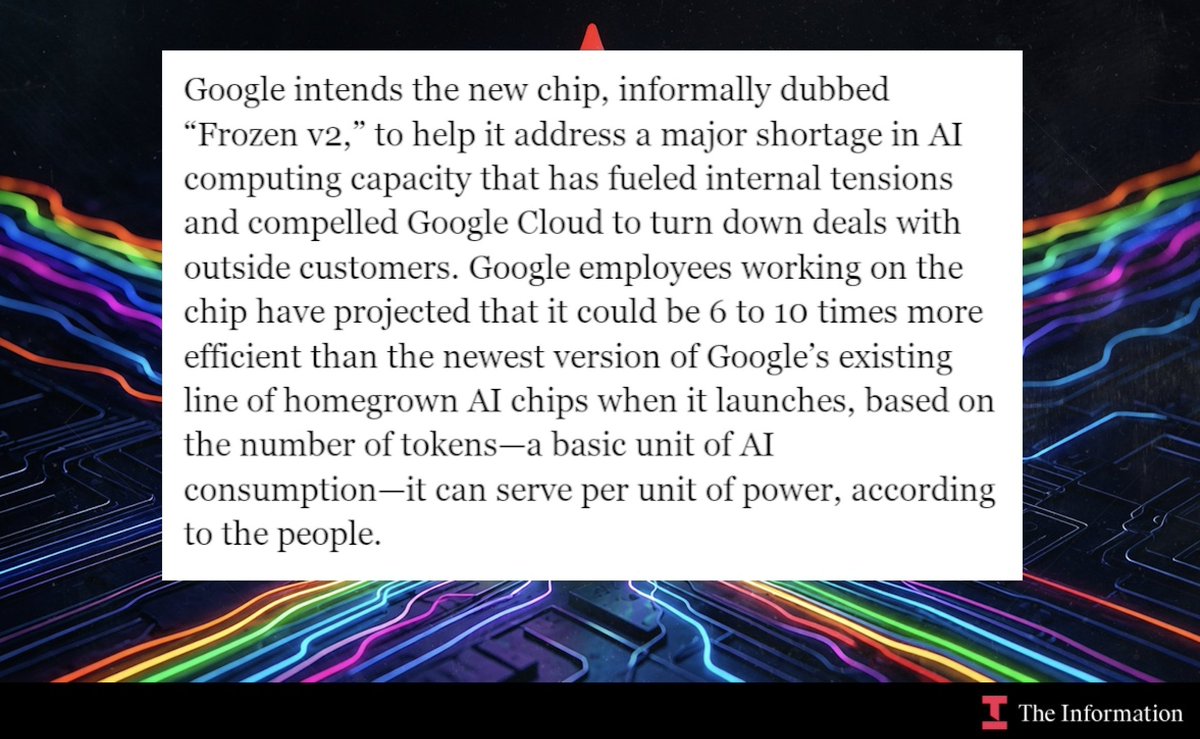
According to a report, Google is in negotiations with semiconductor design company Marvell Technology to jointly develop two new types of AI accelerator chips. The goal is to enhance Google's Tensor Processing Unit (TPU) hardware ecosystem and provide a more competitive alternative to Nvidia's industry-standard GPUs.
Key Takeaways
- Google is reportedly in talks with Marvell Technology to co-develop two new AI chips: a memory processing unit (MPU) to pair with TPUs and a new, optimized TPU.
- This move is a direct effort to bolster Google's custom silicon stack and compete with Nvidia's dominance.
What's Being Developed

The reported collaboration would focus on two specific chips:
A Memory Processing Unit (MPU): This chip is designed to be paired with Google's existing TPUs. Its primary function would be to accelerate memory-bound operations, a common bottleneck in large-scale AI training and inference. By offloading memory management tasks to a dedicated processor, the overall efficiency of a TPU pod could be significantly improved.
A New, Optimized TPU: The second chip would be a new generation or variant of Google's TPU, specifically architected for running AI models. While details are scarce, this suggests a focus on architectural refinements for better performance-per-watt, lower latency, or support for emerging model architectures beyond the current Transformer-heavy workloads.
The Strategic Context: Google's Hardware Ambitions
This move is not an isolated event but a clear step in Google's multi-year strategy to control its AI destiny from silicon to software.
- Reducing Nvidia Dependence: Nvidia's H100 and subsequent GPUs have become the de facto standard for training frontier AI models. By making its TPU stack more capable and attractive—both internally for Google DeepMind and externally via Google Cloud—Google aims to create a viable, high-performance alternative. This provides leverage in procurement and insulates Google from supply chain constraints.
- Vertical Integration for AI: Google's strategy mirrors that of other hyperscalers like Amazon (with its Trainium and Inferentia chips) and Microsoft (designing custom chips with partners). The goal is to tightly couple hardware and software (like the XLA compiler and JAX framework for TPUs) to achieve efficiencies that off-the-shelf GPUs cannot match.
- Why Marvell? Marvell Technology is a major player in custom silicon design, particularly for data infrastructure. It has a proven track record of designing high-performance, low-power chips for cloud and enterprise customers. A partnership allows Google to leverage Marvell's design expertise without bearing the full cost and risk of an entirely in-house development cycle for these specialized components.
What This Means for the AI Hardware Landscape
If finalized, this deal would signal an intensification of the custom silicon race.
- For Cloud Customers: Google Cloud Platform (GCP) could eventually offer new instance types powered by these chips, potentially at a different price-performance point than Nvidia-based instances. The MPU, in particular, could be marketed for memory-intensive workloads like large language model inference or recommendation systems.
- For the Broader Market: It represents another front in the challenge to Nvidia's CUDA ecosystem. While software maturity is a huge hurdle, Google's continued investment in TPUs and its supporting software stack makes the platform increasingly credible for more developers.
- A Focus on System-Level Optimization: The development of a dedicated MPU highlights a shift from just building faster compute chips to optimizing the entire data movement pipeline within a server. Memory bandwidth and latency are critical limiting factors, and addressing them with specialized silicon is a logical next step.
Limitations and Unknowns
The report is based on ongoing talks, meaning a deal is not guaranteed. Furthermore, the development timeline for such complex silicon is measured in years. Even if an agreement is signed today, these chips would likely not be available in production systems until 2027 or later. Key technical specifications, performance targets, and cost structures remain undisclosed.
gentic.news Analysis
This reported move fits squarely into the escalating, multi-front war for AI infrastructure dominance that we have been tracking. It follows Google's established pattern of deepening its custom silicon investments, as seen with the evolution of TPUs from v1 (focused on inference) to the latest v5p (a training and inference powerhouse). However, partnering with Marvell for a memory-centric co-design is a notable tactical shift.
Historically, Google has designed its TPUs largely in-house. Bringing in Marvell—a company with deep expertise in data processing units (DPUs), networking, and custom compute—suggests Google is targeting a specific, complex subsystem (memory hierarchy) where external IP and design experience can accelerate development. This aligns with a broader industry trend we noted in our coverage of AMD's acquisition of Mipsology and Intel's Falcon Shores architecture, where the focus is moving beyond raw FLOPs to solving the data movement problem.
The strategic context is critical. This development directly challenges Nvidia's Grace Hopper superchip architecture, which tightly couples CPU and GPU with high-bandwidth memory. Google's answer appears to be a disaggregated approach: a TPU for compute, paired with a Marvell-designed MPU for memory orchestration. The success of this approach will hinge on the interconnect technology (likely leveraging Google's existing optical switching fabric) and the software's ability to abstract this complexity from developers.
For AI practitioners and cloud architects, this signals that the hardware landscape will remain fragmented and competitive for the foreseeable future. The choice of cloud provider will increasingly be a choice of underlying silicon architecture. While Nvidia's CUDA ecosystem retains a massive software moat, the economic and performance incentives for hyperscalers to bypass it are now too great to ignore. Google's play here is to make its TPU stack not just viable, but technically superior for its own suite of services and for a segment of cloud-native AI workloads.
Frequently Asked Questions
What is Marvell Technology's role in the semiconductor industry?
Marvell Technology is a leading designer of semiconductor solutions for data infrastructure, including data center networking chips, storage controllers, and custom compute processors. They do not operate their own fabrication plants (they are a "fabless" company) but design chips that are then manufactured by partners like TSMC. They are known for their expertise in creating application-specific integrated circuits (ASICs) for major cloud and enterprise customers.
How would a Memory Processing Unit (MPU) work with a TPU?
An MPU would act as a companion chip to the TPU. While the TPU handles the massive parallel matrix multiplications at the core of AI models, the MPU would manage the flow of data to and from memory. It could handle tasks like prefetching data the TPU will need next, managing cache hierarchies, compressing/decompressing data on the fly, or handling memory addressing for sparse models. This specialization allows both chips to operate more efficiently, reducing the time the TPU spends waiting for data.
Are Google's TPUs available for anyone to use?
Yes, but primarily through Google Cloud Platform. You cannot purchase a physical TPU chip or server. Instead, developers and companies can rent access to TPU v4 or v5p pods via Google Cloud services like Google Kubernetes Engine (GKE) or AI Platform. This allows users to leverage TPU performance without managing the physical hardware.
How does this challenge Nvidia?
Nvidia dominates the AI training market because its GPUs are powerful and supported by the mature CUDA software ecosystem. Google's strategy is to compete by offering a vertically integrated alternative: custom TPU hardware optimized for its software frameworks (like JAX and TensorFlow). By developing more specialized chips (like an MPU) and partnering with an experienced designer like Marvell, Google aims to create a system that offers better total cost of ownership (TCO) or performance for specific workloads on Google Cloud, enticing customers away from Nvidia-based instances.