A viral technical critique from developer Navtoor highlights a fundamental tension in modern data storage: users pay monthly fees to companies like Google, Dropbox, and Apple to store files on servers those companies control and can access. This comes alongside recurring security breaches—like Dropbox's 2024 incident exposing user emails, hashed passwords, API keys, and OAuth tokens—and policy changes that could enable scanning of stored content.
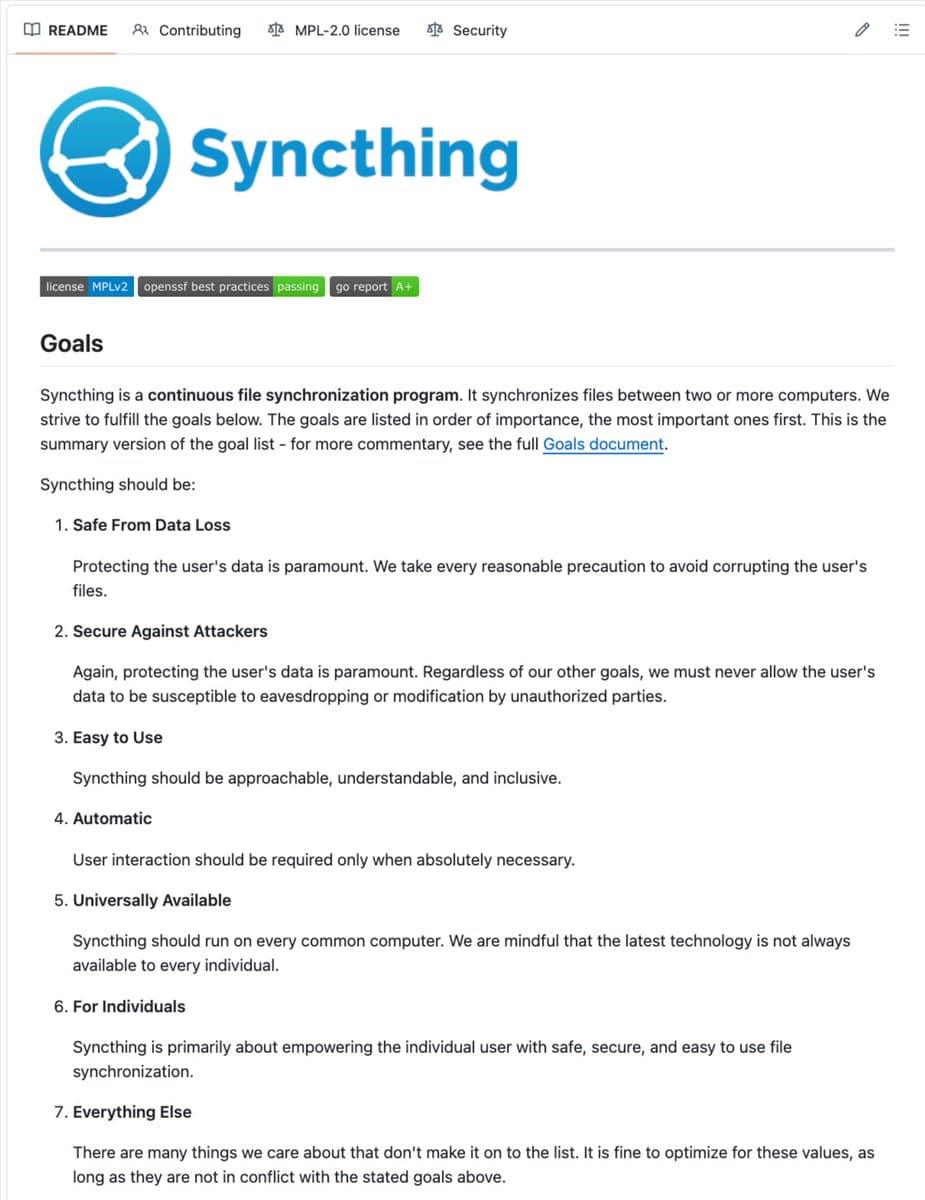
In response, the post spotlights Syncthing, an open-source, peer-to-peer file synchronization tool that eliminates the cloud middleman entirely. With over 81,900 stars on GitHub and battle-tested since 2013, Syncthing represents a mature alternative architecture for file sync that operates without centralized servers.
Key Takeaways
- Syncthing, a peer-to-peer file synchronization tool with 81,900+ GitHub stars, syncs files directly between user devices without any central server, challenging paid cloud storage models.
- It offers encrypted, serverless sync across platforms for free, addressing cloud privacy and cost concerns.
What Syncthing Actually Does: A Technical Breakdown

Syncthing creates a direct, encrypted synchronization network between a user's own devices. There is no Syncthing cloud, no Syncthing company storing data, and no account system. The protocol is fully documented and open (MPL-2.0 licensed).
Core Technical Features:
- True Peer-to-Peer Architecture: Files transfer directly between devices using encrypted tunnels. No data passes through any intermediary server.
- Encryption & Authentication: Every connection uses TLS with perfect forward secrecy. Each device is authenticated with a strong cryptographic certificate.
- Cross-Platform Operation: Runs on Windows, macOS, Linux, Android, FreeBSD, and Solaris. A web dashboard provides monitoring and configuration.
- Selective Synchronization: Users can share specific folders with specific devices or people, creating flexible sharing networks.
- File Versioning: Built-in versioning allows recovery of deleted or changed files.
- NAT Traversal: Works over both local networks and the internet without requiring manual port forwarding.
The installation process reflects its decentralized nature: users install the application, exchange device IDs (cryptographic identifiers), and begin syncing. There's no sign-up, no payment, and no central authority.
The Business Model Contrast: $0 vs. $120+/Year
Syncthing $0 $0 Your hardware User-controlled, peer-to-peer Google One (2TB) $10 $120 Google servers Google can access Dropbox Plus (2TB) $12 $144 Dropbox servers Dropbox can access iCloud+ (2TB) $10 $120 Apple servers Apple can accessSyncthing's cost structure is fundamentally different: users provide their own storage hardware (hard drives, NAS devices, etc.), so there are no per-gigabyte fees. The software itself is free and maintained by the Syncthing Foundation, a Swedish non-profit.
Security & Reliability Implications
The post highlights several critical advantages of Syncthing's architecture:
- No Single Point of Failure: With no central servers, Syncthing cannot be "shut down" in a way that prevents access to files already synchronized between devices.
- Eliminated Breach Surface: Since files never touch third-party servers, they cannot be exposed in breaches like Dropbox's 2024 incident.
- Policy Change Immunity: Cloud providers can change terms of service to enable content scanning; Syncthing's architecture makes this technically impossible.
- Longevity: Google has discontinued 293 products; Syncthing's open-source, decentralized model ensures continuity regardless of corporate decisions.
Practical Considerations & Limitations
While technically compelling, Syncthing requires users to manage their own infrastructure:
- Availability: Files are only accessible when at least one device containing them is online and reachable.
- Backup Responsibility: Users must implement their own backup strategies for disaster recovery.
- Initial Setup: More technical than clicking "Sign up with Google"—requires device pairing and network configuration understanding.
- Mobile Experience: While Android support is robust, iOS availability is limited due to platform restrictions on background processes.
The project's maturity is significant: 349 contributors, 464 releases, 5,000+ forks, and active development since 2013 suggest production-ready stability.
gentic.news Analysis
This critique arrives amid growing enterprise and developer skepticism toward cloud vendor lock-in and escalating SaaS costs. While not an AI tool itself, Syncthing's architecture represents a foundational infrastructure choice that enables privacy-preserving AI workflows. Researchers handling sensitive training data, companies deploying on-premise AI models, or developers building federated learning systems could leverage Syncthing's P2P model to synchronize datasets and model weights without exposing them to third-party cloud scrutiny.
Technically, Syncthing's approach aligns with broader decentralization trends in the AI stack, mirroring movements toward local LLMs (like Llama.cpp), federated learning, and edge AI deployment. As AI models grow larger and training datasets more sensitive, the transportation and synchronization of these assets between research clusters, training facilities, and deployment environments becomes a critical attack surface. A tool like Syncthing that provides encrypted, direct transfer without intermediate storage could become a preferred method for sensitive AI asset distribution.
The post's timing is notable following Dropbox's 2024 breach, which exposed authentication materials that could have compromised integrated AI services. As AI APIs increasingly integrate with cloud storage platforms, breaches of those platforms create downstream risks for AI systems accessing stored training data or configuration files. Syncthing's architecture eliminates this particular risk vector entirely.
However, Syncthing isn't a direct competitor to cloud storage for all use cases—it lacks the global availability guarantees of distributed cloud infrastructure. But for specific scenarios where data sovereignty, cost control, or privacy are paramount, it presents a technically viable alternative that deserves consideration in enterprise AI infrastructure planning.
Frequently Asked Questions
Is Syncthing really free with no catch?
Yes, Syncthing is completely free and open-source software licensed under MPL-2.0. The Syncthing Foundation, a Swedish non-profit, oversees development. There are no paid tiers, premium features, or hidden costs. Users provide their own storage hardware, so the only costs are electricity and hardware maintenance.
How does Syncthing compare to cloud storage for team collaboration?
Syncthing works well for team collaboration through selective folder sharing, but it requires more technical setup than services like Google Drive or Dropbox. Each team member must install Syncthing, exchange device IDs, and ensure their devices remain accessible. For small technical teams prioritizing privacy, it's excellent; for large organizations needing centralized administration, traditional cloud services may be more practical.
Can Syncthing handle large files like AI model weights or datasets?
Yes, Syncthing can synchronize files of any size, making it suitable for AI model weights (often several gigabytes) or training datasets. The peer-to-peer transfer can be faster than cloud sync for devices on the same network since files transfer directly rather than routing through a cloud server. However, transfer speed depends entirely on the connection between devices.
What happens if all my Syncthing devices are offline?
If all devices containing a particular file are offline, that file becomes temporarily unavailable to other devices until at least one comes back online. This contrasts with cloud storage where files remain accessible via the provider's always-on servers. Users often address this by dedicating a always-on device (like a NAS or home server) as part of their Syncthing network.