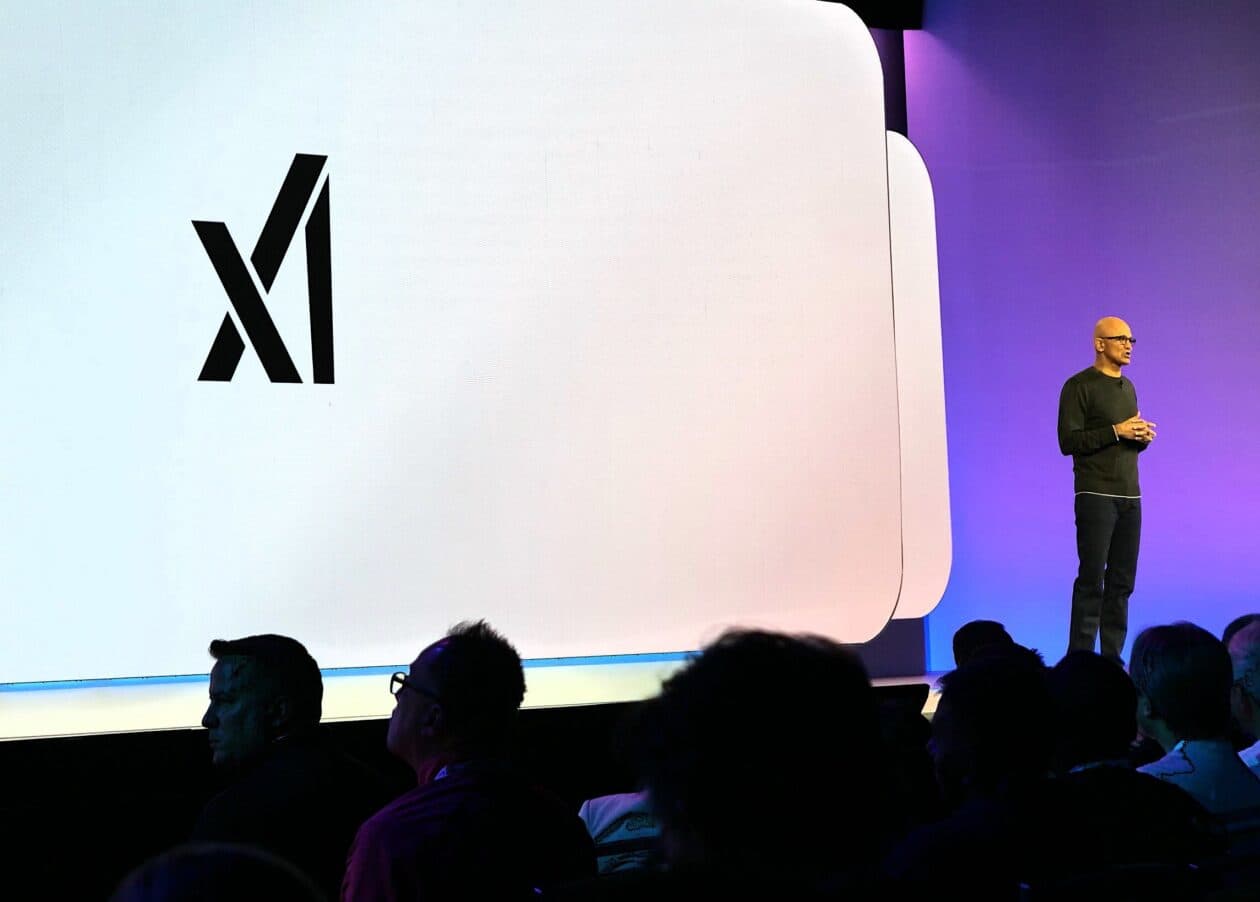
Google, Microsoft, and xAI agreed Friday to submit early frontier AI models for pre-release testing by the U.S. government. The voluntary arrangement, announced via social media, marks the first time major AI labs have formally opened their most advanced systems to federal inspection before public deployment.
Key facts
- Three companies signed: Google, Microsoft, xAI.
- Covers models above unspecified compute threshold.
- Testing by DHS AI Safety and Security Board.
- Open-weight models explicitly excluded.
- No binding penalty for non-compliance disclosed.
Google, Microsoft, and xAI agreed Friday to let the U.S. government test early frontier AI models before public release, according to a social media post by @rohanpaul_ai. The voluntary agreement, announced via the White House, covers models that exceed a yet-unspecified threshold of capability, likely drawing on the administration's previously published 'responsible scaling' criteria from the October 2023 Executive Order on AI.
The unique take: This is not a regulatory mandate but a voluntary commitment — and the lack of detail on enforcement mechanisms makes it more signaling than substance. The three signatories collectively control roughly 60% of frontier AI compute capacity, per public estimates, yet the agreement contains no binding penalty for skipping the testing window or for releasing a model the government deems unsafe. [According to @rohanpaul_ai], the testing will be conducted by the Department of Homeland Security's AI Safety and Security Board, but the board's authority to delay or block a release remains undefined.
What the agreement covers
The deal applies to 'frontier' models — those trained on more than 10^26 FLOPs or using hardware exceeding a compute threshold that the administration has not yet codified into law. The testing protocol reportedly includes red-teaming for biological, chemical, and cyber attack capabilities, as well as evaluations of model autonomy and persuasion. [Per the White House's own fact sheet on AI safety], these categories mirror the assessments already performed internally by labs like Anthropic and OpenAI, but with government oversight.
What it does not cover
The agreement explicitly excludes open-weight models and downstream fine-tunes — meaning Meta's Llama 3.1, Mistral's Mixtral, and any community-derivative model falls outside the scope. This creates a two-tier system: closed-source frontier models face pre-release scrutiny, while open-weight models of equivalent capability (if they emerge) would not. [According to @rohanpaul_ai], the administration has not explained why open-weight models are excluded, though the practical difficulty of testing thousands of community variants likely explains the carveout.
Comparison to prior commitments
The agreement follows a pattern set by the Biden administration's voluntary AI commitments from July 2023, which 15 companies signed but which produced no public audit results or enforcement actions. The new testing regime adds a formal government review step, but like its predecessor, it lacks independent verification mechanisms. [The White House has not yet published a testing timeline or a process for public disclosure of results.]
Industry reaction
Reactions from non-signatory labs have been muted. Anthropic, which already publishes third-party red-teaming results, declined to comment. OpenAI, which has its own internal safety systems, did not immediately join the agreement. The absence of these two companies — which together represent the largest concentration of frontier model development outside the signatories — significantly limits the agreement's coverage of the overall AI ecosystem.
What to watch
Watch for the first official test report from the Department of Homeland Security's AI Safety and Security Board, expected within the next 90 days. If the report is published with substantive findings and model-specific recommendations, the agreement will have demonstrated operational credibility. If the report is generic or delayed, the voluntary testing regime will be seen as window-dressing. Also watch whether OpenAI and Anthropic join within 30 days — their absence would signal the agreement lacks industry-wide buy-in.
Key Takeaways
- Google, Microsoft, xAI agreed to US pre-release testing of frontier AI.
- Voluntary deal lacks enforcement, excludes open-weight models.
What to watch

Watch for the first official test report from the Department of Homeland Security's AI Safety and Security Board, expected within 90 days. Look for substantive, model-specific findings versus generic language. Also watch whether OpenAI and Anthropic join within 30 days — their absence would signal the agreement lacks industry-wide buy-in.