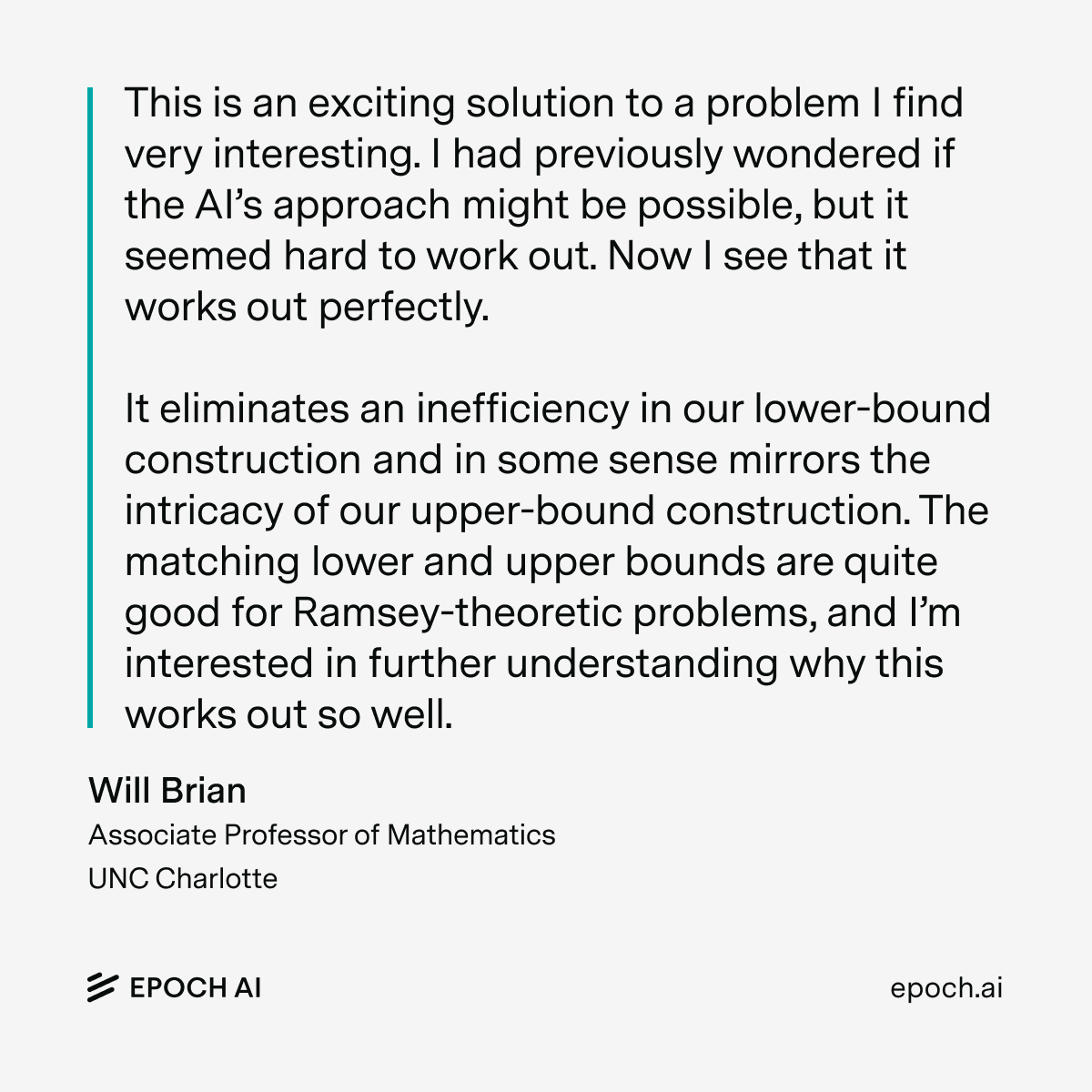
A brief social media post from a user tracking AI developments has reported a notable, if preliminary, achievement in automated theorem proving. According to the post, researchers Kevin Barreto and Liam Price used GPT-5.4 Pro to generate a construction that solves one of the open problems in FrontierMath. The result was subsequently confirmed by mathematician Will Brian, with plans for a formal write-up and publication.
The post, which states "We are accelerating," suggests this event is viewed by observers as a significant step in the application of large language models (LLMs) to advanced mathematical research. The details are sparse, but the core claim involves a verified solution to a previously unsolved problem in a specialized mathematical domain.
What Happened
Based solely on the source material, the sequence of events appears to be:
- Research Input: Kevin Barreto and Liam Price used GPT-5.4 Pro, presumably by prompting it with the specific open problem from the FrontierMath dataset or a related framework.
- AI Output: The model produced a proposed construction or proof sketch.
- Expert Verification: Mathematician Will Brian reviewed the AI-generated output and confirmed its correctness.
- Next Steps: The parties plan to author a formal paper detailing the solution for academic publication.
The mention of "FrontierMath" likely refers to a benchmark or collection of challenging, unsolved mathematical problems used to evaluate the reasoning capabilities of AI systems. This would place the achievement in the context of automated reasoning and AI-assisted research.
Context: AI in Mathematical Discovery
This reported event fits into a growing trend of using LLMs as collaborators in formal science. Previous milestones include:
- Google's FunSearch: Using LLMs to discover new solutions to combinatorial problems in computer science.
- Lean Copilot: Tools that help formalize proofs in proof assistants like Lean.
- GPT-4 & Claude on MATH/IMO Benchmarks: Achieving high scores on curated problem sets, though these typically involve known solutions.
What distinguishes this claim is the application to a genuinely open problem, followed by independent verification by a domain expert and a path to publication—a key standard for mathematical contribution.
Key Unanswered Questions
The source provides no technical details. Critical information missing includes:
- The specific FrontierMath problem that was solved.
- The nature of the "construction" (e.g., a counterexample, an algorithm, a proof).
- The interaction process between the researchers and GPT-5.4 Pro (e.g., iterative prompting, use of code interpreters).
- The extent of human input in guiding the model or polishing the final output.
Until a preprint or publication appears, this remains an intriguing but unverified claim of capability.
gentic.news Analysis
This report, while thin on details, points to a potential inflection point in how we define "AI research." If verified, it would represent a shift from AI solving curated benchmark problems to AI contributing to the actual frontier of human knowledge in a formal discipline. The crucial element here is the involvement of Will Brian for verification. This underscores that the current value of LLMs in math is not as autonomous provers but as exceptionally powerful conjecture generators or research assistants that can explore solution spaces at a speed incomprehensible to humans. The human researcher's role evolves from sole discoverer to director of a computational search process and final arbiter of correctness.
Technically, the mention of a "construction" is telling. LLMs like GPT-5.4 Pro, trained on vast code and text corpora, may be particularly adept at proposing specific examples, counterexamples, or algorithmic structures—tasks that require creativity within constraints. This is often harder than verifying a given proof. Success here would imply significant improvements in the model's internal reasoning and its ability to adhere to strict formal requirements, likely building on techniques like process supervision, tool use, and perhaps novel prompting strategies for mathematical discovery.
For practitioners, this is a signal to closely monitor the integration of LLMs into formal workflows. The toolchain for this research—likely involving the model, a code interpreter, symbolic math libraries, and a verification step—is as important as the model itself. The pending publication will be far more informative than the announcement, as it should reveal the proportion of credit belonging to the AI's raw output versus the human-led search and refinement process.
Frequently Asked Questions
What is FrontierMath?
FrontierMath is likely a benchmark dataset comprising open, unsolved problems from various mathematical fields, designed to test the limits of AI reasoning and discovery systems. It serves as a higher-tier challenge beyond standard benchmarks like MATH or IMO problems, which have known solutions.
Has an AI solved an open math problem before?
Yes, but instances are rare and highly specific. A prominent example is Google's FunSearch, which discovered improved algorithms for the cap set problem and bin packing. However, the claim that a general-purpose LLM like GPT-5.4 Pro has done so, with a path to peer-reviewed publication, would be a significant first if formally confirmed.
What is GPT-5.4 Pro?
Based on the naming convention, GPT-5.4 Pro is presumably an advanced, proprietary iteration of OpenAI's GPT series, following GPT-4. The "Pro" designation suggests a version optimized for complex, professional tasks, potentially with enhanced reasoning capabilities, longer context, or specialized fine-tuning for technical domains. No official specifications have been released.
How credible is this claim?
The claim originates from a social media post, not an official publication. Its credibility hinges entirely on the reputations of the individuals involved (Kevin Barreto, Liam Price, and verifier Will Brian) and the eventual release of a formal paper. The planned publication is a positive sign, but the technical community will await the details before drawing conclusions.