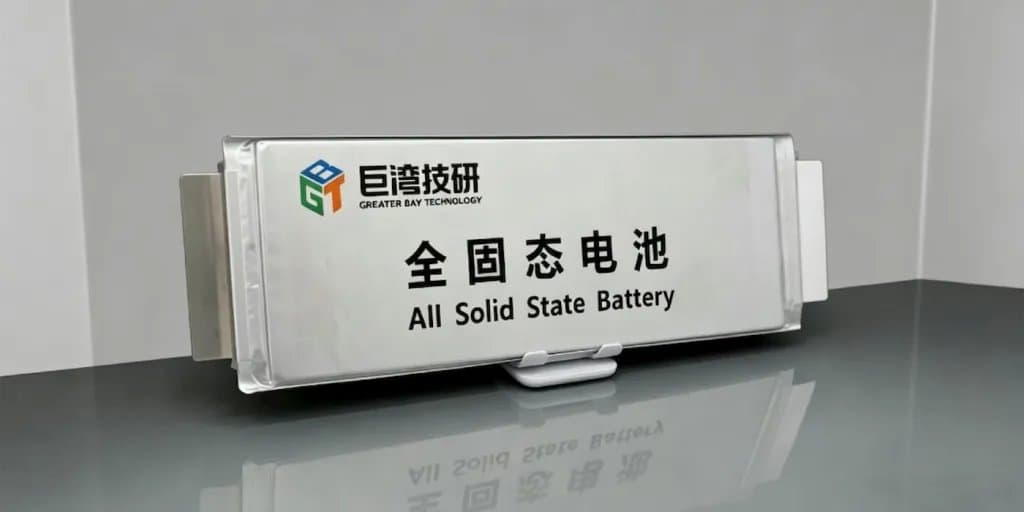
Greater Bay Technology (GBT), a company backed by Chinese automotive giant GAC Group, has announced a significant milestone in next-generation battery technology: the first A-sample all-solid-state battery cells have rolled off its production line. This marks a tangible step from laboratory research toward industrial-scale manufacturing for a technology long promised to revolutionize electric vehicles.
The key achievement is the production of functional prototype cells that contain zero liquid electrolyte—the flammable component in conventional lithium-ion batteries. According to the company, these cells have passed all critical safety tests, including the stringent needle penetration test, without fire or explosion.
Key Takeaways
- Greater Bay Technology has produced its first A-sample all-solid-state battery cells, achieving 260-500 Wh/kg energy density and passing needle penetration tests without fire.
- The company aims for GWh-level mass production and in-vehicle use by 2026.
What's New

The A-sample cells represent the first engineering prototypes from a production line, not a lab bench. GBT reports the cells achieve an energy density range of 260-500 Wh/kg. For context, today's high-performance automotive lithium-ion batteries typically achieve around 250-300 Wh/kg. This leap in density is the key to the promised applications: enabling EV driving ranges exceeding 1,000 km and supporting stable 2-3C fast charging rates, which could significantly reduce charging times.
The company is now targeting GWh-level mass production and actual integration into vehicles by 2026. If achieved, this would position GBT as the world's first company to mass-produce all-solid-state batteries for the automotive market.
Technical Details & Competitive Landscape
GBT's progress is part of a global race. The announcement notes that industry giants including CATL, BYD, Toyota, Volkswagen (via its investment in QuantumScape), and Mercedes-Benz are all pushing toward solid-state production within the next few years. GBT claims a fortified position with over 50 patents across the full technology chain and backing from China's National Development and Reform Commission (NDRC), indicating state-level strategic support.
Its parent company, GAC Group, is reportedly building its own dedicated production line targeting a scale-up between 2027 and 2030, with cells aiming for over 400 Wh/kg.
What to Watch

The transition from A-sample prototypes to GWh-scale production by 2026 is an aggressive timeline. The primary challenges will be scaling the complex manufacturing process for solid-state electrolytes—which often involve sensitive ceramic or polymer materials—and doing so at a cost competitive with mature lithium-ion production. Success would not only enable longer-range EVs but could fundamentally address safety concerns that have led to high-profile battery recalls.
gentic.news Analysis
This announcement from GBT, while a prototype milestone, is a concrete data point in the accelerating timeline for solid-state battery commercialization. For years, the technology has been perpetually "5-10 years away." GBT's 2026 target for mass production, alongside similar timelines from QuantumScape and Toyota, suggests that window is finally closing. The involvement of GAC Group and explicit backing from China's NDRC is significant. It reflects a national industrial strategy to capture leadership in the next phase of EV technology, mirroring the playbook that established China's dominance in lithium-ion battery production. This state-capitalist model, combining corporate R&D with strategic government support, could provide GBT with a unique advantage in the capital-intensive race to scale manufacturing.
The reported energy density of 260-500 Wh/kg is a wide range, likely indicating variation between different cell formats or chemistries under test. The upper bound of 500 Wh/kg would represent a paradigm shift, but the lower bound of 260 Wh/kg is more incremental. The real-world density achieved in a packaged automotive battery pack will be the critical metric to watch, as cell-level gains are often diluted at the pack level. The passing of the nail penetration test is a non-negotiable prerequisite for automotive adoption and, if independently verified, would be a major validation of the core safety promise of solid-state technology.
Frequently Asked Questions
What is an A-sample battery cell?
An A-sample is the first functional prototype built on a production-intent manufacturing line. It's a critical step between lab-scale proof-of-concept and mass production, used to validate the design, manufacturing process, and basic performance before investing in full-scale production tooling.
How does a solid-state battery differ from a lithium-ion battery?
The key difference is the electrolyte. Conventional lithium-ion batteries use a liquid or gel electrolyte to transport lithium ions between the cathode and anode. All-solid-state batteries replace this with a solid electrolyte (ceramic, polymer, or sulfide-based). This eliminates flammability, can enable the use of higher-energy-density anode materials like lithium metal, and potentially improves charging speed and longevity.
Who is leading the solid-state battery race?
The race is highly competitive with no clear winner. Several paths are being pursued: Chinese companies like GBT and CATL, Japanese automakers like Toyota (partnered with Panasonic), and US-based startups like QuantumScape (backed by Volkswagen) and Solid Power (partnered with BMW and Ford). Each is betting on different solid electrolyte materials and manufacturing processes.
What are the main challenges for mass production?
The primary hurdles are manufacturing cost and scalability. Producing thin, defect-free solid electrolyte layers at high speed and yield is extremely difficult. Integrating the solid components into a robust cell that maintains contact through charge cycles (a problem known as interfacial instability) is another major engineering challenge that must be solved for commercial durability.