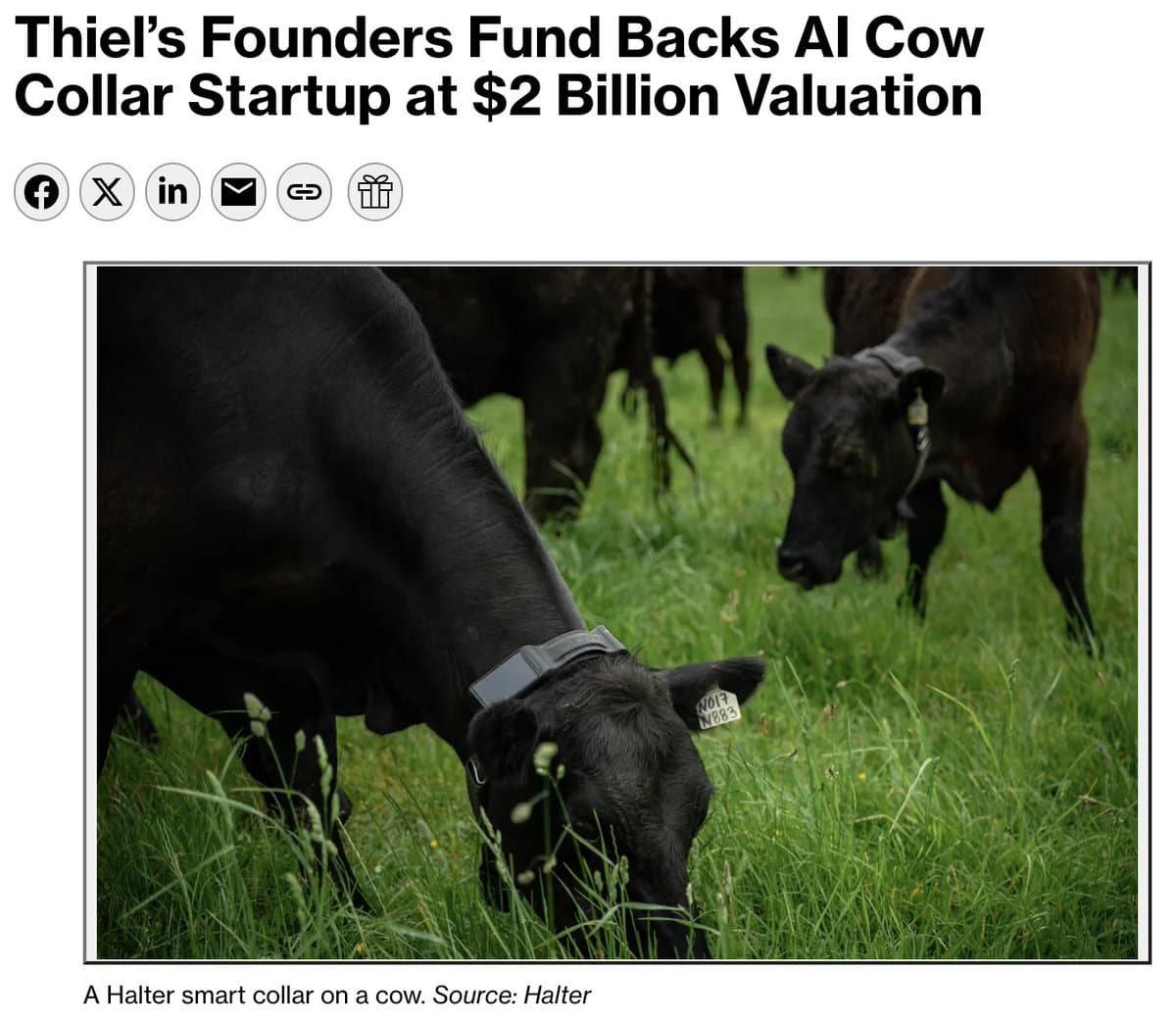
Halter's Solar-Powered Cattle Collars Hit $2B Valuation, Using AI to Replace Physical Fences

Halter's Solar-Powered Cattle Collars Hit $2B Valuation, Using AI to Replace Physical Fences

Livestock tech company Halter reached a $2 billion valuation by replacing physical fences with solar-powered collars that herd cattle using AI-driven vibrations and audio cues. The system turns cows into data streams managed through a smartphone app.

Ggentic.news Editorial·4h ago·1 min read·6 views·via @kimmonismus
Share:

What Happened

Livestock technology company Halter has reached a $2 billion valuation in what the source describes as "a down market." The company's core product replaces traditional physical fencing with solar-powered collars that create virtual boundaries for cattle.

The system works by equipping cattle with collars that emit vibrations and audio cues to guide their movement, effectively allowing farmers to herd animals remotely through a smartphone application. The collars also transmit location data and health indicators, turning individual animals into continuous data streams.

Context

Peter Thiel, through his investment firm Founders Fund, is a notable investor in Halter. The source contrasts common perceptions about AI disruption—typically focused on office work—with Thiel's view that AI's transformative impact may be more significant in agricultural sectors like livestock management.

Halter's approach represents a shift from physical infrastructure (fences, gates, manual herding) to software-defined livestock management. The solar-powered aspect addresses practical deployment challenges in remote pasture environments.

No specific AI architecture details, model sizes, or performance metrics are provided in the source material. The development appears to be a commercial deployment rather than a research breakthrough.


AI Analysis

The Halter valuation signals investor confidence in applying edge AI and IoT systems to traditional industries with high operational costs. The technical challenge here isn't raw computational power but reliable, low-power operation in harsh environments. The AI component likely involves reinforcement learning for optimal herding patterns and anomaly detection for health monitoring—both running on constrained hardware. What's noteworthy is the business model shift: from selling fencing materials (a capital expense) to selling a subscription service for virtual fencing (an operational expense with recurring revenue). The $2B valuation in a tough funding environment suggests investors see scalability beyond New Zealand (where Halter originated) to global cattle operations. Practitioners should note the sensor fusion approach: combining GPS, accelerometers, and potentially biometric sensors with solar power management creates a complete edge AI system. The real innovation may be in the data pipeline—transforming sparse cellular coverage in rural areas into actionable insights rather than in breakthrough algorithms.
Original sourcex.com

Trending Now

More in Funding & Business

View all