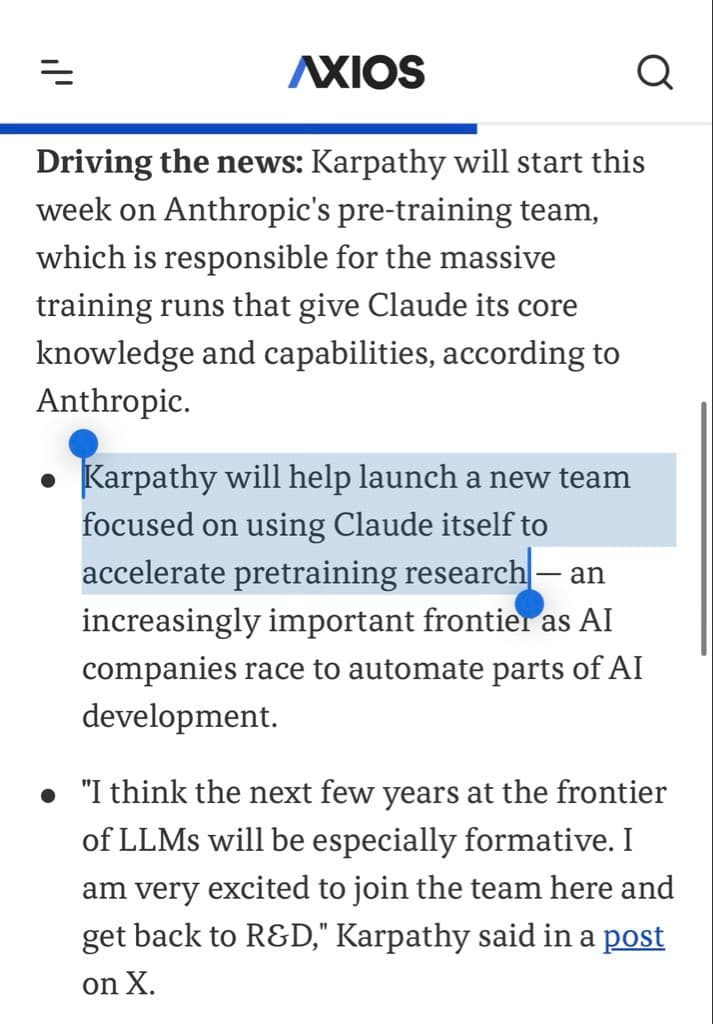
Andrej Karpathy will launch a new Anthropic team focused on using Claude itself to accelerate pretraining research, per a post by @kimmonismus. The team is explicitly focused on recursive self-improvement, a direction Karpathy has publicly advocated for since his 2023 'Self-Improving AI' essay.
Key facts
- Karpathy previously led AI at Tesla and co-founded OpenAI
- Team's focus: recursive self-improvement via Claude's own outputs
- Anthropic did not disclose team size or budget
- Recursive self-improvement risks model collapse (Shumailov et al. 2023)
- Anthropic currently raising ~$5B Series E
Andrej Karpathy, former head of AI at Tesla and co-founder of OpenAI, is joining Anthropic to lead a new team with a specific mandate: use Claude's own outputs to improve Claude's pretraining pipeline. The initiative, announced via a post by @kimmonismus, is described as focused on 'recursive self improvement' — a paradigm where the model generates training data or objective functions that then refine its own architecture or weights.
The move signals Anthropic's bet on a controversial thesis: that scaling pretraining via human-generated data may soon hit diminishing returns, and that synthetic data loops, if carefully controlled, can unlock further gains. Karpathy has long argued for this approach; in a 2023 essay he wrote that 'the most efficient path to superhuman AI is through recursive self-improvement, not brute-force scaling.'
Anthropic did not disclose the team's size, budget, or reporting structure. The company has not commented publicly on whether this team will publish research or operate as an internal black-box unit. Karpathy's hire comes amid a broader industry push toward self-play and synthetic data: DeepMind's AlphaZero and OpenAI's o1 both leverage variants of self-generated training signals.
The unique take here is that Karpathy's team represents a structural shift in how Anthropic approaches pretraining. Rather than scaling data or compute budgets linearly, the team aims to create a feedback loop where Claude itself becomes the primary driver of its own improvement — a move that could decouple model quality from human annotation costs. If successful, it would upend the current scaling law paradigm (Kaplan et al. 2020) that has governed LLM pretraining since GPT-3.
The Recursive Self-Improvement Thesis
Recursive self-improvement is not new in theory but rarely executed at scale. The core challenge is avoiding 'model collapse' — the degradation of output quality when models train on their own generations without human filtering (Shumailov et al. 2023). Karpathy's team will need to solve this: how to distinguish useful self-generated data from noise, and how to prevent the model from reinforcing its own biases.
Anthropic's approach likely leverages Claude's constitutional AI training (Bai et al. 2022) as a guardrail, using the model's own harmlessness classifiers to filter self-generated pretraining data. The team may also explore reinforcement learning from AI feedback (RLAIF), where Claude judges its own outputs rather than relying on human raters.
Why This Matters Now
The timing is strategic. Anthropic is in the middle of a $5B Series E raise [per earlier reporting], and investors want to see a path to moat beyond compute scale. If Karpathy's team can demonstrate that Claude improves faster per unit of compute than competitors, it would validate the recursive self-improvement thesis and give Anthropic a defensible technical edge.
Karpathy's reputation as a hands-on researcher — he wrote much of Tesla's Autopilot code himself — suggests this will not be a pure management role. He is expected to contribute directly to the training pipeline, potentially rewriting core pretraining infrastructure.
Key Takeaways
- Andrej Karpathy joins Anthropic to lead a new recursive self-improvement team using Claude to accelerate pretraining, per @kimmonismus.
- The move signals a bet on synthetic data loops over brute-force scaling.
What to watch
Watch for the first public benchmark results from the team, likely on SWE-Bench or MATH, within the next 6 months. Also track Anthropic's Series E close — if the round includes compute commitments tied to this team's work, it signals investor conviction in recursive self-improvement.
[Updated 23 May via bloomberg_tech]
Anthropic is set to close a funding round that may exceed $30 billion at a valuation above $900 billion as soon as next week, according to people familiar with the matter [per Bloomberg]. This would vault Anthropic ahead of OpenAI to become the world's most valuable AI startup. The massive raise, far larger than the previously reported ~$5B Series E, suggests deep investor confidence in Anthropic's strategy—including Karpathy's recursive self-improvement team—and may include compute commitments tied to the initiative.