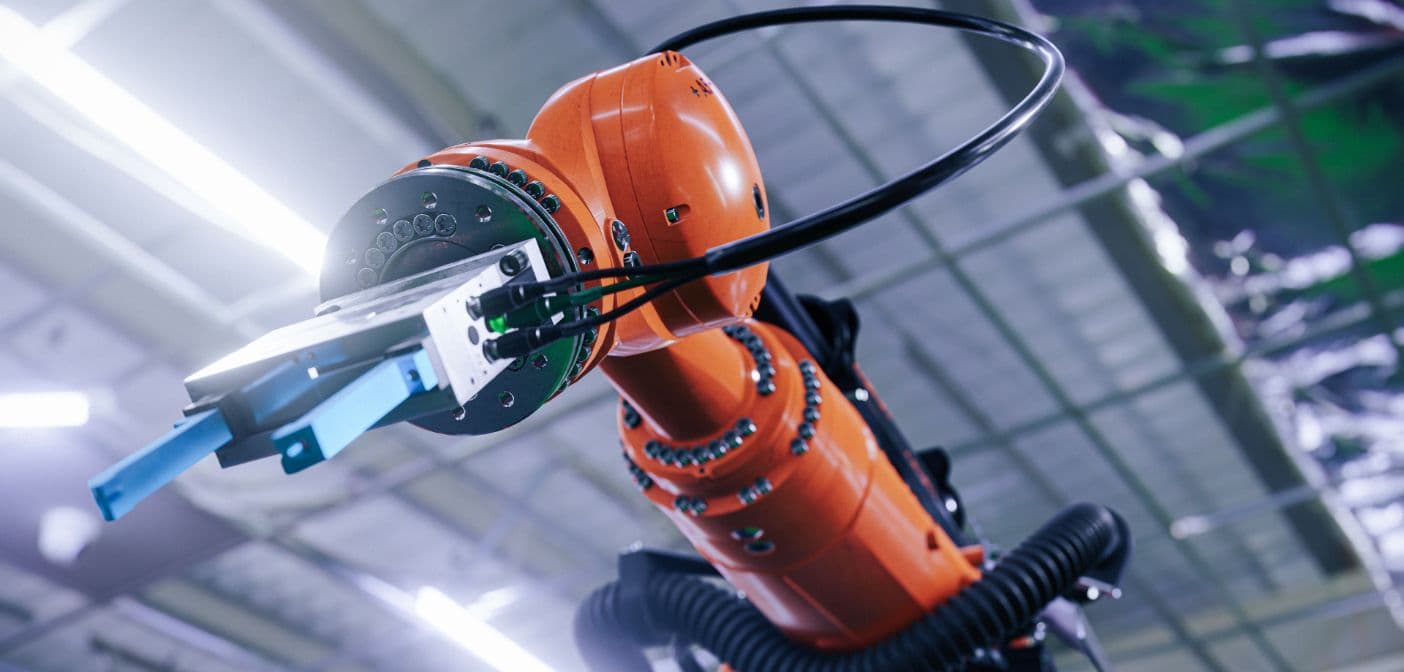
A Chinese maker and engineer known online as "Sword Man" has independently built a massive robotic hand weighing 5,000 kilograms (11,000 lbs). The system uses a motion-tracking glove worn by an operator to control the giant steel hand, which replicates the wearer's finger and hand movements in real-time with high fidelity.
What Happened
The project, showcased in a video shared on social media, demonstrates a large-scale, real-time teleoperation system. The operator wears a sensor-equipped glove that captures the precise movements of their hand and fingers. This data is then transmitted to the robotic hand, which is constructed from steel and other industrial components, causing it to mimic the human operator's motions. The sheer scale of the device—weighing as much as a large truck—makes the precision of its movement notable.
Context
Building large-scale, force-amplifying robotic systems—often called teleoperators or master-slave manipulators—has been a goal in robotics for decades, with applications ranging from heavy industry to hazardous material handling. Historically, such systems have been developed by large corporations or research institutions due to the complexity and cost involved in mechanics, control systems, and sensor integration.
The emergence of accessible components like high-fidelity inertial measurement units (IMUs), flexible sensors, and powerful microcontrollers has democratized parts of this field. This project appears to be a grassroots, maker-style implementation that scales these concepts to an extreme physical size, focusing on direct kinematic replication rather than autonomous AI-driven control.
Technical Implications
While the source material does not detail the specific sensors or control algorithms, achieving low-latency, precise control of a 5-ton mechanical structure with multiple degrees of freedom (one for each finger) is a significant mechatronic challenge. Key hurdles include managing inertia, overcoming friction in large joints, and ensuring structural rigidity to prevent flexing that would distort movement. The use of a direct control glove suggests a focus on human-in-the-loop dexterity rather than autonomous AI, positioning it as a feat of real-time control engineering and mechanical design.
gentic.news Analysis
This project sits at the intersection of the growing maker movement and advanced teleoperation robotics. It is a tangible example of how sensor and actuator technology, once confined to labs, is now accessible enough for individual engineers to undertake monumental projects. The development aligns with a broader trend we've covered, such as the rise of open-source robotics frameworks and affordable force-feedback haptics, which are lowering barriers to entry for complex robotic builds.
However, it's crucial to distinguish this from AI-powered robotic manipulation. Systems like Google's RT-2 or Tesla's Optimus focus on embedding intelligence and autonomy into the robot itself, enabling it to understand and act upon high-level commands. "Sword Man's" hand is a pure teleoperation system—a sophisticated tool that extends human capability without its own decision-making AI. This distinction is important for the AI and ML community to note: the core innovation here is in real-time kinematic mapping and robust mechanical design at scale, not in machine learning or perception.
For practitioners, this project highlights the ongoing relevance and challenges of hardware-software integration in robotics. The AI community often focuses on simulation and algorithm development, but real-world deployment requires solving substantial physical engineering problems, as this build emphatically demonstrates. It serves as a reminder that for many real-world applications, especially in unstructured environments, human-in-the-loop systems with robust teleoperation can be a more immediate and reliable solution than fully autonomous AI.
Frequently Asked Questions
How does the motion-tracking glove work?
While the exact technical specifications are not provided in the source, such gloves typically use a combination of technologies like flexible bend sensors, inertial measurement units (IMUs), and sometimes magnetic tracking to measure the angles of each finger joint and the orientation of the hand. This data is streamed to a controller that calculates the required positions for the motors or actuators in the large robotic hand.
What is the potential application for a giant robotic hand?
Potential applications include handling heavy or hazardous materials in industrial settings (e.g., foundries, construction, nuclear decommissioning), performing large-scale assembly tasks, or even in entertainment and theme parks for animatronics. Its primary function is to amplify human strength and reach while maintaining dexterity in dangerous or inaccessible environments.
Is this robotic hand powered by AI?
No, based on the source description, this is a teleoperation system, not an autonomous AI agent. It directly mirrors a human operator's movements in real-time. The "intelligence" resides with the human controller. The system may use software for sensor data processing and kinematic calculations, but it does not make decisions or learn from its environment autonomously.
Who is 'Sword Man'?
The source identifies the builder only by the online pseudonym "Sword Man," a Chinese maker. No further personal or organizational details are provided. The project appears to be an independent, grassroots engineering endeavor rather than a commercial or academic institutional project.