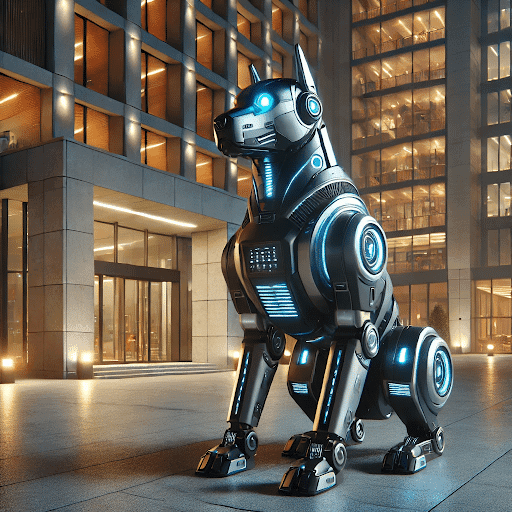
A robotics startup operating in Atlanta, Georgia, has begun deploying autonomous quadrupedal robots—commonly called "robot dogs"—for private neighborhood security patrols. According to a social media report from AI commentator Rohan Paul, the units roam designated areas at night, utilize onboard sensors to detect potential intruders, and are capable of firing off alerts to notify residents or a security service.
The development signals a move toward commercial, subscription-based applications for legged robots, which have historically been developed by research institutions and large corporations like Boston Dynamics for industrial inspection and public safety demonstrations.
What the Startup is Doing
The core service appears to be an automated security patrol for residential communities. The robots are likely equipped with standard robotic payloads: cameras (visible light and thermal), LiDAR, and microphones for situational awareness. Their primary function is persistent, mobile surveillance. Upon detecting anomalous activity—such as a person in a restricted area during quiet hours—the robot's AI system presumably classifies the event and triggers a notification. This could be an audible alarm, flashing lights, or an automated alert sent to a security operations center or a resident's smartphone.
The key differentiator from static cameras or human guards is the combination of mobility and autonomy. A single robot can patrol a pre-mapped route, potentially covering more ground than a fixed camera and operating in all weather conditions. The "roaming at night" detail suggests the service is designed to augment human security, taking over the monotonous and potentially dangerous task of overnight patrols.
Technical and Commercial Context
This application sits at the intersection of several mature technologies: robust quadrupedal hardware platforms (available from companies like Boston Dynamics, Unitree, and Ghost Robotics), sophisticated robot autonomy stacks (SLAM, navigation, obstacle avoidance), and AI-based threat detection computer vision models.
The business model is likely a Robotics-as-a-Service (RaaS) subscription for homeowners' associations or property management companies. This avoids the high upfront cost of purchasing the robots (which can exceed $70,000 per unit) and bundles maintenance, software updates, and monitoring.
Potential Implications and Questions
The deployment raises immediate questions about practicality and public reception:
- Effectiveness: Can the current generation of computer vision reliably distinguish between a resident taking out trash and a genuine intruder in low-light conditions, minimizing false alarms?
- Deterrence vs. Escalation: Does the presence of a robot deter crime, or could it provoke confrontation or vandalism?
- Legal & Regulatory: What are the liabilities if the robot fails to detect a crime or, in a worst-case scenario, is involved in an incident? Most jurisdictions have no clear laws governing autonomous security robots on public sidewalks or communal private property.
- Privacy: The robots would be collecting continuous video and audio data in semi-public spaces, creating new data governance challenges for neighborhoods.
Successful implementation would require robust fail-safes, clear operational boundaries (geofencing), and transparent communication with the community being patrolled.
gentic.news Analysis
This move represents a logical, if ambitious, attempt to productize legged robotics for a tangible business-to-consumer (B2C) application. For years, the narrative around robot dogs has shifted from viral research videos to a pressing question: What is the killer app? Boston Dynamics has focused heavily on industrial inspection with Spot, while other firms have explored military and first-responder roles. A subscription security service for neighborhoods is a novel answer that targets a clear pain point and a willing payer (homeowners' associations).
However, the technical hurdles remain significant. Reliable outdoor navigation at night, over varied terrain like sidewalks, grass, and driveways, is non-trivial. More challenging is the perception and decision-making AI. Security is a high-stakes domain where failure has real consequences. The system's false-positive and false-negative rates would need to be exceptionally low to be viable, requiring highly specialized training data on nighttime residential scenes.
This also enters a competitive landscape alongside traditional security firms, camera networks, and even drone-based patrol services. The robot's physical presence is its unique advantage for ground-level inspection and its potential drawback for public acceptance. The startup's success will depend less on the robotics hardware—which is increasingly commoditized—and more on the robustness of its AI security software and its ability to navigate the complex social and legal environment of community security.
Frequently Asked Questions
What company is making the security robot dogs?
The original source does not name the specific startup. The development is attributed only to a U.S. startup based in Atlanta, Georgia. Several robotics companies, including those that manufacture quadruped platforms, could be involved in such a pilot program.
How do robot dogs detect intruders?
They likely use a suite of sensors including visual cameras, thermal imaging cameras, and LiDAR to create a 3D map of their environment and detect movement. AI algorithms analyze this sensor data in real-time to classify objects (person, vehicle, animal) and identify anomalous behavior based on predefined rules, such as a person crossing a geofenced boundary at night.
Are robot dogs used by police?
Yes, several police departments, particularly in the United States, have conducted pilot programs or acquired quadrupedal robots from companies like Boston Dynamics and Ghost Robotics. These are typically used for dangerous situational awareness, such as inspecting hazardous environments or serving as a mobile camera during hostage or barricade situations, not for routine autonomous patrols.
Is it legal for a robot to patrol my neighborhood?
Laws are largely undeveloped in this area. On private property governed by a homeowners' association (HOA), the HOA likely has the authority to contract for such a service, similar to hiring a security guard. However, if the robot patrols public sidewalks or rights-of-way, it may fall under existing laws governing autonomous vehicles or municipal codes, which vary widely by city and state. This legal ambiguity is a significant hurdle for widespread deployment.