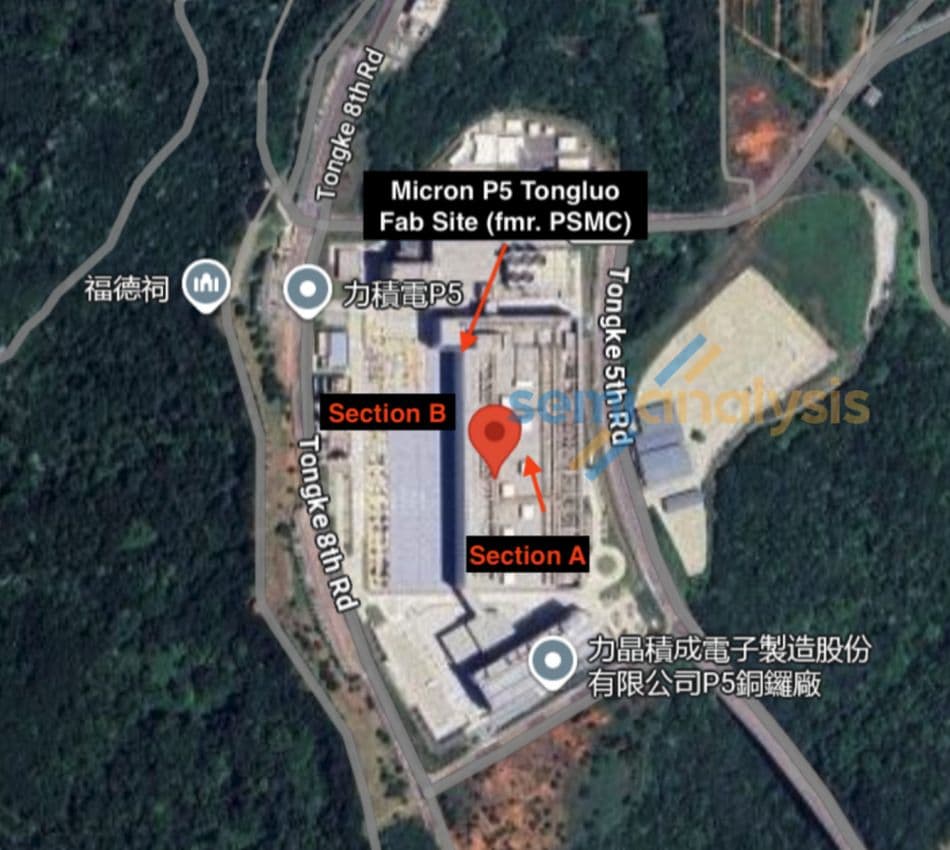
Micron announced it would acquire PSMC's P5 Tongluo fab in Miaoli, Taiwan earlier this year, and the process has officially begun. The $3.8B deal converts a legacy logic fab into advanced memory capacity for HBM and DDR5.
Key facts
- Deal estimated at $3.8B by analysts.
- P5 fab adds 40,000 WSPM for advanced DRAM.
- Reduces time-to-volume by 12-18 months.
- Capital expenditure cut by roughly 30%.
- HBM3E revenue hit $1.2B in Q1 2026.
Micron announced it would acquire PSMC's P5 Tongluo fab in Miaoli, Taiwan earlier this year, and the process has officially begun. The $3.8B deal converts a legacy logic fab into advanced memory capacity for HBM and DDR5. At first glance, this looked like a straightforward legacy logic/memory fab acquisition. But the details worth a close look, according to @SemiAnalysis_.
The acquisition marks a rare pivot for Micron: instead of building greenfield, it's retrofitting an existing fab for memory production. This reduces time-to-volume by 12-18 months compared to a new build, crucial as HBM demand outstrips supply. The P5 fab's existing clean room and infrastructure slash capital expenditure by roughly 30%, per industry estimates.
Why This Matters More Than It Seems
The unique take: Micron is effectively buying a ready-made shell to bypass Taiwan's permitting bottlenecks. PSMC's Tongluo site already has power, water, and labor agreements in place—permits that can take 2-3 years for new fabs. This gives Micron a direct line to HBM3E production by late 2026, directly challenging Samsung's lead in the HBM market.
Competitive Implications
The move intensifies the memory war with Samsung and SK Hynix. Micron's HBM3E revenue hit $1.2B in Q1 2026, but capacity constraints capped growth. The P5 fab adds 40,000 wafer starts per month (WSPM) for advanced DRAM, enough to serve NVIDIA's next-gen Blackwell Ultra GPUs. Samsung, meanwhile, is building its own Pyeongtaek mega-fab at $15B—a 4x cost premium per wafer.
Financial and Strategic Context
Micron did not disclose the exact purchase price, but analysts estimate $3.8B based on PSMC's P5 book value and equipment. The deal includes PSMC's 28nm logic equipment, which Micron will sell or repurpose for specialty memory. The company's blog post says the fab will begin memory production in Q4 2026, ramping to full capacity by mid-2027.
Key Takeaways
- Micron acquires PSMC's P5 fab for $3.8B, converting it for HBM and DDR5 production.
- The deal cuts 12-18 months off time-to-volume, challenging Samsung's HBM lead.
What to watch
Watch for Micron's Q3 2026 earnings call in July for updates on P5 fab ramp progress and HBM3E yield rates. Also monitor NVIDIA's Blackwell Ultra GPU launch timeline—any delays could soften demand, but early production targets suggest tight supply into 2027.