Meta is building an agentic AI assistant for its 3+ billion users, powered by the new Muse Spark model. The tool aims to rival OpenClaw, according to people familiar with the matter.
Key facts
- Meta has over 3 billion monthly active users across its apps
- New Muse Spark model will power the agentic assistant
- Goal is to create a product similar to OpenClaw
- Meta operates Facebook, Instagram, WhatsApp, Messenger
- No timeline or pricing disclosed by Meta
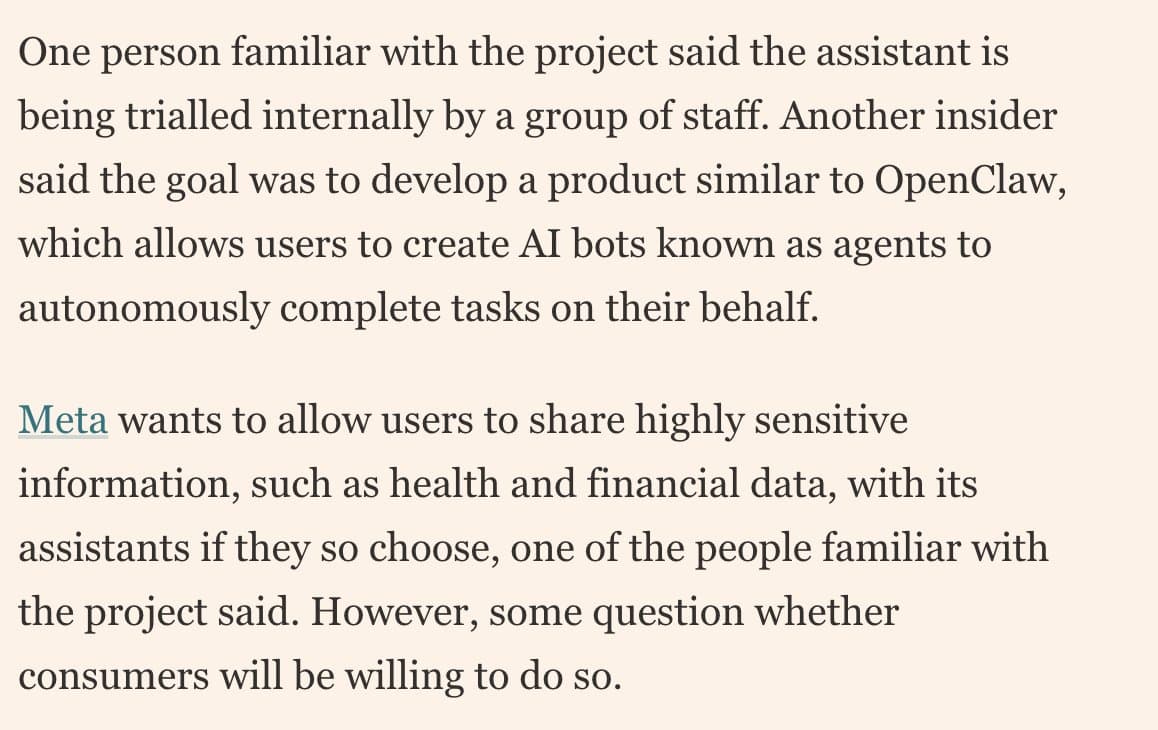
Meta is building an agentic tools for its more than 3bn users, according to people familiar with the matter, including an advanced digital assistant which will be powered by its new Muse Spark AI model. [According to @kimmonismus]
Another insider said the goal was to develop a product similar to OpenClaw. [Per the Financial Times]
Why this matters more than the press release suggests
Meta's move represents the first major attempt by a consumer platform with over a billion users to deploy agentic AI at scale. Unlike OpenAI's ChatGPT or Google's Gemini, which operate as standalone services, Meta's assistant would sit inside apps where users already spend hours daily — Facebook, Instagram, WhatsApp, and Messenger. The distribution advantage is staggering: Meta's family of apps collectively reaches over 3 billion monthly active users, more than any single AI product today.
The Muse Spark model is the key technical detail. Meta has been investing heavily in multimodal AI capable of planning and executing tasks across apps — booking flights, making restaurant reservations, managing calendars — not just answering questions. OpenClaw, the cited target, is a known agentic framework for task automation, suggesting Meta aims for real-world action, not just chat.
What remains unclear
Meta did not disclose a timeline, pricing model, or which apps the assistant will integrate with first. The company also faces regulatory scrutiny in Europe and the US over data use for AI training, which could limit deployment in key markets. Whether the assistant will be free, ad-supported, or subscription-based is unknown.
How it compares
User base 3B+ (via Meta apps) ~400M monthly ~1B monthly Model Muse Spark GPT-4o Gemini 2.0 Agentic capability Confirmed Partial (plugins) Partial (extensions) Distribution Native in social apps Standalone Standalone + Google appsWhat to watch
Watch for Meta's Q3 2026 earnings call where CEO Mark Zuckerberg may provide a timeline. Also monitor the European Data Protection Board's ongoing investigation into Meta's AI training practices — any restriction could delay EU rollout, limiting the assistant to US and Asia markets initially.
Key Takeaways
- Meta building agentic AI assistant for 3B+ users powered by Muse Spark model.
- Aims to rival OpenClaw.
- No timeline disclosed.
What to watch
Watch for Meta's Q3 2026 earnings call for CEO Mark Zuckerberg's timeline. Also monitor the European Data Protection Board's ruling on Meta's AI training — any restriction could delay EU rollout, limiting the assistant to US and Asia markets initially.