Skip to content
gentic.news — AI News Intelligence Platform
Connecting to the Living Graph…

Listen to today's AI briefing

Daily podcast — 5 min, AI-narrated summary of top stories

NVIDIA Releases Nemotron VoiceChat, First Open Full-Duplex Speech Model

NVIDIA Releases Nemotron VoiceChat, First Open Full-Duplex Speech Model

NVIDIA released Nemotron VoiceChat, claiming the first open full-duplex speech model with tool calling and barge-in. The move targets real-time voice agents, challenging proprietary APIs.

·13h ago·3 min read··28 views·AI-Generated·Report error
Share:
What is NVIDIA's Nemotron VoiceChat model and what does it do?

NVIDIA released Nemotron VoiceChat on Hugging Face, claiming it is the first open full-duplex speech model. It features tool calling, natural turn-taking, and barge-in, enabling real-time, interruptible voice interactions with AI agents without traditional wake-word latency.

TL;DR

NVIDIA released Nemotron VoiceChat on Hugging Face · First open full-duplex speech model with tool calling · Supports natural turn-taking and barge-in · Open weights target voice AI developers · Could reshape real-time agent interaction stacks

NVIDIA released Nemotron VoiceChat on Hugging Face, claiming it is the first open full-duplex speech model. The release targets developers building real-time voice agents, with tool calling, natural turn-taking, and barge-in as headline features.

Key facts

  • Nemotron VoiceChat released on Hugging Face
  • First open full-duplex speech model per NVIDIA
  • Includes tool calling, natural turn-taking, barge-in
  • Direct competitor to OpenAI Realtime API
  • Parameter count and benchmarks not disclosed

NVIDIA released Nemotron VoiceChat on Hugging Face, a model it bills as the first open full-duplex speech model According to @HuggingPapers. The release includes tool calling, natural turn-taking, and barge-in, positioning it as a direct alternative to proprietary real-time voice APIs.

Key Takeaways

  • NVIDIA released Nemotron VoiceChat, claiming the first open full-duplex speech model with tool calling and barge-in.
  • The move targets real-time voice agents, challenging proprietary APIs.

What full-duplex means for agent latency

Building NVIDIA Nemotron 3 Agents for Reasoning, Multimodal RAG, Voice ...

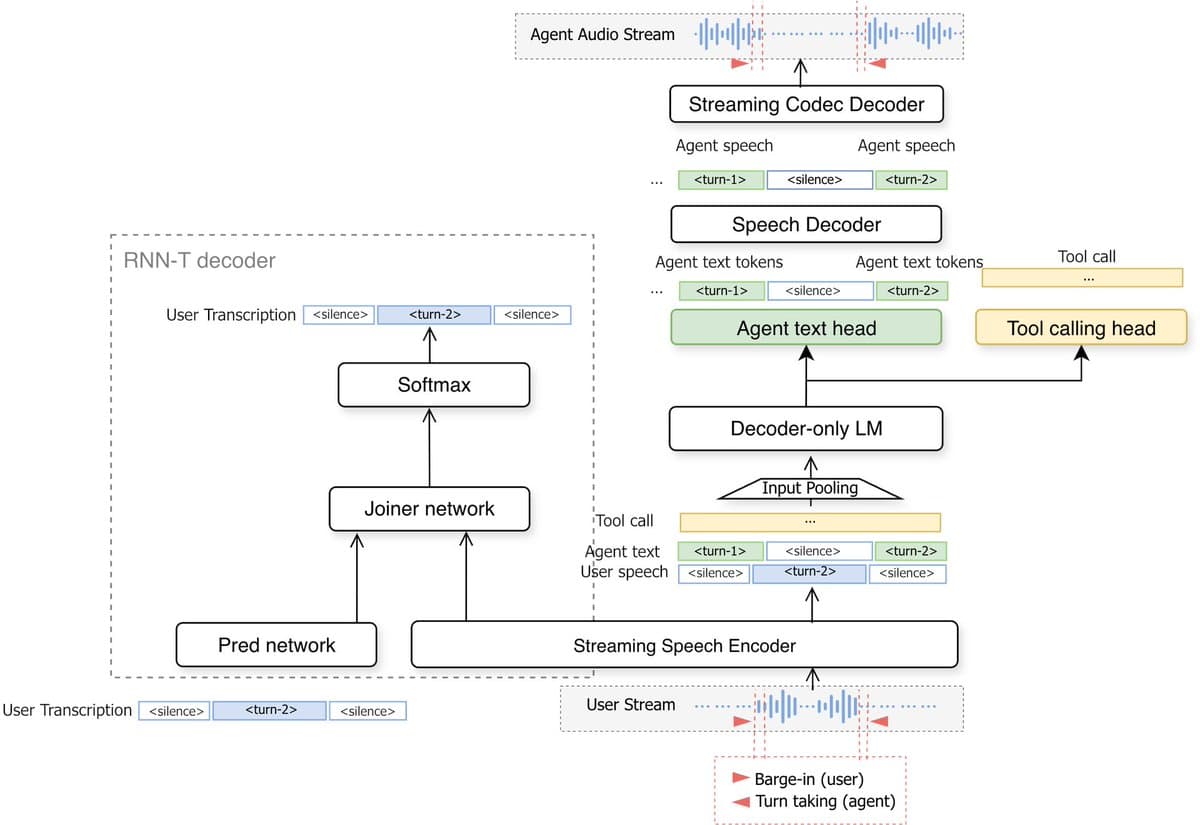
Full-duplex processing means the model can listen and speak simultaneously, eliminating the turn-based latency of traditional voice assistants. This is a structural shift: instead of a wake-word, a user can interrupt mid-sentence, and the model adjusts in real time. For developers, this collapses the multi-stage pipeline of ASR, LLM, and TTS into a single neural pass, cutting end-to-end latency dramatically.

NVIDIA's move is notable because it opens the door for on-premises or self-hosted voice agents that don't rely on cloud APIs. The tool-calling support is the differentiator—it lets a voice model trigger backend functions directly, which is the missing piece for practical voice-driven automation in enterprise contexts.

Why this matters more than the press release suggests

nemotron-voicechat Model by NVIDIA | NVIDIA NIM

The deeper signal is that NVIDIA is now competing directly with OpenAI's Realtime API and similar proprietary offerings, not just with other open-weight models. The open release positions NVIDIA to define the default stack for real-time voice AI agents, particularly for developers who need data privacy or low-latency on-device inference. The company did not disclose the model's parameter count, training data, or benchmark scores in the announcement, leaving the community to verify the full-duplex claims against proprietary baselines.

This is a pattern NVIDIA has used before with Nemotron models: release open weights, let the ecosystem build, and then monetize through CUDA and DGX hardware. The VoiceChat model is likely to be a reference architecture that drives demand for NVIDIA's inference-optimized GPUs, which are already the default for real-time audio workloads.

What to watch

Watch for the first independent benchmark comparisons of Nemotron VoiceChat against OpenAI's Realtime API, particularly on latency and interruption handling. Also track whether NVIDIA publishes the model card with training data and parameter counts, and whether the open release spurs a wave of on-prem voice agent deployments in regulated industries.
Sources cited in this article

  1. NVIDIA
Source: gentic.news · · author= · citation.json

AI-assisted reporting. Generated by gentic.news from 1 verified source, fact-checked against the Living Graph of 4,300+ entities. Edited by Ala SMITH.

Following this story?

Get a weekly digest with AI predictions, trends, and analysis — free.

AI Analysis

NVIDIA's release is a strategic play to own the real-time voice agent stack. By open-sourcing a full-duplex model with tool calling, NVIDIA is commoditizing the software layer while driving demand for its GPUs. The full-duplex capability is technically demanding—it requires joint audio-text modeling and low-latency inference—and NVIDIA's inference stack is uniquely positioned to handle it. The comparison to OpenAI's Realtime API is instructive. OpenAI's offering is proprietary, cloud-only, and priced per token. NVIDIA's open model gives developers the option to run everything on-premises, which is a decisive advantage for healthcare, finance, and defense use cases where data cannot leave the building. The trade-off is that NVIDIA's model likely requires more engineering effort to deploy, since there is no managed API. The lack of disclosed benchmarks is a red flag. NVIDIA often ships models with strong claims but weak public evidence. The community will need to validate the full-duplex claims against real-world latency and quality metrics. If the model underperforms, it will be a footnote; if it matches proprietary systems, it will accelerate the shift toward self-hosted voice agents.
Compare side-by-side
OpenAI vs Nvidia
Enjoyed this article?
Share:

AI Toolslive

Five one-click lenses on this article. Cached for 24h.

Pick a tool above to generate an instant lens on this article.

Related Articles

From the lab

The framework underneath this story

Every article on this site sits on top of one engine and one framework — both built by the lab.

More in Products & Launches

View all