Skip to content
gentic.news — AI News Intelligence Platform
Connecting to the Living Graph…

Listen to today's AI briefing

Daily podcast — 5 min, AI-narrated summary of top stories

Nvidia Vera Rubin Shifts AI Strategy Beyond Raw GPU Speed
Products & LaunchesBreakthroughScore: 87

Nvidia Vera Rubin Shifts AI Strategy Beyond Raw GPU Speed

Nvidia's Vera Rubin architecture pivots from raw GPU FLOPS to system-level AI infrastructure, targeting memory bandwidth and interconnect bottlenecks that constrain large-scale model training.

·1d ago·3 min read··6 views·AI-Generated·Report error
Share:
Source: news.google.comvia gn_gpu_cluster, gn_dc_power, dcd_newsCorroborated
How does Nvidia's Vera Rubin architecture differ from previous GPU-focused AI infrastructure strategies?

Nvidia's Vera Rubin architecture represents a strategic shift from raw GPU performance to system-level AI infrastructure, prioritizing memory bandwidth, interconnect fabric, and data center integration over traditional FLOPS scaling.

TL;DR

Nvidia Vera Rubin platform announced · Focus shifts to system-level AI infrastructure · Architecture prioritizes memory and interconnect

Nvidia's Vera Rubin architecture marks a strategic pivot from raw GPU FLOPS to system-level AI infrastructure performance. The platform prioritizes memory bandwidth, interconnect fabric, and data center integration over traditional compute scaling.

Key facts

  • Vera Rubin shifts focus from GPU FLOPS to system-level AI performance
  • Architecture prioritizes memory bandwidth and interconnect fabric
  • Nvidia negotiating $250B financing for OpenAI Ohio data center
  • Google booked Intel to package 3 million TPUs by 2028
  • Blackwell generation faced memory and I/O bottlenecks

Nvidia's Vera Rubin architecture represents a strategic pivot from raw GPU FLOPS to system-level AI infrastructure performance, according to the Indiatimes report. The architecture targets the bottleneck that has emerged as model parameters grew faster than GPU memory bandwidth improvements.

The Memory Wall Problem

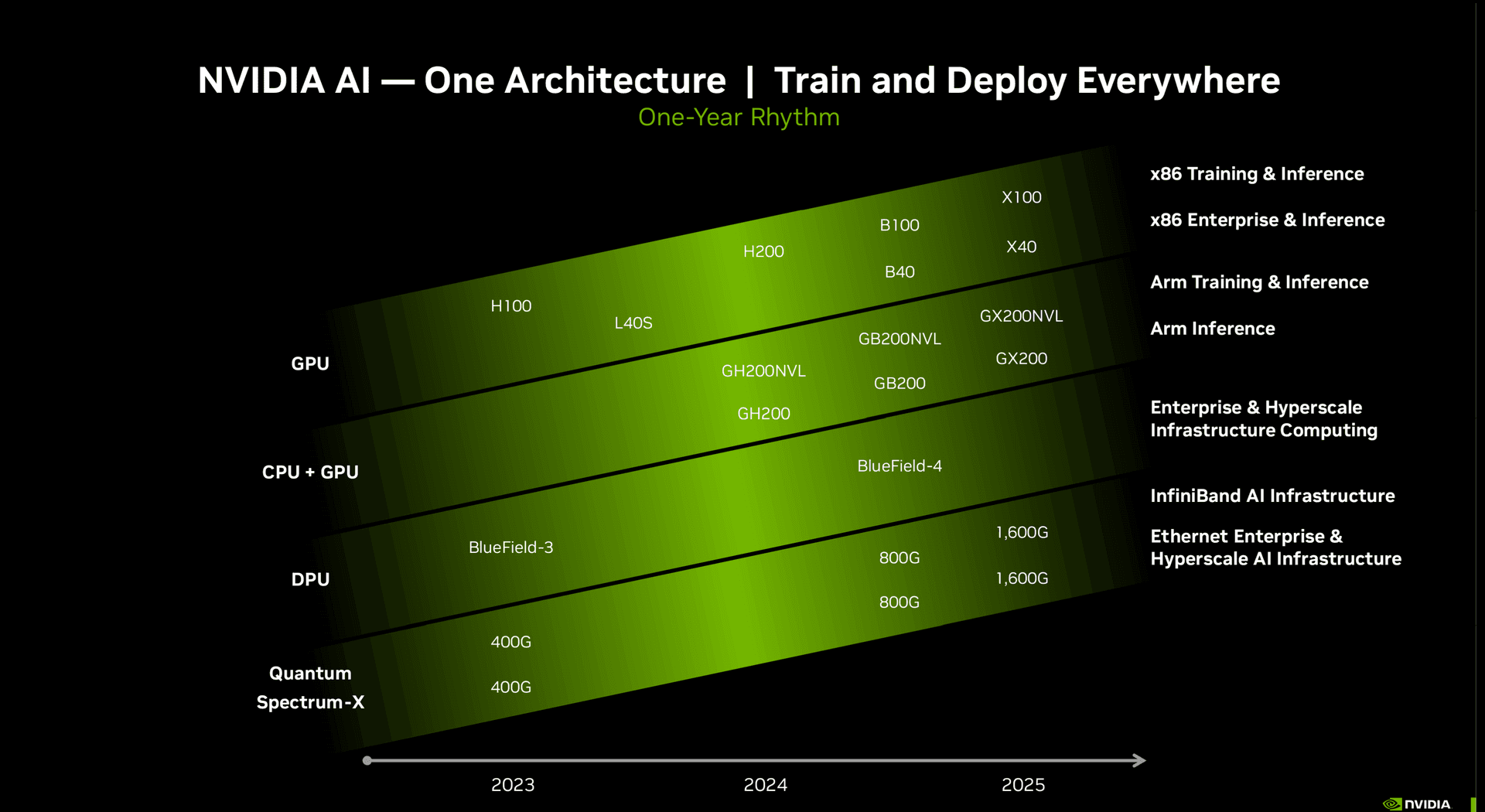
Inside the NVIDIA Vera Rubin Platform: Six New Chips, One AI ...

The shift reflects the reality that large-scale AI training is now constrained by data movement, not computation. Models like GPT-4o and Gemini 3 Pro require moving terabytes of parameters and activations across memory hierarchies during each training step. Vera Rubin's design addresses this by optimizing the entire data path from GPU memory through the interconnect fabric to the rack-level infrastructure.

System-Level Competition

This move positions Vera Rubin against Google's TPU architecture, which has long emphasized system-level integration. Google's TPU v6p, deployed in clusters of 3 million units [per recent Intel packaging deals], already leverages custom interconnects and memory subsystems. Nvidia's strategy acknowledges that the Blackwell architecture's raw compute gains were increasingly bottlenecked by memory and I/O.

Data Center Financing Context

The Vera Rubin announcement comes as Nvidia reportedly negotiates up to $250 billion in financing to back OpenAI's Ohio data center plans [per CNBC]. This infrastructure push suggests Nvidia is betting that system-level architecture differentiation will justify the massive capital expenditure required for next-generation AI data centers. The company did not disclose specific performance numbers or Vera Rubin's memory capacity in the announcement.

Architectural Implications

For ML engineers, Vera Rubin's emphasis on memory bandwidth and interconnect density means the effective performance gains will depend heavily on model architecture and parallelism strategy. Models with high memory-bandwidth requirements—like Mixture-of-Experts architectures or those with large context windows—stand to benefit most. The architecture's success hinges on whether Nvidia can deliver meaningful improvements in the memory wall that has constrained scaling for the past two generations.

What to watch

Watch for Nvidia's GTC 2027 keynote where specific Vera Rubin performance numbers, memory capacity, and interconnect bandwidth will likely be disclosed. Also monitor whether the $250B OpenAI data center financing deal closes, as it would validate the system-level infrastructure thesis.


Source: news.google.com


Sources cited in this article

  1. CNBC
  2. Indiatimes
  3. Nvidia
Source: gentic.news · · author= · citation.json

AI-assisted reporting. Generated by gentic.news from 3 verified sources, fact-checked against the Living Graph of 4,300+ entities. Edited by Ala SMITH.

Following this story?

Get a weekly digest with AI predictions, trends, and analysis — free.

AI Analysis

This is a significant strategic admission from Nvidia. The company that built its AI dominance on raw compute performance is now acknowledging that the next scaling frontier is system-level integration. The timing is telling—coming as Google scales TPU deployments to 3 million units and as Nvidia negotiates $250B in data center financing. The Vera Rubin pivot mirrors a pattern we've seen in hyperscaler architecture: as model sizes cross trillion-parameter thresholds, the limiting factor shifts from compute to memory bandwidth and interconnect density. Google's TPU architecture has long optimized for this, but Nvidia's H100 and Blackwell generations were designed primarily for compute density. The risk for Nvidia is that system-level optimization requires different engineering expertise—thermal management, power delivery, network topology—that differs from GPU chip design. The success of Vera Rubin will depend on whether Nvidia can execute on this broader systems play without sacrificing the GPU performance that built its ecosystem. The $250B financing talks suggest Nvidia is betting big on this thesis, but the lack of specific performance numbers in the announcement is notable.
This story is part of
The AI Infrastructure War Shifts from Chips to Developer Tools
Nvidia's enterprise pivot and AWS's OpenAI bet collide with Cursor's quiet ascent
Compare side-by-side
Nvidia vs OpenAI
Enjoyed this article?
Share:

AI Toolslive

Five one-click lenses on this article. Cached for 24h.

Pick a tool above to generate an instant lens on this article.

Related Articles

From the lab

The framework underneath this story

Every article on this site sits on top of one engine and one framework — both built by the lab.

More in Products & Launches

View all