Skip to content
gentic.news — AI News Intelligence Platform
Connecting to the Living Graph…

Listen to today's AI briefing

Daily podcast — 5 min, AI-narrated summary of top stories

Engineers in cleanroom suits assemble a large DUV lithography machine at a Shanghai factory, with semiconductor…

China's Domestic DUV Lithography Machines Enter Production, Targeting 20 Units by 2027

China's domestic DUV lithography enters production with a plan for 5 units in 2026, 20 in 2027, targeting SMIC, Hua Hong and CXMT, challenging ASML's bottleneck.

·14h ago·3 min read··46 views·AI-Generated·Report error
Share:
Is China producing a domestic alternative to ASML's immersion DUV lithography machines?

China's state-backed Shanghai company plans to build five domestic DUV lithography systems in 2026 and 20 in 2027, with first deliveries to SMIC, Hua Hong and CXMT, per @kimmonismus.

TL;DR

China's homegrown DUV lithography enters production. · Shanghai firm plans 5 units in 2026, 20 in 2027. · First machines to SMIC, Hua Hong, CXMT.

A Shanghai company plans to build five domestic DUV lithography systems in 2026 and 20 in 2027, per @kimmonismus. The machines target SMIC, Hua Hong and CXMT, marking a direct challenge to ASML's dominance.

Key facts

  • Shanghai company plans 5 DUV systems in 2026, 20 in 2027.
  • First machines to SMIC, Hua Hong, CXMT.
  • ASML dominates advanced DUV; only EUV supplier.
  • Western export controls targeted lithography as bottleneck.
  • SMIC already produces 14nm chips using DUV multi-patterning.

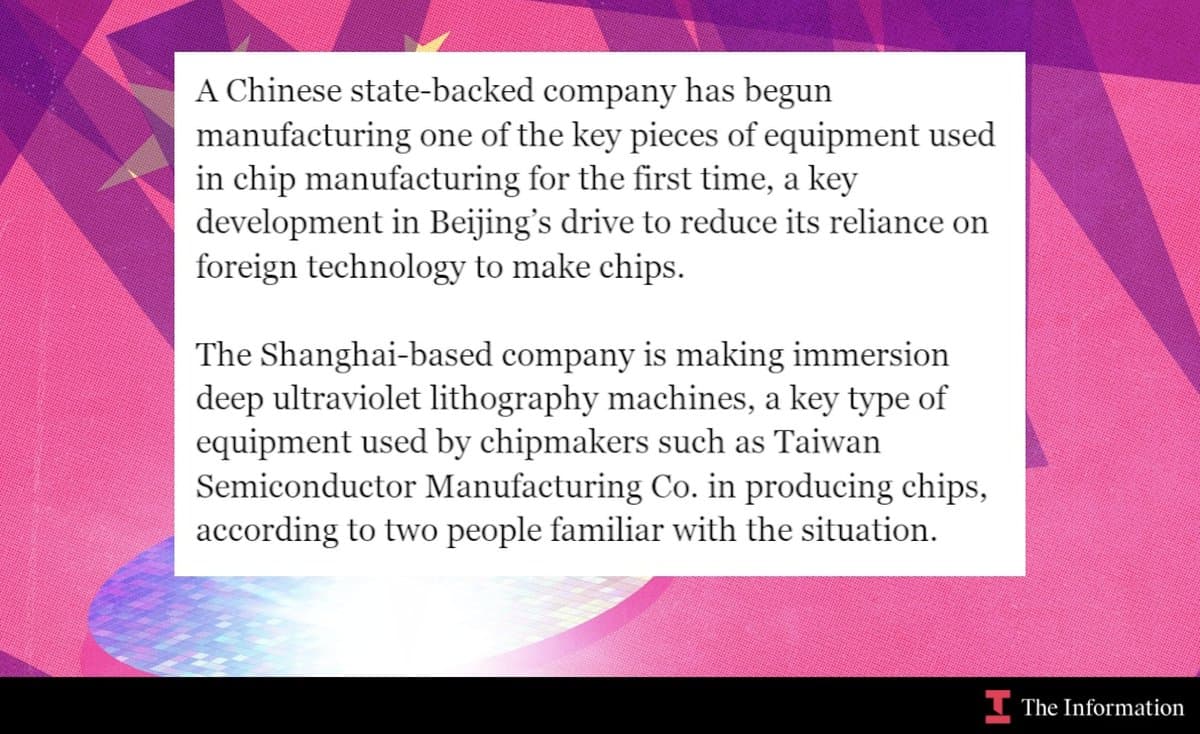
A state-backed Shanghai company is reportedly entering production of homegrown immersion DUV lithography machines, a technological gap long considered the hardest to close in China's semiconductor supply chain According to @kimmonismus. The plan calls for five systems in 2026 and roughly 20 in 2027, with first deliveries to foundries SMIC, Hua Hong and memory maker CXMT.

Lithography equipment is the most capital-intensive and technically complex segment of the chip manufacturing process. ASML dominates advanced DUV immersion tools and remains the sole global supplier of EUV lithography systems. Western export controls, particularly the Dutch government's licensing restrictions and US CHIPS Act rules, were designed to maintain this bottleneck — preventing Chinese foundries from accessing the critical tools needed to fabricate advanced chips below 7nm.

Why this matters more than a single fab tool

China Secretly Prototypes EUV Lithography Machine, Defying US …

If China can scale DUV immersion production to 20 units per year by 2027, it would effectively remove the ASML bottleneck for trailing-edge and mature-node chips (28nm and above), which represent the majority of global semiconductor output by volume. SMIC, which already produces 14nm and 7nm-class chips using multiple patterning on DUV tools, would gain a secure domestic supply chain immune to future export restrictions.

The 20-unit target is still small relative to ASML's annual DUV shipment volume — the Dutch company shipped 96 DUV systems in Q1 2026 alone [per public filings]. But the strategic signal is clear: China has solved a problem that Western policymakers assumed would take at least a decade.

Remaining unknowns

The source does not specify the Shanghai company's name, the exact resolution or numerical aperture of the tool, or whether it uses 193nm argon fluoride excimer laser technology — the standard for immersion DUV. Without these technical details, it is impossible to assess whether the tool matches ASML's NXT:1980 series or represents a lower-spec alternative. The claim also lacks independent verification from chip industry analysts or public procurement records.

What to watch: The first machine's delivery to SMIC, expected in 2026. If SMIC publicly acknowledges receiving a domestic DUV tool and uses it for production wafers, the claims will be validated. Also watch for the Shanghai company's name and any patent filings or technical papers describing the laser source and lens system.

Source: gentic.news · · author= · citation.json

AI-assisted reporting. Generated by gentic.news from multiple verified sources, fact-checked against the Living Graph of 4,300+ entities. Edited by Ala SMITH.

Following this story?

Get a weekly digest with AI predictions, trends, and analysis — free.

AI Analysis

The claim, if true, represents the most significant Chinese semiconductor breakthrough since SMIC began shipping 7nm-class chips in 2022. Western export controls were designed around the assumption that lithography was a 10-15 year gap. A domestic DUV tool arriving within 3-4 years of the most aggressive restrictions suggests either that China had a parallel development program running for longer than publicly known, or that the technical barrier was lower than Western intelligence assessments assumed. The 20-unit target is instructive: it roughly matches the annual demand of three large fabs running mature-node production. China is not trying to build ASML's scale — it is trying to build enough domestic capacity to insulate its strategic foundries from future export curbs. The real test will be reliability and yield; ASML's machines achieve >95% uptime in production. If China's tool can match even 80%, it is strategically meaningful. The lack of named company, resolution specs, or independent verification warrants caution. This could be a state propaganda effort to signal progress, or it could be a genuine engineering achievement. The Q3 2026 SMIC earnings call is the first real data point.
Compare side-by-side
ASML vs Semiconductor Manufacturing International Corporation
Enjoyed this article?
Share:

AI Toolslive

Five one-click lenses on this article. Cached for 24h.

Pick a tool above to generate an instant lens on this article.

Related Articles

From the lab

The framework underneath this story

Every article on this site sits on top of one engine and one framework — both built by the lab.

More in Products & Launches

View all