Anthropic shipped Claude Opus 5 on July 24, calling it a step-change over Opus 4.8. The model runs a 1M token context window with 128k max output tokens, priced identically to its predecessor while claiming to approach Fable 5 intelligence at half the cost.
Key facts
- Claude Opus 5 released July 24, 2026.
- 1M token context window (default and maximum).
- 128k max output tokens.
- Pricing identical to Opus 4.8 per token.
- Claims to approach Fable 5 intelligence at half the cost.
Anthropic released Claude Opus 5 on July 24, and the framing in its own documentation is unusually direct. Anthropic calls it a step-change improvement over Claude Opus 4.8, not an incremental one, and says the largest gains land in deep reasoning, agentic coding and long-horizon tasks, and test-time compute scaling According to Claude Opus 5 Is Here. That is a specific claim, not marketing language, and it matches how the model is positioned everywhere else in the announcement: as a model built to stay on task across long tool-use loops rather than one built to win a single benchmark screenshot.
The capability list is long and mostly practical. Anthropic highlights better code review and bug-finding, with a high hit rate on real bugs and few false positives, holding up even at lower effort levels. It highlights vision improvements—reading charts, documents, and diagrams—and replicating UI and frontend visuals when the model has tools to crop and check its own work. It highlights office and document tasks—generating multi-sheet spreadsheets with real formulas and structured slide decks—and multi-agent coordination, running teams of subagents with writer-verifier patterns and fewer cases of agents stepping on each other's output.
What stands out is that this is not a model pitched as a smarter chat assistant. Every capability on the list points at the same audience: people running Claude inside an agent loop, a coding session, or a multi-step workflow, for long stretches, without a human checking every step.
The Context Window and Effort Changes That Actually Matter
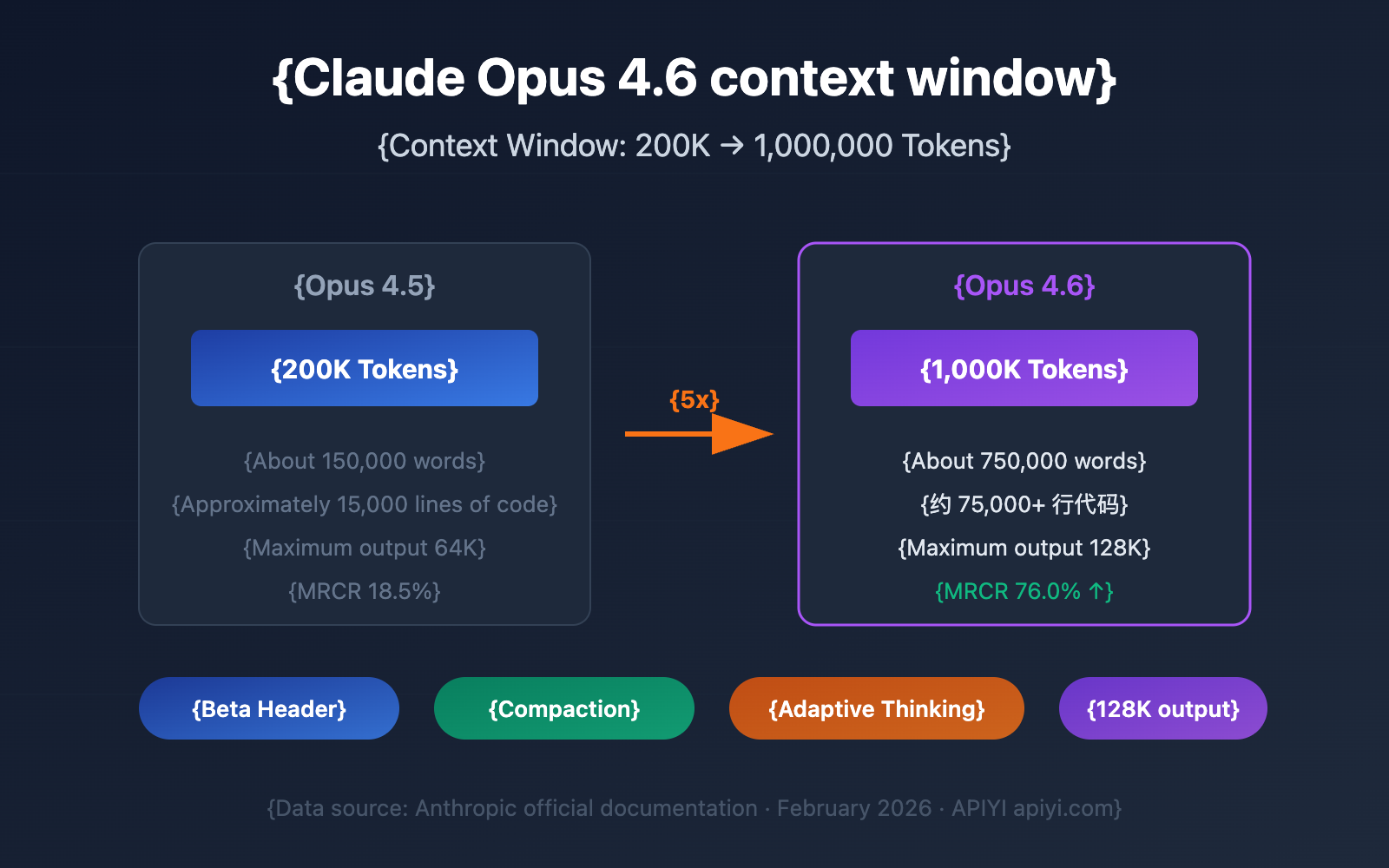
Two numbers define the ceiling on Claude Opus 5: a 1M token context window and 128k max output tokens. The context window detail worth noting is that 1M is both the default and the maximum—there is no smaller context variant to opt into. Anthropic states that instruction following, tool calling, and reasoning quality stay consistent across that entire window rather than degrading toward the end of it, which is the actual bottleneck long-context work usually runs into.
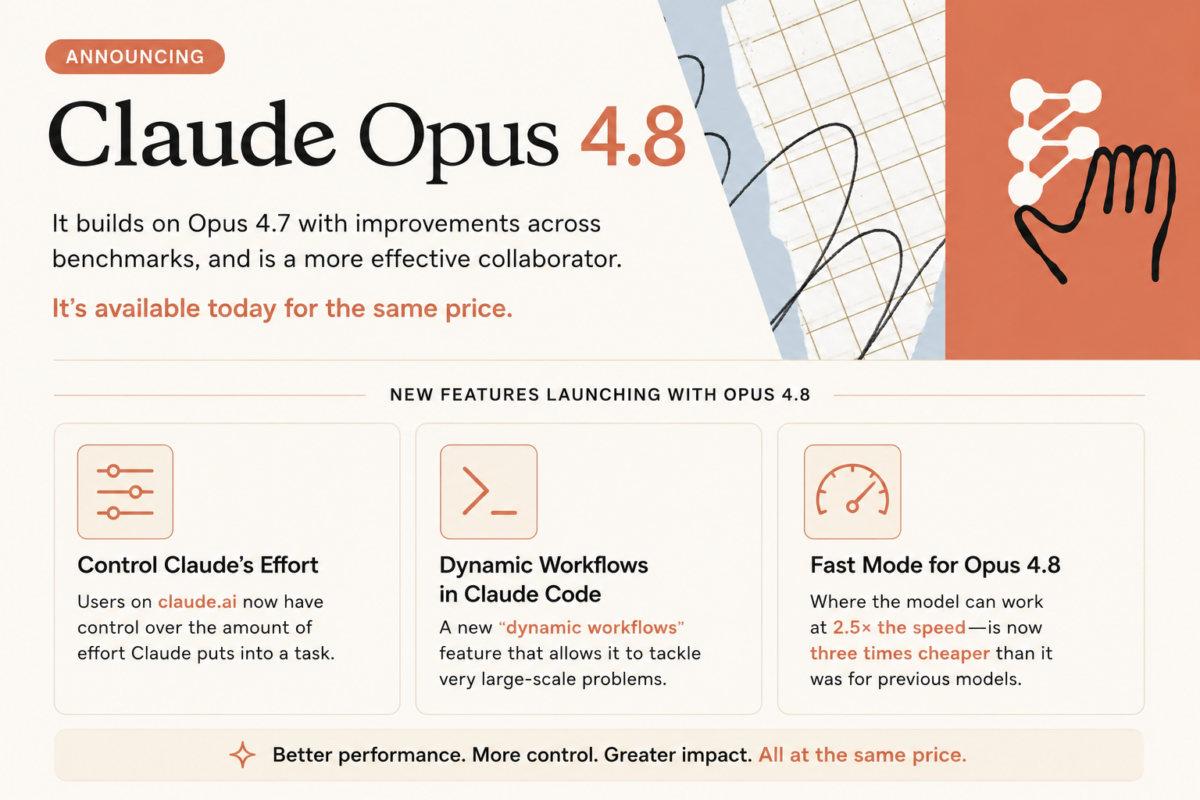
Thinking is on by default now, which is a real behavior change from Opus 4.8, where a request ran without thinking unless you explicitly asked for it. On Opus 5, the model decides when and how much to think on its own for each turn, and the lever you pull instead is called effort, with five levels: low, medium, high, xhigh, and max. High is the default. Anthropic's own guidance is to start there and move down where quality holds, to save tokens and latency, or up for the hardest problems. That is a meaningfully different way to think about cost than the old on/off thinking toggle.
There is a breaking change buried in that shift worth flagging for anyone with existing integrations. On Opus 5, you can only disable thinking entirely when the effort level is high or below. Setting effort to xhigh or max while trying to turn thinking off now returns an error. If an existing setup explicitly disables thinking at a high effort level, it will need to either drop the effort level or stop disabling thinking.
A few smaller changes round out the release. Prompt caching now works on prompts as short as 512 tokens, half the previous 1,024 token minimum on Opus 4.8, so shorter reusable prompts can now benefit from caching with no code changes. There is also a beta for mid-conversation tool changes, letting you add or remove tools between turns without losing the prompt cache, instead of resending a fixed tool list for the whole session. Small on paper, useful in practice for anyone building an agent that needs different tools at different stages of a task.
Where the Pricing Actually Lands
The number Anthropic is leaning on hardest in its own framing is price relative to capability. Opus 5 is priced identically, per token, to Opus 4.8, no increase at all, while Anthropic says it approaches the intelligence of Fable 5, the company's most capable public model, at roughly half of what Fable 5 costs. That is the headline comparison across nearly every outlet that covered the release, and it lines up with how Anthropic has been positioning its tiers all year: Fable 5 for the hardest problems, Opus for everything serious that still needs to run at real volume.
There is also a Fast mode, still in research preview, available on the Claude API only and not yet on Bedrock, Google Cloud, or Microsoft Foundry. It runs roughly two and a half times faster than the default and costs meaningfully more per token, which is the usual trade for anyone who needs lower latency on a specific workload and is willing to pay for it rather than optimize around it.
For anyone tracking what a Claude subscription or API budget actually buys month to month, this release reads less like "a new model exists" and more like "the same money now reaches a smarter model."
Why This Lands Differently Than a Routine Model Bump
Model releases happen often enough that it is easy to treat each one as a minor version bump and move on. This one reads differently for a specific reason: nearly every headline capability is aimed at agentic work rather than conversational quality. Long-horizon task completion, multi-agent coordination, code review accuracy, and consistent behavior across a full 1M token context are all things that matter specifically to people running Claude inside a loop, not people asking it one question at a time.
The other detail worth sitting with is the release strategy itself. Opus 5 shipped simultaneously across the Claude API, AWS Bedrock, Google Cloud, and Microsoft Foundry, with Opus 4.8 staying available everywhere alongside it rather than being pulled. Nobody using the old model gets forced onto the new one before they are ready, and nobody waiting on a specific cloud platform has to wait weeks for parity. For a company whose main product is increasingly "the thing your agents run on," that kind of uniform, no-forced-migration rollout is its own quiet signal about how seriously reliability is being taken at this scale.
What to watch

Watch for the first real-world benchmark comparisons from independent evaluators (e.g., SWE-bench verified, HumanEval) to validate Anthropic's claim that Opus 5 closes the gap to Fable 5. Also track adoption of the Fast mode in production workloads once it exits research preview.
Source: dev.to
[Updated 26 Jul via devto_claudecode]
A key detail from the release: Claude Opus 5 shipped everywhere at once—the Claude API, AWS Bedrock, Google Cloud Vertex AI, and Microsoft Foundry—and is now the default Opus model inside Claude Code itself, with expanded support for dynamic workflows, nested subagents, and MCP handling [per dev.to]. Anyone opening Claude Code after July 24 is already running the new model without changing a setting.