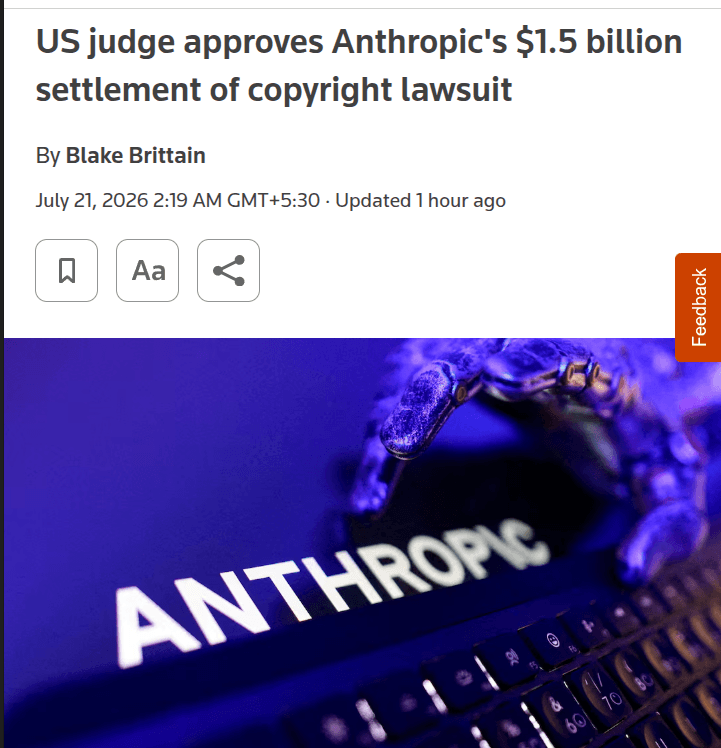
A US judge approved Anthropic's $1.5B settlement with authors whose books trained Claude, the largest known payout in any US copyright case. The ruling preserves a key fair use win for AI training while penalizing the company for storing 7 million pirated copies.
Key facts
- $1.5B — largest known US copyright settlement
- 7 million pirated books stored by Anthropic
- 91% of covered authors claimed their share
- Training on books ruled fair use by judge
A US judge approved Anthropic's $1.5B settlement with authors whose books trained Claude, the largest known payout in any US copyright case. According to @rohanpaul_ai, the fight started when writers sued the company for grabbing pirated copies of their books. Those stolen texts were fed in to teach the model how to answer prompts.
The judge ruled that training on books is fair use, so that part stayed legal. But the same judge flagged a separate problem, one unrelated to training: the company had saved over 7 million pirated books into a central library it barely used. Storing stolen copies is infringement on its own, even without any training.
That exposure was huge, since a trial could have pushed damages into the hundreds of billions. So both sides settled, and 91% of covered authors have already claimed their share. Some writers pushed back, calling the sum too small and the fees too fat. The judge said that complaints about the settlement's size were "not grounded in a realistic assessment of the overall risks and rewards of a trial." A few opted out and are still chasing their own cases against the company.
The Fair Use Precedent That Survived
The settlement's structure reveals a strategic calculation: Anthropic paid $1.5B to protect a fair use win for AI training. By conceding on storage infringement, the company avoided a trial that risked hundreds of billions in statutory damages — the kind of existential threat that could have forced it to shut down Claude or re-license its entire training corpus.
This is the largest known settlement in any US copyright case, dwarfing the $500M Google paid in 2024 for similar claims around YouTube content. The 91% author participation rate suggests most writers viewed the payout as better than a trial's uncertain outcome, even if some activists condemned it as too low.
What to watch
Watch for the opt-out authors' individual cases, which could test whether the fair use ruling holds when applied to specific works. Also track whether other AI companies — particularly Meta with its Llama models — face similar storage-infringement claims as they scale training datasets.
[Updated 21 Jul via fortune_tech]
The settlement breaks down to roughly $3,000 per book, which plaintiffs call the largest copyright recovery ever [per Fortune]. That per-title figure gives authors a concrete sense of their individual payout, beyond the aggregate $1.5B sum.