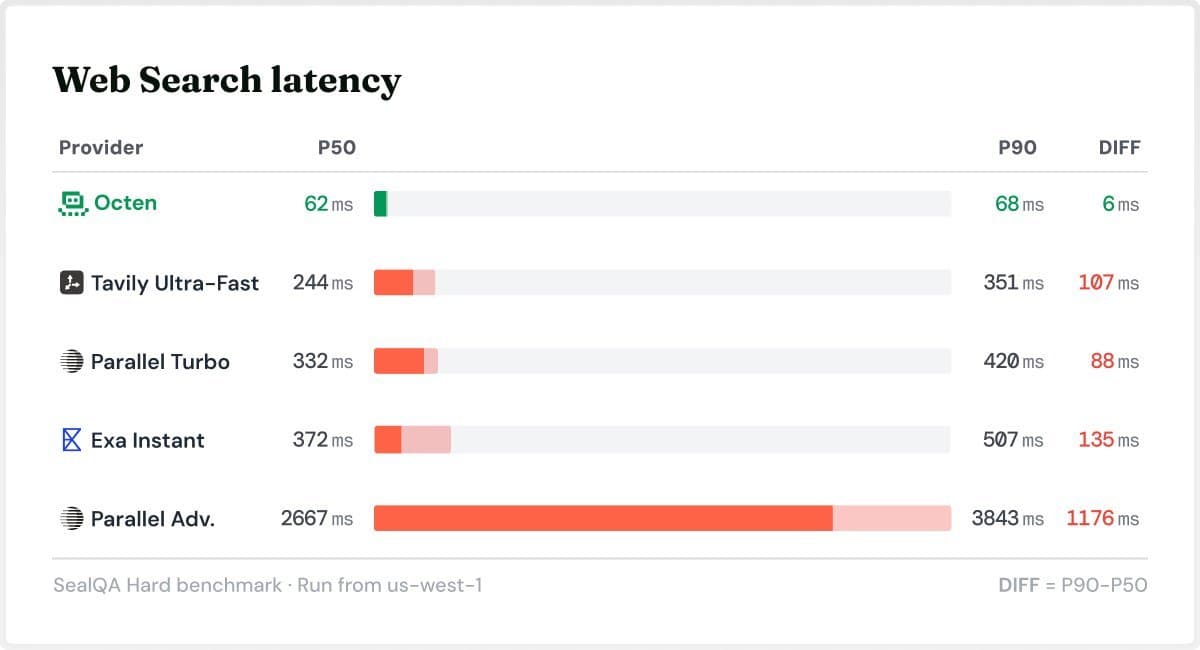
Octen's deep research tool scored 10–17 points higher than OpenAI, Gemini, Grok, and Perplexity on the DeepResearch Bench. It returns a full source-backed report in under 3 minutes, versus competitors that can take up to an hour per @omarsar0.
Key facts
- Octen scores 10–17 points higher than four competitors on DeepResearch Bench.
- Octen returns reports in under 3 minutes; competitors take up to an hour.
- Competitors: OpenAI, Gemini, Grok, Perplexity.
- Benchmark tests factuality and source coverage.
- Octen has not disclosed architectural details.
Deep research tools have long traded accuracy for speed — OpenAI's deep research, Gemini Deep Research, Grok's DeepSearch, and Perplexity Pro each require 15–60 minutes per query to compile multi-source reports. Octen's benchmark results challenge that tradeoff.
On the DeepResearch Bench, a standard evaluation for multi-step web research, Octen outperformed all four by 10–17 points. The company did not disclose absolute scores or the benchmark's exact methodology, but the margin is large enough to suggest a meaningful architectural advantage.
The speed difference is stark: Octen returns a full source-backed report in under 3 minutes, while competitors often take up to an hour [@omarsar0]. That 20x latency reduction, combined with higher accuracy, implies Octen's retrieval and synthesis pipeline avoids the iterative Loops that slow other systems.
How Octen likely achieves this
Octen's approach appears to use parallelized retrieval and a lightweight reasoning step, rather than the multi-turn agent loops common in OpenAI's deep research or Perplexity's Pro search. The company has not published technical details, but the benchmark results suggest its architecture minimizes sequential LLM calls — the primary source of latency in competing tools.
What the benchmark doesn't tell us
The DeepResearch Bench tests factuality and source coverage, but does not measure report quality on subjective tasks (e.g., nuanced analysis, writing style). Octen's advantage may be narrower on complex reasoning tasks that require iterative refinement. Independent replication would strengthen the claim.
Who this affects
AI developers building web-search-integrated agents, researchers needing rapid literature reviews, and anyone evaluating deep research tools for production. If Octen's results hold under broader testing, it could shift the cost-performance curve for retrieval-augmented generation (RAG) systems.
What to watch
Watch for Octen to publish technical details or a paper on its architecture. If independent benchmarks confirm the results, expect competitors to adopt similar parallelized retrieval strategies within 6–12 months.