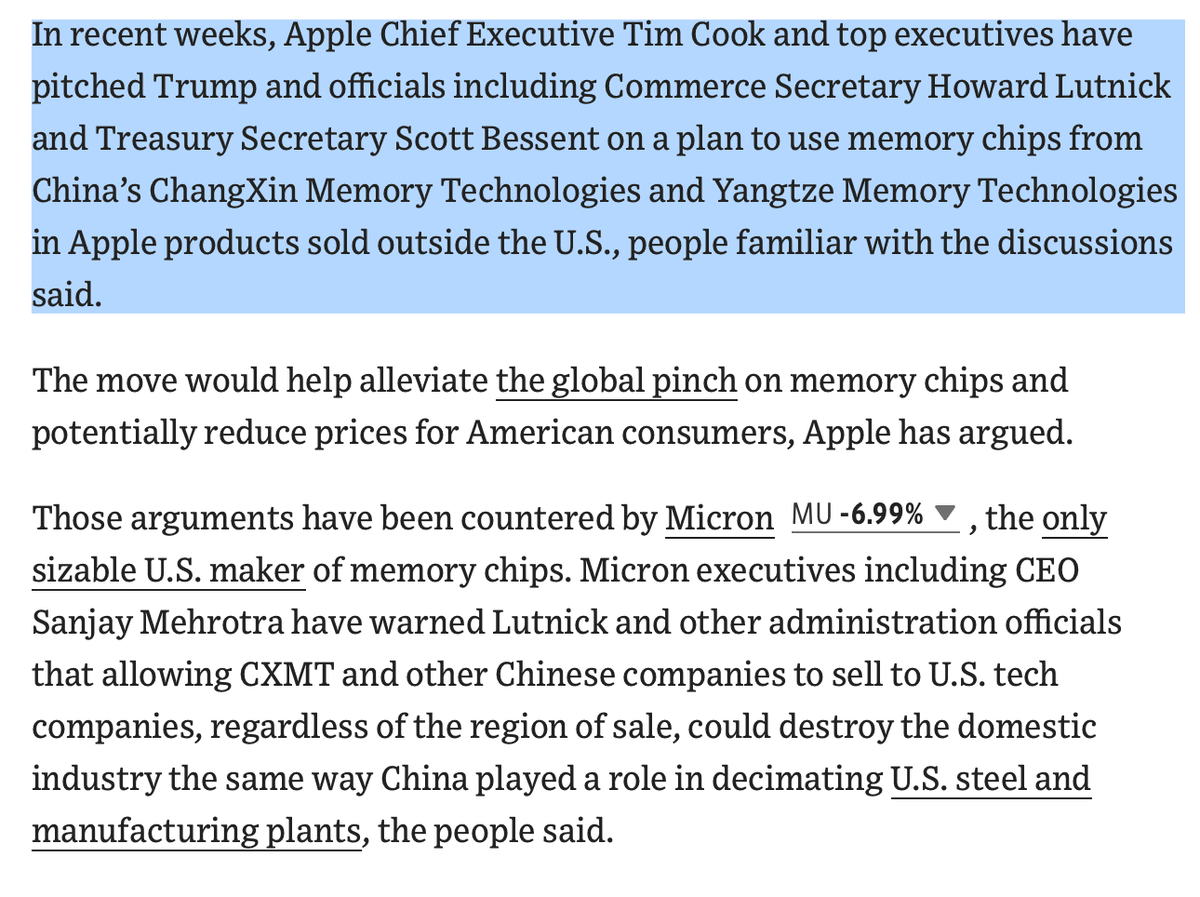
Apple CEO Tim Cook asked the Trump administration to approve Chinese memory chips from CXMT and YMTC. Micron warned the move could destroy America's last major memory-chip producer, per the WSJ @kimmonismus.
Key facts
- Memory-chip prices quadrupled over the past year
- Micron's gross margins exceed 80%
- Apple seeks chips from China's CXMT and YMTC
- US gave Micron $6.1 billion in CHIPS Act subsidies
- CXMT and YMTC under US export controls since 2022
Tim Cook has reportedly asked the administration to let Apple use chips from China’s CXMT and YMTC in products sold outside the US. Apple says this would ease the global shortage and lower costs. Memory-chip prices have quadrupled over the past year, while Micron’s gross margins now exceed 80%. Apple accuses the company of raising prices and reserving too much new capacity for AI data centers per the WSJ, reported by @kimmonismus.
Key Takeaways
- Apple asked Trump to approve Chinese memory chips; Micron warns it could destroy US industry.
- Prices quadrupled, margins exceed 80%.
The Structural Conflict

This is not a standard supply-chain squabble — it's a direct challenge to the CHIPS Act's core premise. The Biden administration spent $39 billion subsidizing domestic semiconductor production, including $6.1 billion for Micron's New York fab. Apple's request would effectively undercut that investment by importing Chinese chips. Micron's warning that the move could "destroy America's last major memory-chip producer" is hyperbolic but not baseless: CXMT and YMTC have been under U.S. export controls since 2022 for national security reasons, and approving their use would signal a reversal of that policy.
The memory market is already distorted. Prices quadrupled in 12 months, and Micron's 80% gross margins suggest pricing power that Apple finds exploitative. But Apple's alternative — sourcing from Chinese suppliers — would require the administration to waive its own sanctions, a politically explosive ask in an election year.
What's at Stake

For Apple, the request is about cost control and supply diversification. For Micron, it's existential — the company controls roughly 25% of the global DRAM market, and losing Apple as a customer to Chinese rivals would crater its revenue. For the administration, the decision tests whether industrial policy can survive corporate lobbying. The WSJ report does not indicate a timeline for a decision, but the Trump administration's trade hawk instincts suggest approval is unlikely.
What to watch
Watch for the administration's formal response, likely within 90 days, and whether Micron files a formal protest under the Defense Production Act. Also track CXMT and YMTC export license applications — approval would signal a policy pivot.