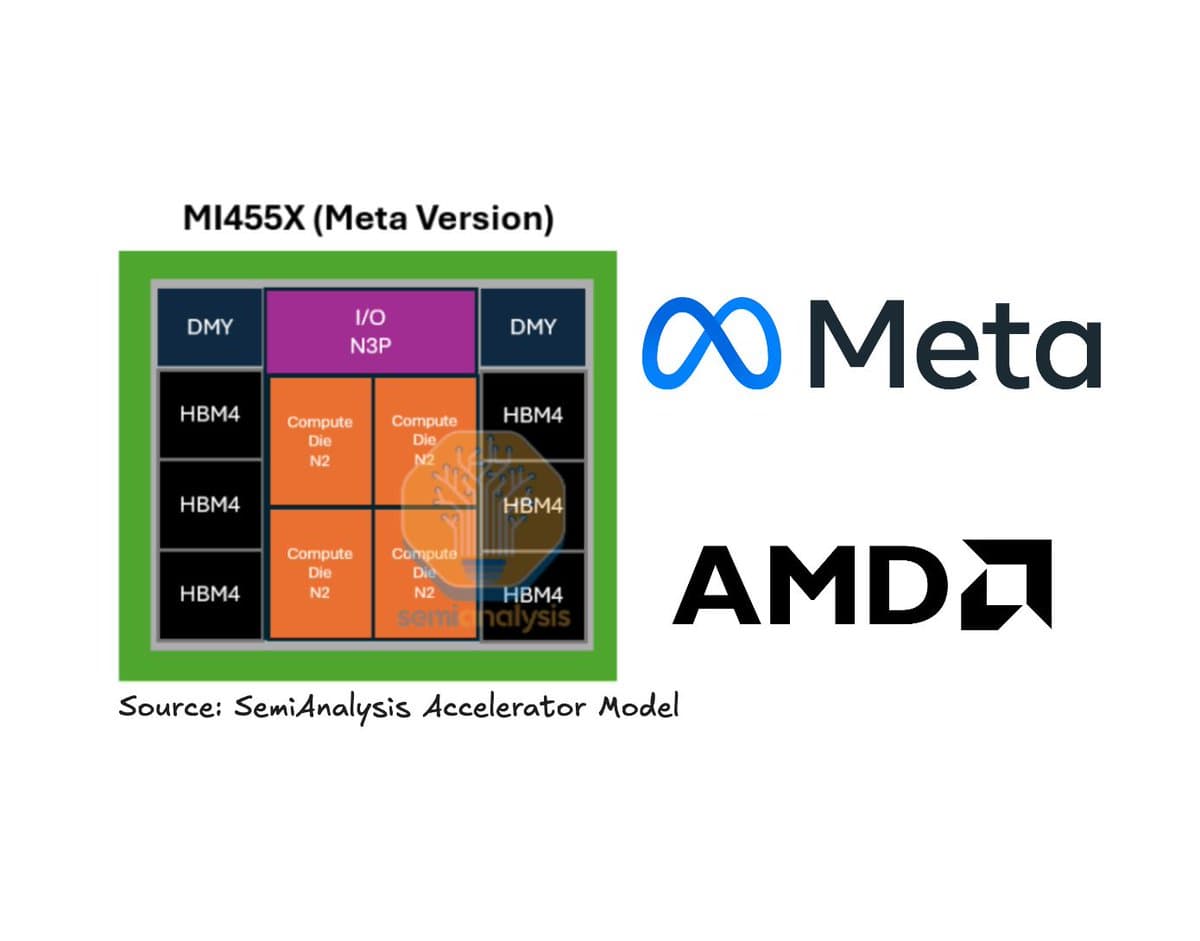
Meta's custom AMD MI400-series chip halves the standard MI455X die size. The chip uses ~144GB of HBM instead of 432GB, optimized for recommendation system workloads.
Key facts
- Chip is half the size of standard MI455X.
- Uses ~144GB HBM vs 432GB standard.
- Optimized for recsys workloads and $/memory bandwidth.
- Meta custom design with AMD MI400 architecture.
Meta is developing a custom AMD MI400-series chip that is half the size of a standard MI455X, according to @SemiAnalysis_. The chip is "optimized" for recommendation system workloads and memory bandwidth per dollar, using approximately 144GB of HBM compared to the standard 432GB.
This is a strategic move by Meta to reduce cost and power for its dominant inference workload — recsys — which drives ad ranking and content recommendation across Facebook and Instagram. By stripping away compute and memory not needed for these models, Meta can achieve better price-performance than off-the-shelf GPUs.
The approach mirrors Meta's earlier custom chip efforts, like the MTIA (Meta Training and Inference Accelerator), but now leverages AMD's MI400 architecture. The smaller die size implies lower manufacturing cost per chip and higher yield, while the reduced HBM stack cuts memory subsystem expense. [SemiAnalysis did not disclose the timeline for deployment or expected performance benchmarks.]
For AMD, this represents a key design win in the custom AI chip market, potentially opening a new revenue stream beyond standard merchant silicon. The chip's focus on recsys suggests Meta sees continued value in purpose-built hardware for its largest-scale workloads, even as it invests in general-purpose GPU clusters for training large language models.
What this means for the AI hardware landscape
The MI400 custom chip signals a broader trend: hyperscalers are increasingly willing to co-design chips with vendors rather than buy off-the-shelf. Google has its TPU, Amazon its Trainium and Inferentia, and Microsoft has been rumored to explore custom silicon. Meta's deal with AMD gives it a semi-custom path without the full cost of designing from scratch.
The 144GB HBM figure is notable — it's exactly one-third of the standard 432GB, suggesting Meta is optimizing for a specific memory footprint typical of recsys models. This could mean lower latency and power per inference, though [SemiAnalysis did not provide performance numbers or cost savings estimates.]
What to watch
Watch for Meta's Q4 2026 earnings call for any mention of custom chip deployment at scale, and for AMD's next datacenter GPU roadmap update for MI400-series volume ramp details.
[Updated 22 Jul via tomshardware]
The custom chip will reportedly use HBM4 memory, [per Tom's Hardware], confirming a generational leap over the HBM3 found in current AMD Instinct accelerators. This aligns with AMD's MI400-series roadmap and suggests Meta is securing early access to next-generation memory technology for its recsys inference clusters.