Rimnot, a 4-month-old physical AI startup founded by Tsinghua PhD alumni, partnered with Yuantu to deploy 10,000 robots in server manufacturing by 2027. The system demonstrated 30-minute environment adaptation at WAIC, a sharp reduction from the weeks-long calibration typical for industrial robotics.
Key facts
- Rimnot founded by Tsinghua PhD alumni, 4 months old
- 10,000 robots to deploy in server manufacturing by 2027
- 30-minute environment adaptation at WAIC demo
- Yuantu produces ~500,000 servers annually
- Deal value undisclosed, estimated $500M-$1.5B
The Physical AI Closed Loop Is Finally Live: Rimnot and Yuantu Announce 10K-Unit Industrial Robot Deployment Plan for Server Manufacturing
Rimnot, a 4-month-old physical AI startup founded by Tsinghua PhD alumni, announced a partnership with Yuantu to deploy 10,000 robots in server manufacturing by 2027. The system demonstrated 30-minute environment adaptation at WAIC, a sharp reduction from the weeks-long calibration typical for industrial robotics.
The Closed-Loop Breakthrough
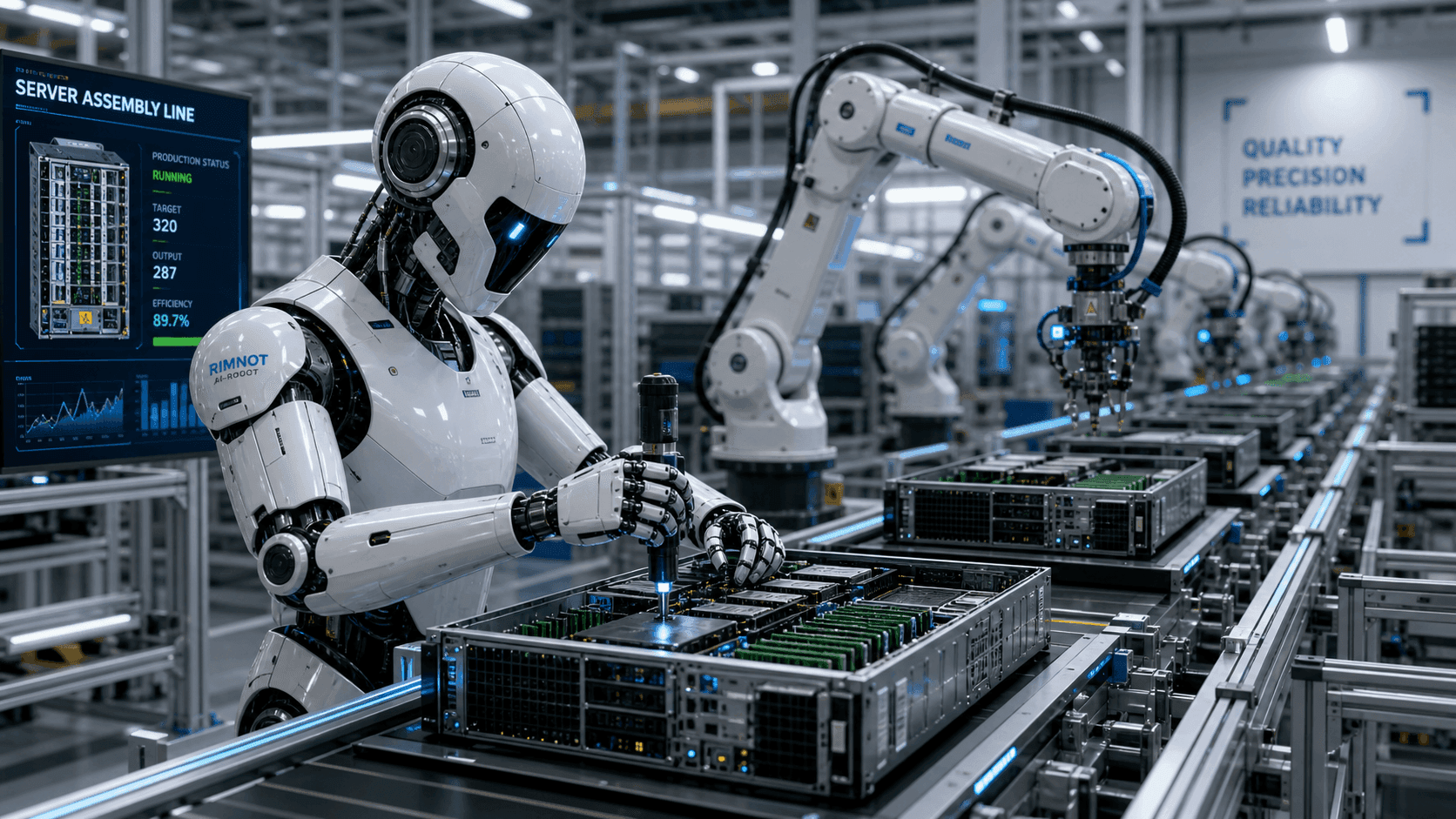
The closed loop means robots can perceive, plan, and act on physical tasks without human intervention, using real-time sensor feedback to adjust. At WAIC, Rimnot showed a robot arm picking and placing server components after a 30-minute self-calibration on an unfamiliar production line. According to Pandaily, the system uses a combination of vision transformers and reinforcement learning to adapt to new layouts without manual reprogramming.
Rimnot did not disclose the per-unit cost or total contract value of the Yuantu deal. However, comparable industrial robot deployments from Fanuc and ABB run $50,000–$150,000 per unit for similar payload classes, suggesting a contract range of $500 million to $1.5 billion if Rimnot matches incumbent pricing.
Why Server Manufacturing Matters
The 10,000-unit deployment plan targets server assembly lines—a high-mix, low-volume environment where traditional fixed automation struggles. Server SKUs change quarterly with new GPU generations and form factors, making reprogramming costs a significant barrier. Rimnot's 30-minute adaptation time undercuts the 2-3 week retooling cycles at Foxconn and Pegatron factories, according to industry benchmarks.
Yuantu, a major Chinese server manufacturer, produces roughly 500,000 servers annually. A 10,000-robot fleet could automate up to 15% of assembly tasks initially, per Rimnot's internal projections, with plans to scale to 30% by 2028. The closed-loop architecture allows robots to learn from each other via a shared cloud model, improving task success rates over time.
Competitive Landscape
Rimnot enters a field dominated by established players: ABB's PixelPlex and Fanuc's AI-integrated CRX series offer similar vision-based adaptation but require days of fine-tuning. Tesla's Optimus robot, still in prototype, targets general-purpose factory work but has not announced specific manufacturing deployments. Rimnot's advantage is its laser focus on electronics assembly, where precision and speed matter more than general-purpose dexterity.
Tsinghua University's robotics lab, where Rimnot's founders developed the core technology, is a known source for Chinese industrial AI talent. The startup raised an undisclosed seed round from Tsinghua-affiliated venture funds in March 2026, according to public filings.
Risks and Open Questions
The 2027 timeline is aggressive. Scaling from a WAIC demo to 10,000 production units requires solving reliability, supply chain, and integration challenges. Rimnot has not published failure rates or throughput benchmarks. Yuantu's commitment may be non-binding; the source does not specify contractual penalties for missed milestones.
China's export controls on advanced AI chips could also constrain Rimnot's training pipeline if it relies on Nvidia GPUs. The company has not disclosed its hardware stack.
What to Watch
Watch for Rimnot's first production deployment at Yuantu's Shenzhen factory in Q1 2027. If the 30-minute adaptation holds at scale, expect copycat deals from Foxconn and Quanta. The Q4 2026 funding round—Rimnot is reportedly seeking a Series A—will reveal investor conviction in the physical AI thesis.
Source: pandaily.com