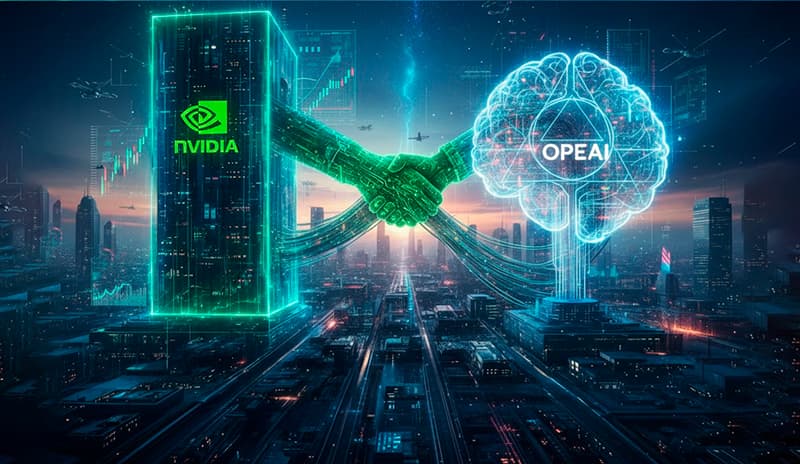
Nvidia is negotiating a $250 billion investment in OpenAI, according to TradingView. The deal would be the largest AI capital injection ever, eclipsing Microsoft's $13 billion stake in the company.
Key facts
- $250B — Nvidia's potential investment in OpenAI
- 96GB — HBM3e per GPU in the upgraded NVL72
- $25B — planned Nvidia bond issuance
- 80GB — HBM3e in the original NVL72 configuration
- 2028 — delayed next-gen Nvidia rack system
Nvidia is in talks to invest $250 billion in OpenAI, a deal that would dwarf every prior AI funding round. According to TradingView The figure is more than six times Microsoft's $13 billion stake in the company, which has been OpenAI's primary backer since 2019. The talks are ongoing and no final terms have been disclosed.
Key Takeaways
- Nvidia in talks to invest $250B in OpenAI, six times Microsoft's stake.
- NVL72 now ships 96GB HBM3e; $25B bond planned.
The NVL72 memory bump
The NVL72 rack now ships with 96GB of HBM3e per GPU, up from the 80GB in the original configuration. That's a 20% memory increase per accelerator, which matters for serving long-context models — OpenAI's own GPT-5.6 Luna and competitor Claude both push context windows past 200K tokens. The company did not disclose pricing for the upgraded rack.
Financing the buildout
Nvidia plans a $25 billion bond issuance to fund the expansion, the company confirmed. The debt raise comes as Nvidia faces a delayed next-gen rack system, now pushed to 2028 due to manufacturing snags. The bond sale would give Nvidia dry powder to lock in HBM3e supply from SK Hynix and Micron while competitors like Google book Intel to package 3 million TPUs by 2028.
The $250 billion figure makes Nvidia's potential stake the largest single investment in AI history. It would also blur the line between Nvidia as chip supplier and OpenAI as customer — a relationship that has already raised antitrust questions in Washington. The talks come as Moonshot AI's Kimi K3 reportedly runs on 20,000 Nvidia chips through Alibaba, per Startup Fortune, with US officials alleging export control breaches.
What to watch
Watch for final terms of the Nvidia-OpenAI deal, expected in Q4 2026. Also track whether Nvidia's $25B bond issuance clears regulatory review and whether the 96GB NVL72 begins shipping to hyperscalers before year-end — a signal on HBM3e supply constraints.
Source: news.google.com
[Updated 03 Aug via gn_gpu_cluster]
Meanwhile, a Chinese startup called DFSX claims its new SuperNode delivers twice the memory bandwidth of Nvidia's GB200 NVL72, using a 14nm process that eliminates microbumps in favor of vertical compute-memory towers. The design, reported by Wccftech, could challenge Nvidia's dominance in AI hardware, especially as export controls tighten. If verified, DFSX's approach may offer a viable alternative for Chinese firms like Moonshot AI, which is already running its Kimi K3 on 20,000 Nvidia chips via Alibaba amid alleged export breaches. This development adds a competitive twist to Nvidia's NVL72 upgrade and its $250B OpenAI talks.