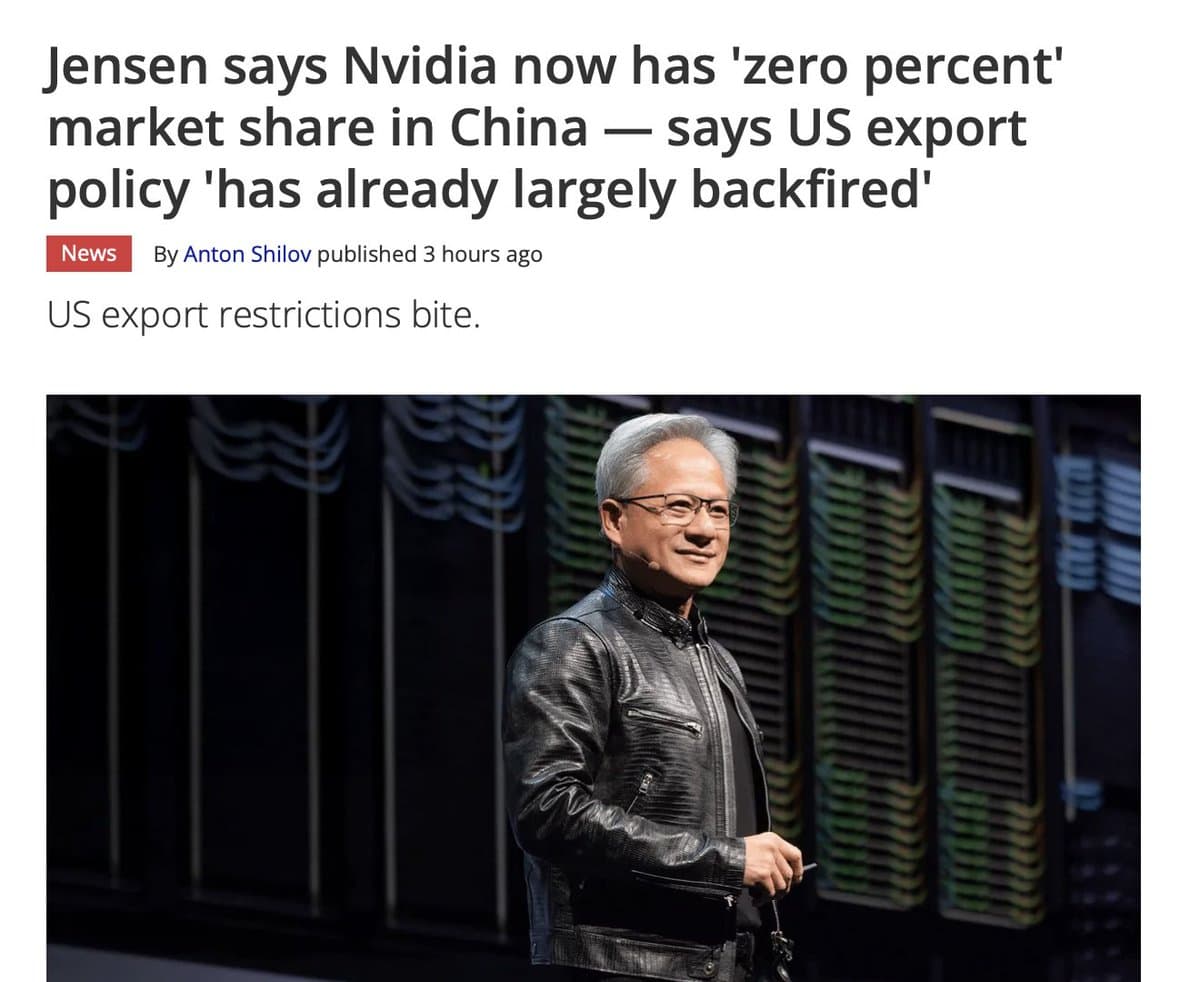
Nvidia CEO Jensen Huang says US export controls have driven Nvidia's market share in China to zero. The restrictions have backfired by accelerating China's domestic chip ecosystem, he argues.
Key facts
- Nvidia's China market share dropped to zero, per Jensen Huang
- China's domestic chip production grew 14% in 2024
- Huawei's Ascend 910B/910C compete with Nvidia H100
- Nvidia China revenue fell from $5.7B to ~$1.5B
- Chinese AI chip startups raised $3B in 2024
Nvidia CEO Jensen Huang says the company's market share in China has dropped to zero due to US export controls, and he's arguing the restrictions have basically backfired by pushing China to build its own chip ecosystem faster. [According to @kimmonismus]
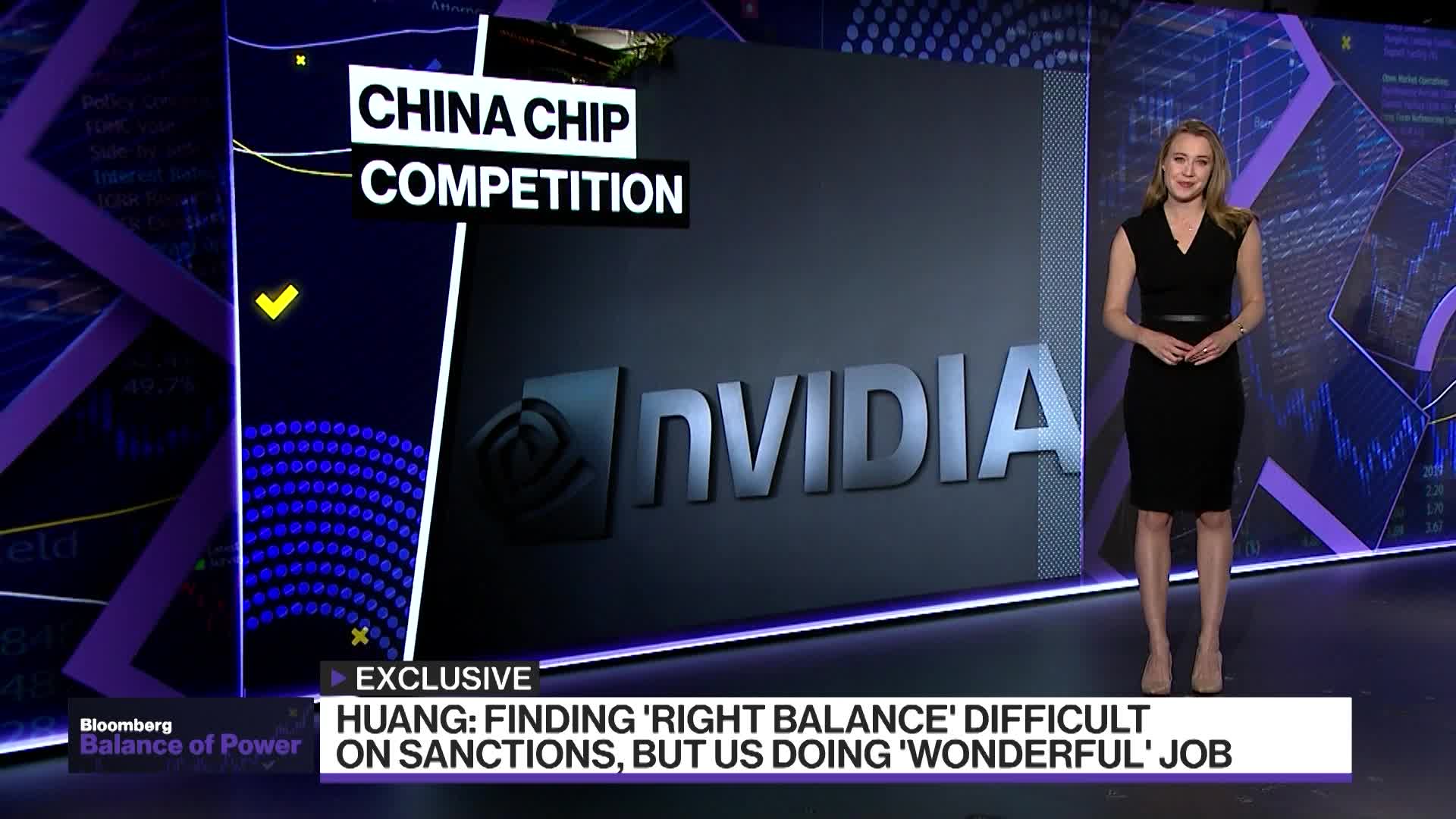
China has managed to become largely independent in chip development, Huang stated, a claim that reflects the growing capability of domestic alternatives like Huawei's Ascend series. The US sanctions, imposed in 2022 and tightened through 2024, banned export of Nvidia's A100, H100, and later modified chips to China.
The backfire mechanism
Huang's argument is that export controls created a vacuum that Chinese firms filled aggressively. Huawei's Ascend 910B, launched in 2023, and the 910C, expected in 2025, now compete directly with Nvidia's H100 in Chinese data centers. Chinese AI labs including Baidu, ByteDance, and Tencent have reduced Nvidia orders and shifted to domestic chips.
Market reality check
Nvidia's China revenue collapsed from $5.7 billion in fiscal 2022 to approximately $1.5 billion in fiscal 2025, [per Nvidia's 10-K filings]. The company previously derived roughly 25% of data center revenue from China; that figure is now negligible. The zero market share claim likely refers to the high-end AI chip segment where US export bans apply directly.
What the data shows
Semiconductor Industry Association data shows China's domestic chip production grew 14% year-over-year in 2024, reaching $45 billion in revenue. Chinese AI chip startups raised over $3 billion in 2024, [per PitchBook]. The US Commerce Department's Bureau of Industry and Security has not commented on Huang's claim.
Huang's statement is notable because it comes from the CEO of the company most affected by the controls. It aligns with his public lobbying against further restrictions, which he has called economically counterproductive.
What to watch
Watch for the US Commerce Department's next export control update, expected Q2 2026, and whether it broadens restrictions to cover Chinese AI chips built on older process nodes. Also monitor Nvidia's Q4 FY2026 China revenue figure and Huawei's Ascend 910C production yields.
[Updated 05 May via tomshardware]
Huang clarified that while he supports global trade, the US should retain the most advanced AI hardware, stating 'the first, the most, and the best' should stay in America. He specifically excluded China from receiving Nvidia's next-generation Blackwell and Rubin GPUs [per Tom's Hardware]. This contrasts with his earlier criticism of export controls, suggesting he only opposes broad bans, not targeted restrictions on cutting-edge chips.