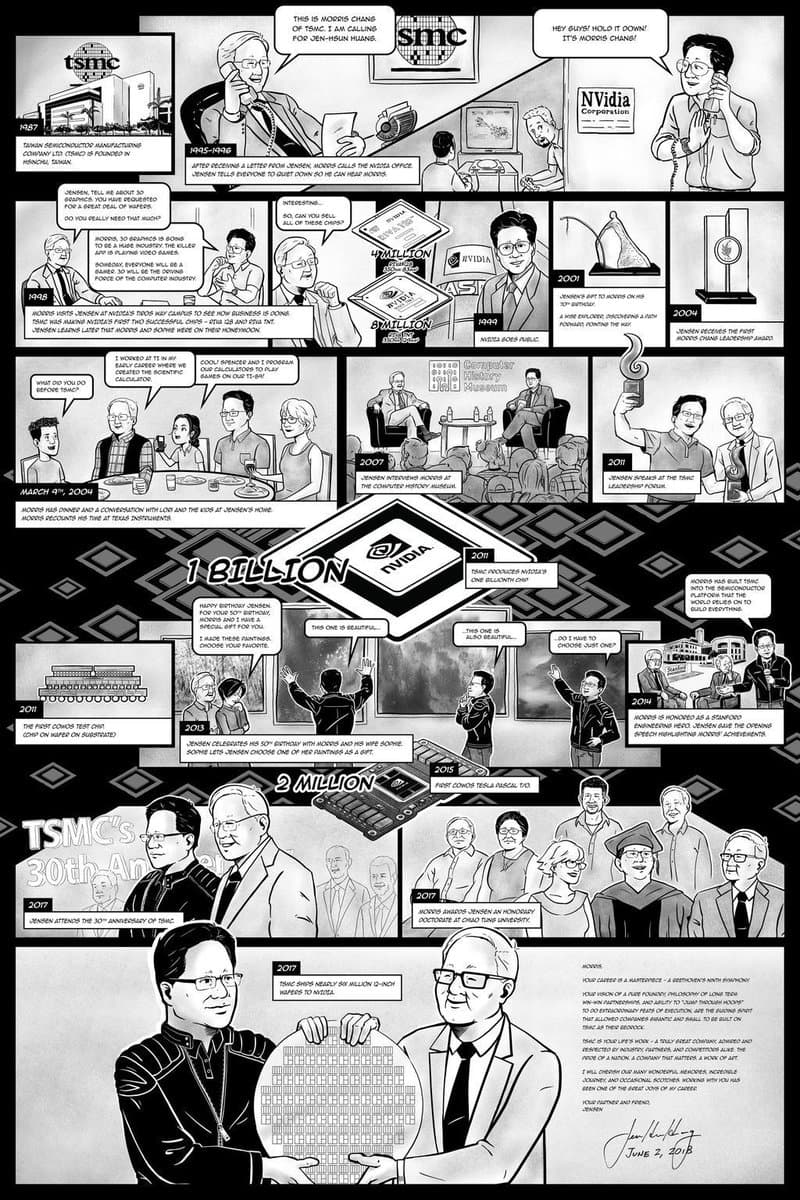
The more things change, the more they stay the same. A recently surfaced comic from 30 years ago depicts a young Jensen Huang desperately trying to convince TSMC to supply wafers for a new category of chips: those dedicated to rendering 3D graphics. Fast forward to today, and Jensen Huang is still fighting for more wafer supply from TSMC — but now the GPUs are for AI model training and inference, not just gaming.
Key Takeaways
- A 30-year-old comic shows Jensen Huang convincing TSMC to supply wafers for 3D graphics chips.
- Today, he's still fighting for wafer supply, but now for AI GPUs, alongside Broadcom, AMD, MediaTek, and Amazon.
What Happened

The comic, commissioned by Nvidia as a gift to Morris Chang on his retirement as TSMC CEO, commemorates the special relationship between the two companies. It captures the moment when Nvidia, then a fledgling startup, convinced TSMC to bet on an unproven market: 3D graphics accelerators.
Context
Today, Nvidia is not alone in its wafer supply struggle. The likes of Broadcom, AMD, MediaTek, and Amazon are all in the same position — desperate for TSMC's advanced process nodes to produce their own AI chips. One thing in Nvidia's favor, however, is Jensen's long-standing relationship with TSMC, built over three decades of collaboration.
gentic.news Analysis

This story highlights a recurring theme in the semiconductor industry: the critical importance of wafer supply. TSMC's advanced nodes (5nm, 3nm, and beyond) are the bottleneck for the entire AI boom. While Nvidia's GPU architecture and CUDA ecosystem are formidable moats, the real constraint is manufacturing capacity. The comic serves as a reminder that Nvidia's relationship with TSMC is not just transactional — it's a deeply personal partnership that has survived multiple technology transitions.
This also underscores a broader trend: the AI chip race is increasingly a manufacturing race. Companies like AMD, Amazon, and Google are designing custom chips, but they all depend on TSMC to fabricate them. The demand for AI accelerators is so intense that even Nvidia, with its massive scale, cannot secure enough supply. This is why Nvidia has been investing in alternative packaging and exploring multiple foundry partners, though TSMC remains dominant.
The comic is a rare glimpse into the early days of a relationship that would define the modern computing landscape. It also serves as a cautionary tale: even the most successful companies are ultimately at the mercy of their supply chain.
Frequently Asked Questions
Why is TSMC so important for AI chips?
TSMC is the world's leading semiconductor foundry, producing the most advanced chips for companies like Nvidia, AMD, and Apple. Its 5nm and 3nm process nodes offer the performance and energy efficiency needed for AI training and inference. Without TSMC's capacity, AI chip supply is severely constrained.
How long has Jensen Huang worked with TSMC?
Jensen Huang has worked with TSMC for over 30 years, dating back to Nvidia's early days when it was developing chips for 3D graphics. The relationship was commemorated with a comic given to TSMC founder Morris Chang on his retirement.
What other companies are competing for TSMC's wafer supply?
Besides Nvidia, companies like Broadcom, AMD, MediaTek, and Amazon are all vying for TSMC's advanced wafer capacity. Each is producing AI-focused chips, from custom accelerators to general-purpose GPUs.
Does Nvidia have an advantage in securing TSMC supply?
Yes, Nvidia's long-standing relationship with TSMC gives it preferential access to advanced nodes. However, demand is so high that even Nvidia struggles to secure enough supply to meet the explosive growth of AI workloads.