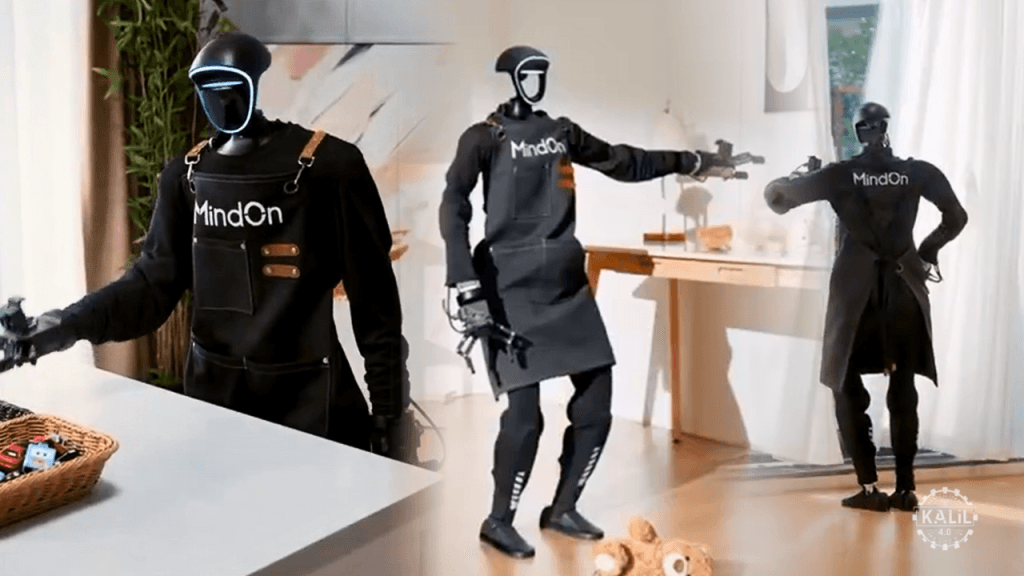
A new AI startup, MindOn, has released a demonstration video showing its software stack enabling a Unitree G1 humanoid robot to perform a series of household tasks fully autonomously. The demo, highlighted by AI researcher Rohan Paul, shows the robot operating in a domestic environment without apparent remote teleoperation.
What Happened
The video depicts a Unitree G1—a commercially available, affordable humanoid robot platform—navigating a home setting. Key demonstrated capabilities include:
- Picking up scattered toys from the floor and presumably placing them in a container.
- Handing items to a child, requiring precise manipulation and social interaction.
- Running outdoors with kids, demonstrating dynamic mobility and environmental adaptation.
According to the source, MindOn's model "processes the scene in real time to decide actions." This implies the perception, planning, and control loops are running onboard the robot, a significant step beyond scripted behaviors or remote piloting.
Context & Technical Implications
The Unitree G1 is known as a lower-cost, agile humanoid platform, often used for research and development. MindOn's achievement, claimed just six months after the company's founding, suggests a focus on a lightweight, efficient AI stack capable of running on the robot's embedded compute. The tasks shown—particularly unstructured pick-and-place and social handing—are non-trivial challenges in robotics, combining vision, navigation, manipulation, and rudimentary social cue recognition.
Successful demos in this domain typically rely on a combination of:
- Robust perception: Segmenting and identifying objects (toys, people, hands) in cluttered, variable lighting.
- Task and motion planning: Sequencing actions like "locate toy," "grasp toy," "navigate to bin," "release toy."
- Real-time control: Executing stable bipedal locomotion and arm trajectories while interacting with the physical world.
The claim of full autonomy and real-time processing points to a potentially optimized model architecture, possibly leveraging techniques like imitation learning, reinforcement learning, or vision-language-action models distilled for edge deployment.
The Competitive Landscape
The push for useful domestic robots is intensifying. Established players like Boston Dynamics (Atlas, Spot) excel in mobility but have been slower to integrate high-level, language-driven task planning. Meanwhile, AI labs like Google DeepMind (RT-2, AutoRT) and startups like Covariant and Figure are racing to develop the "brain" for general-purpose robots. MindOn enters a crowded field but distinguishes itself by showcasing a working stack on a specific, affordable platform (Unitree G1) targeting the home environment directly.
A key unanswered question is the generality and robustness of MindOn's system. Demos are curated; the real test is performance over thousands of trials in novel environments. The lack of published benchmarks or peer-reviewed methodology is typical for an early-stage startup demo but leaves the technical ceiling unclear.
gentic.news Analysis
This demo fits squarely into the accelerating trend of embodiment for large AI models. For years, the field has been bifurcated: spectacular progress in virtual reasoning (LLMs, VLMs) and separate advances in robotic actuation and control. The fusion point—capable, affordable robots taking instruction and acting in the real world—is now the central battleground.
MindOn's rapid progress from founding to demo echoes the pace seen at other well-funded robotics AI startups, suggesting they may be building on abundant existing open-source research and commoditized hardware (the Unitree platform). Their choice of the Unitree G1 is strategic; it's a capable, sub-$100k humanoid, making it a plausible candidate for eventual commercialization, unlike multi-million-dollar research prototypes.
This development also contextualizes recent moves by larger tech firms. For instance, Tesla's Optimus program has shown similar chore-focused demos (sorting battery cells, folding laundry), applying its automotive-scale AI infrastructure to robotics. Figure AI, which recently partnered with BMW and raised significant capital, is on a parallel path. MindOn's demo suggests that a focused software approach on standardized hardware can yield compelling results quickly, potentially enabling a new wave of vertical SaaS for robotics—the "brains as a service" for specific hardware platforms.
The critical next steps for MindOn will be to demonstrate repeatability, scale to a broader set of tasks, and likely pursue partnerships with hardware OEMs or specific verticals (e.g., elder care, light industrial). If their real-time, onboard claim holds under scrutiny, it addresses a major bottleneck—latency and reliability of cloud-based robot control—bringing us closer to robots that can operate safely and usefully in human spaces.
Frequently Asked Questions
What is MindOn?
MindOn is a newly founded AI startup, approximately six months old as of this report, focused on developing software for autonomous robot control. Little public information exists beyond this demo.
What robot was used in the MindOn demo?
The demo used a Unitree G1 humanoid robot. The G1 is a general-purpose, bipedal robot platform known for its agility and relatively low cost compared to industrial or research humanoids.
How is "full autonomy" different from remote control?
Full autonomy means the robot uses its own sensors (cameras, LiDAR, etc.) and onboard computer to perceive the environment, make decisions, and execute actions without a human operator sending step-by-step commands. Remote control (teleoperation) requires a human to directly guide the robot's movements in real time.
What are the main technical challenges for a robot doing household tasks?
Key challenges include: Perception (reliably identifying objects and people in messy, changing environments), Manipulation (grasping diverse objects without dropping or breaking them), Navigation (moving safely around obstacles and people), and Task Planning (breaking high-level instructions like "tidy the room" into a sequence of feasible actions).