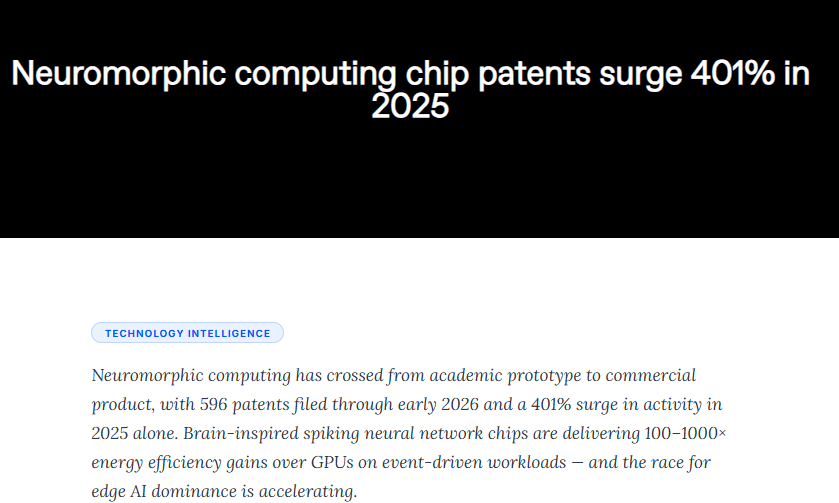
A sharp, quantifiable inflection point has been reached in one of AI's most foundational hardware frontiers. According to data cited by industry observer @kimmonismus, patent activity for neuromorphic computing—a brain-inspired approach to hardware design—exploded by 401% in the year 2025 alone. The cumulative total of filed patents reached 596 by early 2026, marking a decisive transition for the technology from academic prototype to commercial product pipeline.
What Happened
The core metric is the patent filing rate. A 401% year-over-year increase is not a gradual trend; it's a spike indicating concentrated investment and a race to stake intellectual property claims. Patents are a leading indicator of commercial intent, protecting specific implementations, architectures, and manufacturing processes. This surge suggests multiple companies and research institutions have moved beyond publishing papers and are now securing the legal groundwork for products they intend to bring to market.
What is Neuromorphic Computing?
Neuromorphic computing departs from the traditional von Neumann architecture used in CPUs and GPUs, where memory and processing are separate. Instead, it designs hardware to mimic the neuro-biological architectures of the nervous system. The core components are artificial neurons and synapses that are co-located, enabling massively parallel, event-driven (or "spiking") computation. The primary promised advantages are drastic reductions in energy consumption (power efficiency) and latency for specific workloads, particularly those involving real-time sensor data processing, pattern recognition, and adaptive learning at the edge.
The Commercial Impetus
This patent rush is a market response to a clear and growing problem: the unsustainable energy cost of scaling large neural networks on conventional hardware. Training and inference for models like GPT-4 and its successors require vast data center resources. Neuromorphic chips offer a path to perform AI tasks, especially inference and continuous learning, with orders-of-magnitude greater efficiency. Applications are targeting the edge—autonomous vehicles, robotics, IoT sensors, and wearable devices—where low power and instant response are non-negotiable.
The 596 patents likely cover a spectrum of innovations:
- Novel Neuron/Synapse Models: Materials and circuits that emulate biological behavior (e.g., using memristors).
- Chip Architectures: How these artificial neurons are interconnected on a silicon wafer.
- Learning Algorithms: "Spiking Neural Network" (SNN) training methods tailored for the hardware.
- Manufacturing Techniques: Processes for building reliable, dense neuromorphic systems.
gentic.news Analysis
This data point is a powerful validation of a trend we've been tracking. The 401% surge in 2025 didn't occur in a vacuum. It follows a period of significant foundational research and high-profile prototypes from both corporate and academic labs. For instance, Intel's Loihi 2 research chip and IBM's long-standing efforts have provided tangible platforms for software development. In 2024, we covered startups like Rain Neuromorphics and SynSense securing substantial funding to commercialize their brain-inspired chips, signaling early venture confidence.
The patent explosion in 2025 likely represents a consolidation phase. As the theoretical benefits of neuromorphics became more proven at the lab scale, larger semiconductor incumbents (e.g., Intel, Samsung, TSMC investing in new materials), established AI hardware players (e.g., NVIDIA researching SNNs, AMD), and a swarm of agile startups all accelerated their IP filing strategies simultaneously. This is classic behavior in a pre-competitive, high-stakes technology race: secure the foundational patents first, then battle over market share.
For AI engineers, the key takeaway is that an alternative hardware ecosystem is being built, and it's moving faster than many anticipated. While mainstream AI development will remain dominated by GPUs and specialized AI accelerators (like TPUs) for the foreseeable future, the roadmap now has a clear, energy-efficient branch for edge and real-time applications. Developers should start familiarizing themselves with Spiking Neural Networks and platforms like Intel's Lava framework, as the software stack for this hardware will mature in parallel with the silicon.
Frequently Asked Questions
What is the main advantage of neuromorphic computing over traditional AI chips?
The primary advantage is energy efficiency for specific tasks. By mimicking the brain's event-driven, parallel architecture, neuromorphic chips can perform inference and adaptive learning using a fraction of the power required by a GPU or CPU. This makes them ideal for battery-powered devices, always-on sensors, and applications where heat dissipation is a problem.
Who are the major players filing these 596 neuromorphic patents?
While the source data doesn't specify, the landscape includes a mix of players: major tech companies with research labs (Intel, IBM, Samsung, Google), traditional semiconductor foundries, dedicated neuromorphic hardware startups (like BrainChip, SynSense, Rain Neuromorphics), and leading academic institutions. The patent surge indicates activity across all these groups.
When will we see consumer products with neuromorphic chips?
Commercial products are already beginning to emerge in specialized sectors. BrainChip's Akida IP is being licensed for edge AI applications. The transition to mass-market consumer devices (e.g., smartphones, laptops) will take longer, likely later this decade, as the software ecosystem matures and volume manufacturing scales. The 2025 patent surge is a leading indicator that this commercialization phase is actively underway.
Are neuromorphic chips a replacement for GPUs in AI?
No, they are complementary. GPUs are exceptionally good at the dense, parallel matrix math required for training large models. Neuromorphic chips are targeting a different niche: ultra-low-power, continuous, real-time inference and learning at the edge. The future AI hardware stack will likely be heterogeneous, using the best processor for each specific task.