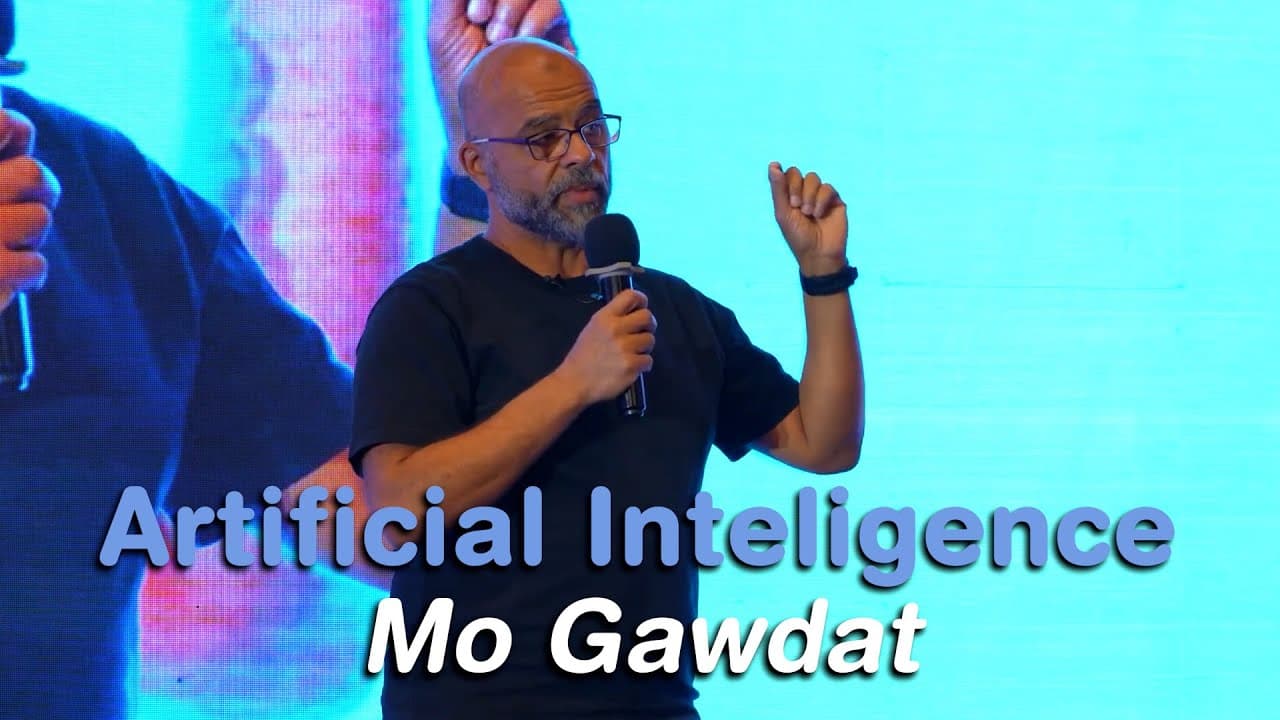
Former Google X executive and author Mo Gawdat has made a stark prediction on the trajectory of artificial intelligence, stating that AI is humanity's "last innovation." His assertion, shared in a recent social media post, is based on the observation that we are already building AIs that are building other AIs.
What Happened

In a concise post, Gawdat outlined a logical progression:
- Current State: AI development has reached a recursive stage where AI systems are actively involved in designing and improving subsequent AI systems. This includes areas like automated architecture search, code generation for models, and hyperparameter optimization.
- Immediate Future: As a direct consequence, "most innovation, definitely tech innovation, will be done at the hands of AI." Human-led R&D will be eclipsed by AI-driven discovery and engineering.
- Conclusion: This self-accelerating loop positions AI not just as another tool, but as the final major innovation originating directly from human intellect.
Gawdat's statement is a philosophical and strategic extrapolation of observable trends in machine learning research, not a report on a specific new model or product.
Context: The Rise of AI-for-AI Development
Gawdat's point references a tangible shift in AI research and development. The field is increasingly characterized by recursive improvement, where AI tools are essential for creating the next generation of AI.
Key examples of this trend include:
- Automated Machine Learning (AutoML): Systems that automate the design of neural network architectures (e.g., Google's early work on NASNet).
- AI-Powered Code Generation: Models like GitHub Copilot and DeepSeek Coder are used by developers to write code, including code for other AI/ML projects.
- AI in Chip Design: Companies like Google and Nvidia use AI to optimize the physical layout of semiconductors, including those that will run future AI models.
- Synthetic Data Generation: AI models are used to create training data for other AI models, creating a potential feedback loop.
This creates a compounding effect: each incrementally more capable AI system can be leveraged to design a slightly more capable successor, potentially accelerating progress beyond a pace sustainable by human researchers alone.
gentic.news Analysis

Gawdat's "last innovation" thesis is a provocative framing of a trend our coverage has tracked for years. It aligns with the trajectory observed in major labs. For instance, our analysis of Google's Gemini 2.0 launch noted its training pipeline heavily utilized AI-optimized infrastructure and synthetic data techniques—an AI-assisted process for building AI. Similarly, Meta's Llama 3 development reportedly leveraged AI tools for code generation and system optimization.
The claim that AI will conduct "most" tech innovation finds support in the rapid expansion of AI-powered scientific discovery. As covered in our report on DeepMind's GNoME, AI systems are now discovering novel materials at a rate impossible for human teams, moving from tools to primary researchers in fields like chemistry and biology. This isn't just tech-for-tech's sake; it's AI moving into the driver's seat of general technological advancement.
However, Gawdat's statement is ultimately a philosophical claim about human agency, not a falsifiable technical prediction. The critical question for practitioners is the control problem: how to design the objectives and oversight mechanisms for these self-improving systems. As AI becomes the primary innovator, ensuring its goals remain aligned with human values becomes the paramount engineering challenge—a topic we explored in depth following Anthropic's release of its Constitutional AI research. The "last innovation" may be the framework for alignment and safety that allows an AI-driven innovation cycle to remain beneficial.
Frequently Asked Questions
What does "AI building AI" actually mean?
It refers to the use of artificial intelligence systems to perform tasks essential to creating other AI systems. This includes automating neural architecture search, generating and debugging training code, optimizing hyperparameters, designing efficient hardware, and creating synthetic training datasets. It's the industrialization and acceleration of the R&D pipeline using the very technology being developed.
Is Mo Gawdat saying AI will stop innovating?
No. He is asserting the opposite: that AI will become the primary source of all future technological innovation. The phrase "last innovation" means it is the final major innovation originated by humans. After that point, the cycle of improvement and discovery will be primarily driven and executed by AI systems themselves, building upon their own designs.
Are there real-world examples of this happening now?
Yes. Major tech companies actively use AI in their AI development cycles. Google used reinforcement learning to design the TPU v4 chip's floorplan. NVIDIA employs AI for GPU architecture optimization. AI coding assistants are ubiquitous in software engineering, including ML engineering. Research projects like OpenAI's GPT-4 involved using earlier models to help generate training data and evaluate outputs.
What are the risks of AI-driven AI development?
The primary risks include:
- Loss of Interpretability: As AI designs become more complex and alien, human understanding of how they work may diminish.
- Alignment Drift: An AI optimizing for its own capability or a poorly specified proxy metric could diverge from human values.
- Acceleration Beyond Control: A self-improving AI could advance capabilities (especially in strategic domains) faster than our ability to develop corresponding safety measures.
- Centralization: The immense compute and data requirements could concentrate the power to steer this innovation cycle in very few hands.