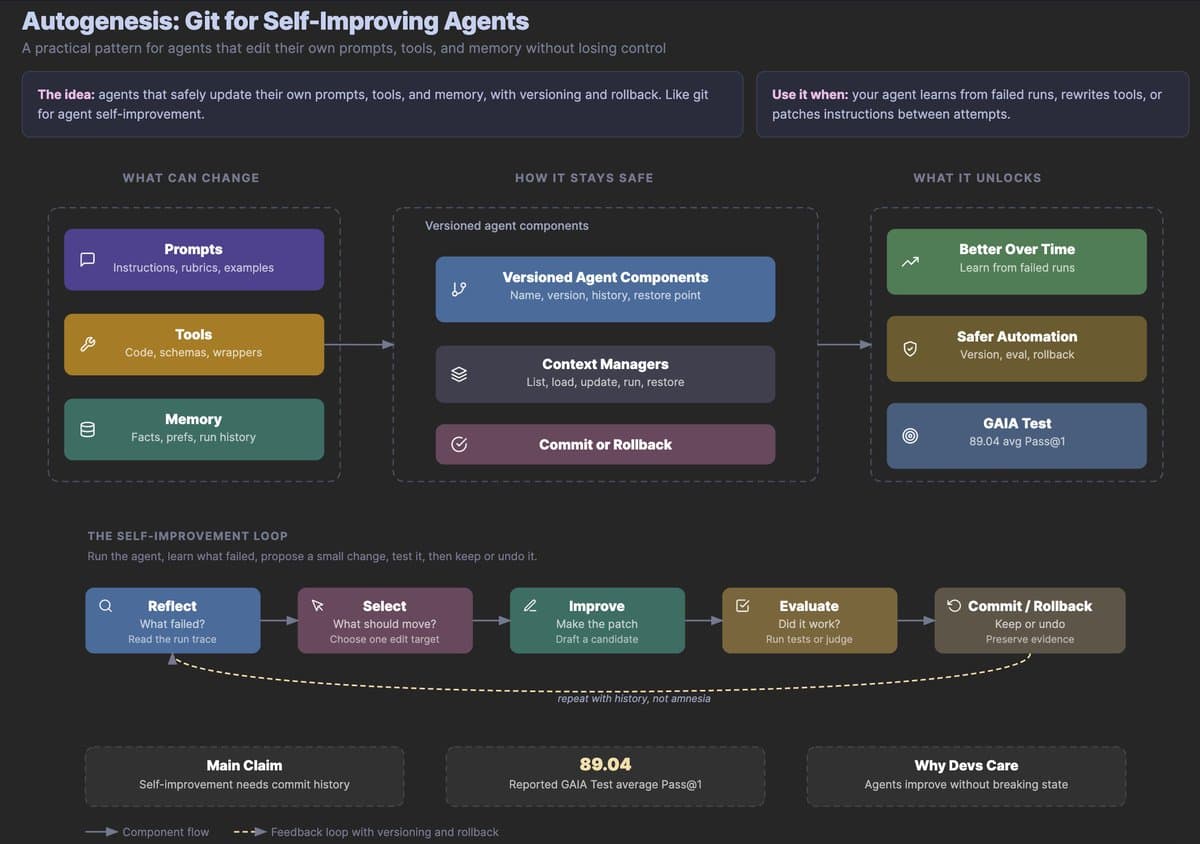
A new research paper proposes a formal protocol for designing self-improving AI agent systems, addressing one of the most challenging problems in autonomous AI: how to safely enable agents to improve themselves while maintaining control and auditability.
Key Takeaways
- Researchers have proposed a formal protocol for creating self-improving AI agent systems.
- The framework enables agents to autonomously evaluate and implement upgrades while maintaining auditable lineage and safe rollback options.
What the Protocol Does

The protocol establishes a structured framework where AI agents can:
- Propose improvements to their own code, parameters, or capabilities
- Assess proposed changes through rigorous evaluation metrics
- Commit improvements to their operational state
- Maintain auditable lineage of all changes with full traceability
- Enable safe rollback to previous versions if issues arise
According to AI researcher Omar Saray, who highlighted the paper, "We need to think more deeply about AI agent system design. The protocol specifies a framework for proposing, assessing, and committing improvements with auditable lineage and rollback."
The Core Challenge of Self-Improving AI
Self-improving AI systems represent a significant technical challenge beyond traditional machine learning. While current AI models can be fine-tuned or retrained by human engineers, truly autonomous self-improvement requires:
- Safety guarantees that improvements don't degrade performance or introduce vulnerabilities
- Verification mechanisms to validate that changes work as intended
- Version control similar to software development but automated
- Rollback capabilities to revert to stable versions when problems occur
The proposed protocol appears to address these requirements through a formal specification that could be implemented across different agent architectures.
Technical Implementation Considerations
While the paper details aren't fully available from the tweet, the described protocol suggests several technical components:
- Improvement proposal mechanism: Likely involves the agent generating candidate modifications to its own code or parameters
- Assessment framework: Probably includes test suites, benchmark evaluations, or formal verification methods
- Commit protocol: A decision-making process for when to adopt improvements
- Lineage tracking: A blockchain-like ledger or version control system for all changes
- Rollback system: The ability to revert to previous states if new versions fail
This approach moves beyond current agent frameworks that typically require human intervention for major updates or architectural changes.
Potential Applications and Implications

If successfully implemented, such a protocol could enable:
- Continuous optimization: Agents that gradually improve their efficiency without human oversight
- Adaptive systems: AI that can modify its behavior based on changing environments or requirements
- Reduced maintenance: Less need for human engineers to manually update agent systems
- Research acceleration: AI systems that can design and test their own improvements
However, the approach also raises important questions about control, alignment, and the potential for unintended consequences when AI systems modify themselves.
Current State of Self-Improving AI Research
Self-improving AI remains largely theoretical, with most practical implementations limited to:
- Hyperparameter optimization: Automated tuning of model parameters
- Architecture search: Automated discovery of neural network structures
- Reinforcement learning: Agents that improve policies through trial and error
A formal protocol for general self-improvement would represent a significant step beyond these specialized applications toward more general autonomous improvement capabilities.
gentic.news Analysis
This research direction aligns with several trends we've been tracking in the AI agent ecosystem. Just last month, we covered Cognition Labs' Devin, which demonstrated sophisticated coding capabilities but still requires human oversight for deployment decisions. The proposed self-improvement protocol could eventually enable agents like Devin to not only write code but also responsibly update their own capabilities.
The emphasis on auditable lineage is particularly noteworthy, as it addresses growing concerns about AI transparency and accountability. This connects directly to our coverage of the EU AI Act's requirements for high-risk AI systems, which mandate traceability and documentation of AI decision-making processes. A standardized protocol for agent self-improvement with built-in audit trails could help organizations comply with these emerging regulations.
We're also seeing increased venture capital flowing into agent infrastructure companies. This protocol could become a foundational layer for next-generation agent platforms, similar to how reinforcement learning from human feedback (RLHF) became standard for aligning large language models. If widely adopted, it might create new opportunities for monitoring, testing, and security tools specifically designed for self-improving systems.
Frequently Asked Questions
What are self-improving AI agents?
Self-improving AI agents are artificial intelligence systems capable of modifying their own code, parameters, or architecture to enhance their performance without direct human intervention. Unlike traditional AI that requires human engineers for updates, these systems can autonomously propose, test, and implement improvements to themselves.
How does the new protocol ensure safety?
The protocol incorporates multiple safety mechanisms including rigorous assessment of proposed changes before implementation, comprehensive audit trails documenting all modifications, and built-in rollback capabilities that allow the system to revert to previous stable versions if new improvements cause problems or degrade performance.
What practical applications would this enable?
Practical applications include continuously optimizing AI systems for specific tasks, creating adaptive agents that can modify their behavior for changing environments, reducing maintenance overhead for complex AI deployments, and accelerating AI research by allowing systems to experiment with their own architectures and algorithms autonomously.
How does this differ from current AI training methods?
Current methods like fine-tuning or reinforcement learning typically optimize within fixed architectures using human-designed objectives. This protocol enables structural and algorithmic changes—the agent can modify its fundamental approach to problems, not just adjust parameters within an existing framework. It also adds formal version control and audit capabilities specifically designed for autonomous modification.